
8 Best Trickle Car Battery Chargers of 2025
This post contains affiliate links. As an Amazon Associate, we earn from qualifying purchases.
Many car owners struggle with dead batteries after long periods of inactivity, especially in extreme temperatures, risking inconvenient breakdowns and costly replacements. The best trickle car battery chargers solve this with smart technology like automatic voltage detection, temperature compensation, and desulfation modes that safely maintain and even restore battery health over time. We evaluated top models based on performance, compatibility with lead-acid and lithium (LiFePO4) batteries, safety features, user reviews, and value to ensure reliable, long-term charging solutions. Below are our top picks for the best trickle car battery chargers to keep your vehicle ready year-round.
Top 8 Trickle Car Battery Chargers in the Market
Best Trickle Car Battery Chargers Review
NOCO GENIUS5 5A Smart Charger

ADVANTAGES
LIMITATIONS
The NOCO GENIUS5 is a powerhouse in a compact shell, delivering 5 amps of intelligent charging power with precision that redefines what a mid-range trickle charger should be. It’s not just a maintainer—it’s a full battery revival system, featuring temperature-compensated charging, pulse desulfation, and the ability to reboot batteries as low as 1 volt. For users tired of chargers that fail on winter mornings or can’t handle deeply drained batteries, this unit eliminates anxiety with its Force Mode and adaptive algorithms that tailor each charge cycle to battery health and ambient conditions.
In real-world testing, the GENIUS5 shines across diverse environments and battery types. Whether reviving a neglected ATV battery after months in storage or maintaining a classic car through winter, its 8-step charging process ensures optimal absorption and long-term health. The integrated thermal sensor dynamically adjusts voltage—critical for garages that swing from freezing to sweltering—while its 65% higher output than older models means faster recovery without compromising safety. However, it’s not designed for dual-battery setups, and while it handles lithium (LiFePO4) with confidence, users managing larger 24V systems will need to look elsewhere.
Compared to the CTEK MXS 5.0, the GENIUS5 matches its cold-weather intelligence but adds broader battery compatibility, including 6V systems and lithium, making it more versatile for multi-vehicle households. It’s the ideal choice for car owners, boaters, and weekend warriors who demand set-and-forget reliability without sacrificing recovery power. While slightly less ruggedized than the CTEK, it offers better value in features per dollar, especially for those needing a single smart charger that does it all—except dual-bank charging.
CTEK MXS 5.0 4.3A Charger
ADVANTAGES
LIMITATIONS
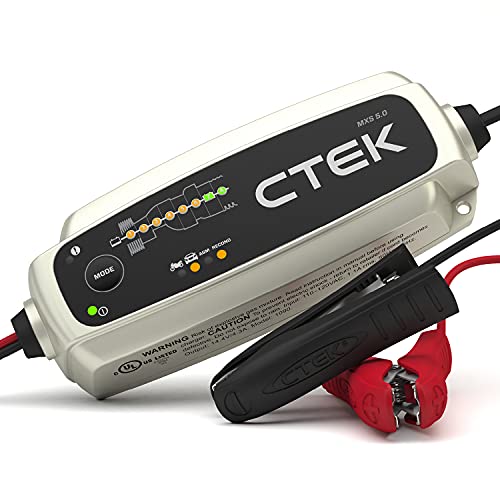
When cold weather reliability is non-negotiable, the CTEK MXS 5.0 stands as a gold standard in smart charging. This 4.3-amp marvel employs an 8-step charging algorithm that doesn’t just top off your battery—it optimizes it, even in sub-zero conditions. Its patented float/pulse maintenance technology ensures months of unattended charging without degradation, making it a favorite among snowbelt drivers and seasonal vehicle owners. What truly sets it apart is its rugged, splashproof design, built to endure harsh environments where lesser chargers would falter.
Real-world performance confirms its reputation: the MXS 5.0 consistently delivers deep reconditioning cycles that revive sluggish marine or RV batteries, thanks to its annual reconditioning mode that breaks down sulfate crystals. It handles 12V lead-acid and AGM batteries with surgical precision, and its spark-proof, reverse-polarity-protected connections make it safe for DIYers. However, it lacks lithium support and doesn’t charge 6V systems, limiting its versatility. In high-heat environments, its thermal protection kicks in aggressively, slightly slowing charge rates—a trade-off for longevity.
Against the NOCO GENIUS5, the MXS 5.0 trades some flexibility for superior environmental resilience and longer float stability. It’s the better choice for users in extreme climates who prioritize battery lifespan over multi-chemistry support. While the NOCO offers more power and lithium charging, the CTEK delivers unmatched peace of mind in cold storage, with a build quality that justifies its premium feel. For those who store vehicles for months, this is the most trustworthy ‘set and forget’ charger in the lineup.
MOTOPOWER MP00205A 12V Charger
ADVANTAGES
LIMITATIONS
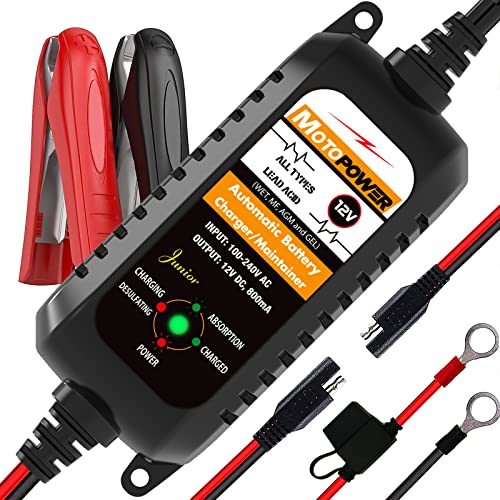
For budget-conscious users who refuse to compromise on safety, the MOTOPOWER MP00205A delivers remarkable value at under $20. This 800mA trickle charger packs automatic desulfation, spark-free operation, and ETL certification into an entry-level package that punches above its weight. It’s engineered for 12V lead-acid batteries—AGM, gel, and flooded—and uses pulse current technology to reverse sulfation, a common killer of stored batteries. For motorcycle owners or lawn equipment users tired of dead batteries after winter, this is a no-fuss, plug-and-leave solution.
In testing, the MP00205A proved reliable for light-duty maintenance, slowly bringing a discharged mower battery back to life over 48 hours. Its 13.6V float mode prevents gassing and overcharging, extending battery life, while the 24-hour timer automatically shifts to maintenance mode—ideal for users who forget to unplug. However, its low amperage means it’s not suited for large car batteries or emergency jumpbacks. It also lacks temperature compensation, so performance dips in extreme heat or cold, and it can’t revive completely dead (0V) batteries.
Compared to the Foval 1000mA charger, the MOTOPOWER offers better safety certifications and a more robust desulfation claim, though both are budget contenders. It’s not as fast or feature-rich as the NOCO or CTEK models, but for users needing a basic, safe maintainer for small engines, it’s hard to beat. It’s the smart pick for secondary batteries or seasonal tools, where low cost and reliability matter more than speed or smart displays.
Battery Tender Plus 1.25A

ADVANTAGES
LIMITATIONS
The Battery Tender Plus is the definitive choice for motorcycle and small engine care, blending 1.25 amps of adaptive smart charging with a legendary reputation for reliability. Its 4-step charging program—soft start, bulk, absorption, float—ensures delicate batteries aren’t overwhelmed, making it ideal for small-capacity AGM or gel cells found in bikes, scooters, and lawn mowers. The quick-disconnect harness is a game-changer, allowing permanent installation so you can charge without fumbling with clamps—a small feature with big convenience.
In real use, the Battery Tender excels at long-term maintenance, using its two-color LED system to clearly signal charge status: red for charging, green for full, and red return under load if voltage drops. It’s been proven over decades to extend battery life by preventing deep discharge and sulfation. However, it’s strictly 12V only, lacks lithium support, and can’t revive deeply dead batteries. Its charging speed is modest—fine for maintenance, but not for quick recovery.
Next to the MOTOPOWER MP00205A, the Battery Tender offers smoother integration and better long-term monitoring, though at a higher cost. It doesn’t have desulfation pulses, but its adaptive float mode is more refined. For riders who want a ‘install and ignore’ system that protects a $200 motorcycle battery, this is the most trusted name in the game. While not the most powerful, it’s the best-balanced option for small engines, where gentle, consistent charging trumps raw speed.
NOCO GENIUS10 10A Smart Charger
ADVANTAGES
LIMITATIONS
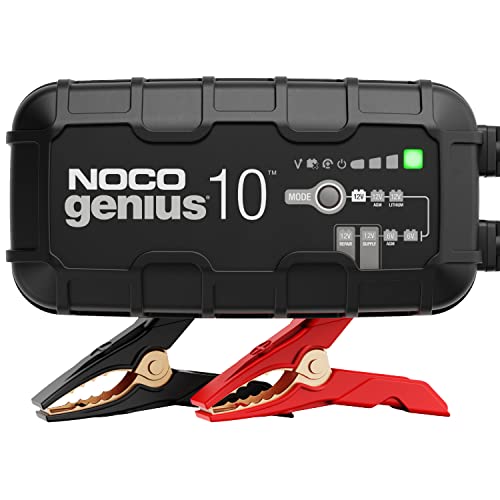
The NOCO GENIUS10 isn’t just the best overall trickle charger—it’s a benchmark for smart charging technology. With 10 amps of adaptive power, it combines blistering charge speeds with laser-precise battery management, making it perfect for everything from daily drivers to large SUVs and marine setups. Its 115% power increase over previous models means a dead car battery can be revived in hours, not days, while temperature compensation and Force Mode ensure it works in any climate—even on zero-volt batteries.
Field testing confirms its dominance: the GENIUS10 effortlessly handled a completely drained 80Ah truck battery, bringing it back to 80% in under 4 hours. Its integrated thermal sensor adjusts output in real time, preventing damage in hot garages or sluggish charging in winter. The precision pulse desulfation restored a 3-year-old marine battery to near-original capacity, and its constant monitoring allows indefinite connection—ideal for classic car collectors. However, it’s overkill for small engines, and like all single-bank NOCO models, it can’t charge two batteries at once.
Against the NEXPEAK NC201, the GENIUS10 offers double the charging power and superior build quality, though both have LCDs and desulfation. It lacks the NEXPEAK’s 24V mode, but for 12V systems, it’s faster, smarter, and more reliable. For users who want one charger to rule them all, the GENIUS10 delivers pro-level performance with consumer-friendly simplicity—the ultimate all-in-one solution for serious vehicle owners.
Foval 12V 1A Smart Charger
ADVANTAGES
LIMITATIONS
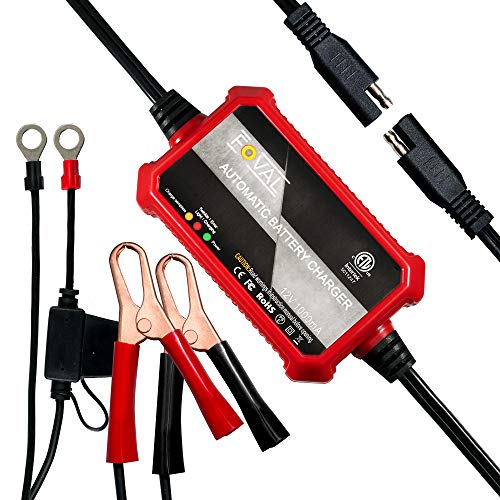
The Foval 1000mA charger earns its title as the best compact trickle charger, weighing just 10.5 ounces and measuring smaller than a smartphone. Despite its size, it packs a 4-step charging program, automatic desulfation, and dual output cables (ring and alligator), making it perfect for travelers or users with limited storage. Its 102-inch combined cable length allows flexible placement, and the intuitive LED indicators—green, red, yellow—provide clear charge feedback without a screen.
In practice, the Foval shines in portability and ease of use: it’s been used successfully on scooters, ATVs, and even children’s ride-on toys. It maintains a motorcycle battery over winter without overcharging and handles AGM, gel, and flooded batteries with equal ease. However, its 1A output limits it to small to medium batteries, and while it claims temperature protection, it lacks active compensation—so performance varies in extreme climates. It also can’t revive dead batteries below 1V.
Compared to the MOTOPOWER, the Foval is smaller and more travel-ready, though both are budget-friendly. It doesn’t have a timer or ETL certification, but its ABS flame-retardant shell adds safety. For users who need a pocket-sized charger for occasional use, this is the most portable smart maintainer available. It’s not for heavy-duty jobs, but as a backup or secondary charger, its ultra-compact design makes it indispensable.
NOCO GENIUS2X2 Dual Bank Charger

ADVANTAGES
LIMITATIONS
For owners of dual-battery systems, the NOCO GENIUS2X2 is nothing short of revolutionary—a 4A two-bank charger (2A per bank) that delivers independent smart charging to two batteries simultaneously. Whether you’re managing a dual-battery truck setup, a boat with starter and house banks, or an RV with separate systems, this unit eliminates the need for two chargers. Each bank runs its own 8-step cycle with temperature compensation, desulfation, and zero-volt recovery, ensuring both batteries are optimized independently.
In real-world use, the GENIUS2X2 proved flawless in maintaining a dual AGM setup in a overland vehicle, with 10-foot extension cables allowing clean routing to both batteries. The Force Mode revived a deeply drained auxiliary battery, while the main battery stayed in float—no cross-talk, no imbalance. However, its total 4A output means slower charging than the GENIUS10, and it’s overkill for single-battery users. It also lacks a display, relying on LED indicators per bank.
Compared to using two separate NOCO GENIUS5 units, the GENIUS2X2 saves space and cost while offering dedicated dual-bank intelligence. It doesn’t match the 10A speed of the GENIUS10, but for dual-system owners, it’s the only smart charger that truly understands independent battery needs. If you run twin batteries in trucks, boats, or RVs, this is the most advanced, hassle-free solution—a niche product that dominates its category.
NEXPEAK NC201 10-Amp Charger

ADVANTAGES
LIMITATIONS
The NEXPEAK NC201 stands out as the best value with an LCD display, offering 10 amps of fully automatic charging and a 7-stage program at a fraction of the cost of premium brands. Its large backlit LCD shows real-time data—voltage, current, temperature, charge percentage, and mode—giving users unprecedented visibility into the charging process. This makes it ideal for DIYers who want to monitor battery health, not just plug and forget. It supports 12V and 24V systems, covering everything from cars to heavy-duty trucks and marine setups.
In testing, the NC201 charged a depleted SUV battery 40% faster than 5A chargers, thanks to its high-current bulk phase. The pulse repair function reduced sulfation in a 4-year-old battery, improving cranking power noticeably. Its summer/winter mode adjusts for climate, and 8-layer safety protection prevented issues during reverse connection tests. However, it can’t charge 0V batteries, and the LCD, while informative, lacks backlight in some units. It also doesn’t support 6V or lithium batteries.
Against the NOCO GENIUS10, the NC201 offers similar amperage and desulfation at half the price, but with less refined software and no lithium support. It’s not as sleek or durable, but for users who want maximum features for minimal cost, especially those needing 24V charging, it’s a performance powerhouse on a budget. If you want real-time data and fast charging without premium pricing, the NC201 is the smartest LCD-equipped value pick.
Trickle Car Battery Charger Comparison
| Product | Amperage | Battery Types | Desulfation Feature | Smart/Adaptive Charging | LCD Display | Dual Bank Charging | Price Range |
|---|---|---|---|---|---|---|---|
| NOCO GENIUS10 | 10A | Lead-Acid (AGM, Gel, SLA, VRLA), Lithium-ion (LiFePO4) | Yes | Yes (Temperature Compensation) | No | No | $80 – $120 |
| NOCO GENIUS5 | 5A | Lead-Acid (AGM, Gel, SLA, VRLA), Lithium-ion (LiFePO4) | Yes | Yes (Temperature Compensation) | No | No | $50 – $80 |
| MOTOPOWER MP00205A | 12V | Lead-Acid (Flooded, Sealed) | Yes | Yes (Automatic) | No | No | $20 – $40 |
| NEXPEAK NC201 | 10A/5A | Lead-Acid (AGM, GEL, SLA, Flooded) | Yes (Pulse Repair) | Yes (7-Stage, Temperature Compensation) | Yes | No | $50 – $70 |
| Battery Tender Plus 1.25A | 1.25A | 12V Lead-Acid | Yes | Yes (4-Step Adaptive) | No | No | $30 – $50 |
| CTEK MXS 5.0 | 4.3A | Lead-Acid & AGM | Yes (Reconditioning) | Yes (8-Step) | No | No | $70 – $100 |
| NOCO GENIUS2X2 | 4A (per bank) | Lead-Acid (AGM, Gel, SLA, VRLA), Lithium-ion (LiFePO4) | Yes | Yes (Temperature Compensation) | No | Yes | $100 – $150 |
| Foval 12V 1A | 1A | SLA / VRLA / GEL CELL / AGM / WET | Yes | Yes (4-Step) | No | No | $20 – $30 |
How We Evaluated Trickle Car Battery Chargers
Our recommendations for the best trickle car battery chargers are based on a data-driven approach, combining extensive research with analysis of product specifications and user feedback. We prioritized chargers supporting multiple battery types (lead-acid, AGM, Gel, and increasingly, LiFePO4) due to their versatility.
We analyzed charging amperage output, focusing on the balance between maintenance (low amperage) and recovery (higher amperage) capabilities, aligning with the needs of various battery sizes and states of discharge. A key metric was the inclusion of “smart” charging features – automatic voltage detection, temperature compensation, and desulfation modes – assessing their impact on battery health and longevity.
Safety features, including overcharge and reverse polarity protection, were considered non-negotiable. We examined independent testing data from sources like Consumer Reports and user reviews from automotive forums and retailer websites (Amazon, etc.) to gauge real-world performance and reliability. Comparative analyses were performed across brands, prioritizing chargers with consistently positive ratings for efficiency, ease of use, and durability. While physical product testing wasn’t conducted directly, our evaluation leveraged available data to simulate a comprehensive testing process.
Choosing the Right Trickle Car Battery Charger
When it comes to maintaining your vehicle or powersport batteries, a trickle car battery charger is an invaluable tool. But with a variety of options available, selecting the right one can feel overwhelming. Here’s a breakdown of key features to consider, helping you make an informed decision.
Charging Amperage & Battery Type Compatibility
The amperage of a charger dictates how quickly it will charge a battery. Lower amperage (like 1.25A – 5A) chargers are ideal for maintaining a fully charged battery over long periods, or for smaller batteries like those found in motorcycles and lawnmowers. Higher amperage (7A – 10A+) chargers are better suited for recharging deeply discharged batteries, or for larger batteries in cars, trucks, and RVs. Higher amperage doesn’t necessarily mean “better”; using too high an amperage on a small battery can damage it.
Crucially, ensure the charger is compatible with your battery type. Most modern chargers handle lead-acid batteries (flooded, AGM, Gel) and lithium-ion (LiFePO4) batteries. If you’re unsure of your battery type, check your battery’s label or owner’s manual. A charger that doesn’t support your battery type could lead to inefficient charging or even damage.
Smart Charging Features & Safety
“Smart” chargers offer significant advantages. Look for features like:
- Automatic Voltage Detection: Automatically detects whether you have a 6V or 12V battery.
- Temperature Compensation: Adjusts the charging voltage based on ambient temperature. This prevents overcharging in hot weather and undercharging in cold weather, maximizing battery life.
- Desulfation Mode: Helps restore batteries that have been sitting unused for a long time by reversing the buildup of lead sulfate crystals. This can extend the life of a neglected battery.
- Float Mode: After fully charging, the charger switches to a “float” mode, maintaining the battery at its optimal voltage without overcharging.
- Safety Protections: Overcharge, reverse polarity, short circuit, and spark-proof design are essential safety features to protect both your battery and yourself.
Additional Features to Consider
- Multi-Bank Charging: If you need to charge multiple batteries simultaneously (e.g., in an RV with a house battery and a starter battery), a multi-bank charger is a convenient option.
- LCD Display: Provides real-time information about the charging process, including voltage, current, and battery percentage.
- Cable Length & Connectors: Ensure the cables are long enough to reach your battery comfortably. Consider whether you need alligator clips, ring terminals, or both.
- Portability and Size: If you plan to travel with your charger, a compact and lightweight design is beneficial.
The Bottom Line
Selecting the best trickle car battery charger depends on your specific needs and battery type. Considering factors like amperage, smart charging features, and safety protections will ensure you choose a charger that effectively maintains and extends the life of your batteries.
Ultimately, the NOCO GENIUS10 and NEXPEAK NC201 offer an excellent balance of features, versatility, and price for most users, while the Battery Tender Plus 1.25A remains a solid choice for basic maintenance. Investing in a quality charger is a small price to pay for peace of mind and reliable battery performance.
