
9 Best Trainers for Bikes 2025
This post contains affiliate links. As an Amazon Associate, we earn from qualifying purchases.
Finding the right trainer for your bike can be overwhelming, especially when balancing performance, noise, and compatibility with your home setup and training goals. The best bike trainers solve this by offering either realistic resistance through fluid or magnetic systems, or immersive, app-connected workouts with smart electromagnetic control and precise power measurement. Our picks are based on a rigorous analysis of lab-tested performance data, real-world user reviews, and key factors like resistance accuracy, connectivity, noise levels, and value across different budgets. Below are our top-rated trainers for bikes to match every cyclist’s needs.
Top 9 Trainers For Bikes in the Market
Best Trainers For Bikes Review
Saris M2 Smart Indoor Trainer

ADVANTAGES
LIMITATIONS
The Saris M2 Smart punches well above its weight, delivering a connected training experience that feels anything but budget-tier. With electromagnetic resistance and ±5% power accuracy, it brings lab-grade precision to home cyclists who want real data without breaking the bank. Unlike basic trainers that just add resistance, this one transforms your bike into a smart machine—perfect for riders tired of guesswork and seeking Zwift-certified performance with seamless app integration. It solves the classic indoor training dilemma: how to get serious fitness gains without sacrificing engagement or accuracy.
In real-world use, the M2 shines brightest when paired with virtual platforms like Rouvy or Zwift. At 20 mph, it hums at just 69 decibels, making it quiet enough for apartment living—though not silent. The wheel-on design means no disassembly is needed, and the included steel quick-release skewer ensures compatibility with most road and mountain bikes. However, don’t expect pro-level power output; while consistent, the resistance caps out modestly, so elite climbers or sprinters may find it limiting during high-wattage intervals. Still, for structured workouts and steady-state endurance rides, it delivers a smooth, controlled feel across all gears.
When stacked against the ThinkRider X2Max, the M2 trades raw power for simplicity and affordability. It’s not as powerful or as quiet, but it’s far more accessible for newcomers dipping their toes into smart training. Compared to fluid trainers like the Sportneer Fluid, the M2 offers interactive control and app syncing—a game-changer for motivation. This is the go-to trainer for riders who want smart features without complexity, blending reliability, connectivity, and solid performance in one no-fuss package that quietly earns its keep.
Saris Fluid2 Indoor Bike Trainer

ADVANTAGES
LIMITATIONS
The Saris Fluid2 is a masterclass in analog efficiency—fluid resistance that mimics real-road inertia with a buttery, progressive curve that builds naturally as you pedal harder. There’s no motor, no software updates, just pure mechanical brilliance that rewards effort with realism. Cyclists who hate tech clutter but crave a consistent, self-paced workout will love how it smooths out surges and simulates outdoor momentum. It’s the antidote to jerky, artificial-feeling trainers—ideal for those who want to ride, not troubleshoot.
On the road feel scale, this trainer lands impressively close to actual pavement. The machined aluminum roller grips your tire firmly, minimizing slippage even during aggressive standing efforts, while the fluid unit ramps resistance seamlessly up to ~90% of what most riders will ever need. At 21.5 inches long, it’s compact enough for small spaces, and the foldable design makes storage a breeze. That said, it lacks smart capabilities—so if you’re chasing structured intervals or elevation simulation, you’ll need an external sensor and app pairing, which adds cost and complexity.
Against the Sportneer Fluid, the Fluid2 feels more refined and durable, with better build quality and a smoother resistance profile. Compared to the M2 Smart, it loses digital interactivity but gains a quieter, more organic ride—especially at mid-zone efforts where fluid units truly sing. This is the pick for low-maintenance riders who value feel over features, offering long-term reliability and a near-silent operation that won’t wake the household. For pure mechanical satisfaction and plug-and-play simplicity, few beat its balance of performance and peace.
Tacx Antares Retractable Rollers

ADVANTAGES
LIMITATIONS
Roll into skill development with the Tacx Antares Rollers, where every pedal stroke demands focus, balance, and finesse. These aren’t just rollers—they’re a neuromuscular gym for your legs and brain, forcing you to stabilize, spin smoothly, and ride with precision. The tapered rollers keep wheels self-centered, reducing the fear factor for beginners while still challenging veterans. If you’ve ever spun too fast or wobbled off mid-session, this model’s stability enhancements make staying on far less intimidating—without sacrificing the core benefit: improved pedaling efficiency and bike handling.
Real-world testing reveals a surprisingly forgiving learning curve. The 3.93”–4.33” roller diameter provides a stable platform, and the folding design collapses to just 31.5 inches, making it one of the most space-smart high-performance options available. Once dialed in, riding these feels like gliding—especially with slick tires—delivering a natural, free-spinning motion unmatched by any trainer type. But let’s be honest: they’re not for everyone. High-cadence intervals? Great. Watching Netflix while coasting? Not happening. You must pedal to move, and any lapse in focus means tapping out—literally.
Compared to the CXWXC magnetic rollers, the Antares wins on passive simplicity and maintenance-free use—no batteries, no resistance knobs, just pure kinesthetic feedback. Against smart trainers like the ThinkRider X2Max, it trades data and automation for raw riding authenticity. This is the ultimate tool for off-season refinement, ideal for racers and technique-focused riders who want to build smooth power delivery and core engagement. While it won’t simulate hills or sync with Zwift, it builds foundational skills no smart algorithm can replicate—making it a stealth powerhouse for serious cyclists.
Fitvids Fluid Magnetic Bike Trainer

ADVANTAGES
LIMITATIONS
Don’t underestimate the Fitvids Budget Trainer—it’s the dark horse of entry-level stands, packing fluid-magnetic hybrid resistance into a rugged steel frame that laughs at wobble. At under $70, it delivers a shockingly stable ride, thanks to a wide base and low center of gravity, supporting up to 330 lbs with zero flex. The rubber feet grip everything from hardwood to tile, eliminating slide even during intense sprints, and setup takes minutes—no tools required. For riders who want a no-frills, ‘set it and forget it’ station, this is a steal.
In action, the resistance feels smooth and moderately quiet, though tire choice matters: slick tires drastically reduce noise, while knobby MTB treads amplify hum. It doesn’t offer smart connectivity or adjustable levels, so your workout intensity depends entirely on cadence and gear shifting—fine for casual riders, limiting for serious trainees. Still, the fluid flywheel effect adds a touch of realism, mimicking outdoor momentum better than basic magnetic units. Where it stumbles? Long-term durability. The steel frame resists rust, but the resistance unit isn’t serviceable, meaning eventual wear could spell the end.
Versus the Sportneer Magnetic, it lacks remote resistance switching but wins on price and stability. Against pricier smart trainers, it’s obviously outgunned in tech—but that’s not the point. This is the perfect starter trainer for commuters, casual riders, or families wanting a simple way to stay active indoors. It’s also a solid backup for seasoned cyclists needing a second unit. While it won’t simulate climbs or sync with apps, it gets the fundamentals right: stability, compatibility, and quiet usability at a price that leaves room in the budget for tires or apps.
CXWXC Magnetic Resistance Rollers
ADVANTAGES
LIMITATIONS
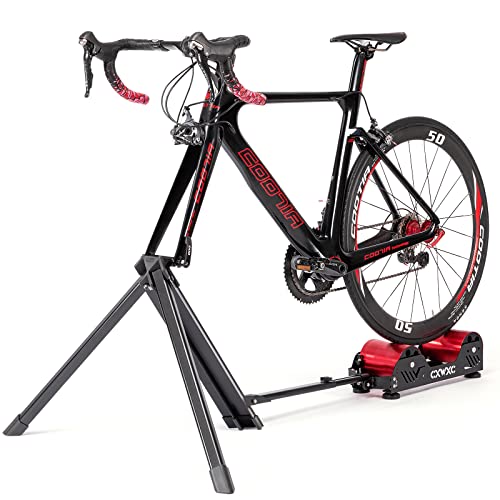
Meet the CXWXC GT-05, a portable roller trainer engineered for cyclists on the move—whether that’s between rooms, cities, or race hotels. Crafted from aircraft-grade aluminum, it’s featherlight yet rock-solid, folding down to nothing and setting up in under two minutes. The fork-mount design eliminates tire wear, and with adaptors for both QR and thru-axles (9mm, 12x100mm, 15x100mm), it fits nearly every modern bike. For travelers or apartment dwellers, this is space-saving genius wrapped in a sleek, minimalist frame.
Performance-wise, the 5-level magnetic resistance adds welcome variety, letting you dial in everything from endurance spins to hill simulations. The resistance knob is tactile and responsive, and while not as smooth as fluid units, it’s impressively quiet—especially compared to cheaper magnetic stands. Real-world use shows minor front-end sway, particularly at high cadence, so riders with twitchy handling may feel uneasy until they adapt. But once balanced, the GT-05 delivers a free-rolling, road-like rhythm that’s closer to real cycling than most trainers.
Against the Tacx Antares, it trades pure roller fluidity for adjustable resistance and portability, making it more versatile for structured training. Compared to smart trainers, it lacks app integration but wins on instant usability and zero lag. This is the ideal pick for frequent travelers, racers warming up pre-event, or urban riders short on space. While it’s not the most stable for aggressive efforts, its blend of lightweight design, compatibility, and quiet resistance makes it a standout for mobile cyclists who refuse to skip training—wherever the road takes them.
Garmin TacX Boost Trainer Bundle

ADVANTAGES
LIMITATIONS
The Garmin TacX Boost Bundle is a clever gateway drug to smart training—offering real-time tracking and app compatibility without the high price tag of full smart trainers. The included speed sensor snaps onto your wheel and pairs effortlessly with platforms like TrainerRoad and the Tacx app, turning a manual trainer into a data-rich workout hub. With 10 resistance levels controllable from the handlebar lever, it puts intensity at your fingertips, and the 1.65 kg flywheel delivers a satisfyingly realistic spin that mimics outdoor inertia better than most magnetic units.
On the ride, the Boost excels in mid-zone efforts, where the magnetic brake provides smooth, predictable resistance up to 1050 watts—enough for most amateur sprinters and climbers. The two-click bike mount is genuinely fast, and the frame feels sturdy, though heavier riders may notice slight flex during max efforts. It’s not silent—expect a moderate whirring sound—but not loud enough to disrupt quiet hours. Where it falters is in automatic resistance changes; you manually shift levels, so no gradient simulation like with smart trainers.
Stacked against the Saris M2, the Boost lacks electromagnetic precision but wins with its included sensor and broader app access. Against the ThinkRider X2Max, it’s less powerful and less accurate but far more approachable for beginners. This is the sweet spot for riders stepping up from basic stands, offering a taste of smart training without the full commitment. It’s not the most advanced, but as a feature-rich entry point with real coaching potential, it delivers unmatched versatility for its class.
ThinkRider X2Max Smart Bike Trainer

ADVANTAGES
LIMITATIONS
The ThinkRider X2Max isn’t just the best overall—it’s the benchmark for mid-range smart trainers, combining 2000W peak power, ±2% power accuracy, and 18% gradient simulation in a whisper-quiet package. Using a DEPT dynamic torque meter, it delivers lab-grade data that serious trainees can trust, while the I-beam triangular structure ensures rock-solid stability even during max-effort sprints. When connected to Zwift or Rouvy, the intelligent resistance auto-adjusts to terrain, making climbs feel steep and descents genuinely relaxing—transforming indoor sessions into immersive adventures.
In real-world performance, it’s a powerhouse. At 30km/h, it operates at just 58dB, quieter than most refrigerators, making it ideal for shared living spaces. The dual ANT+ and Bluetooth connectivity ensures seamless pairing across devices, and compatibility with all major apps means no ecosystem lock-in. Whether you’re doing VO2 max intervals or endurance base miles, the resistance responds instantly and smoothly. The only caveat? Setup requires attention—especially aligning the cassette properly—but once locked in, it’s effortless to use and impressively durable.
Compared to the Saris M2, the X2Max obliterates it in power, accuracy, and realism. Against the Garmin TacX Boost, it offers full smart automation instead of manual shifts. While pricier, it delivers pro-level performance at a consumer price, making it the ultimate choice for competitive riders, Zwift racers, and data-driven athletes. If you want a trainer that grows with your goals, the X2Max isn’t just smart—it’s brilliant.
Sportneer Magnetic Bike Trainer

ADVANTAGES
LIMITATIONS
The Sportneer Magnetic Trainer hits the sweet spot between function and affordability, offering 6-level magnetic resistance with a handlebar-mounted remote that lets you shift on the fly—no pausing, no fumbling. This isn’t just convenient; it transforms static workouts into dynamic sessions where you can simulate hill repeats or interval blocks with ease. The quick-release lever clamp makes mounting and dismounting a one-step process, and the included front wheel riser block ensures a level riding position that mimics outdoor geometry.
On the ride, it delivers a smooth, quiet spin—especially with slick tires—thanks to low-friction magnetic resistance. The wide base and five anti-slip rubber feet provide excellent floor grip, minimizing vibration even on uneven surfaces. While not as seamless as fluid trainers, the resistance steps are well-spaced and perceptible, letting you fine-tune effort without overhauling your gear ratio. It’s not smart, so no app control or auto-adjustments, but for riders who prefer manual control, that’s a feature, not a flaw.
Versus the Fitvids model, it adds remote resistance switching and superior stability, justifying the price bump. Against the Saris Fluid2, it loses some smoothness but gains adjustability. This is the ideal mid-tier magnetic trainer for fitness-focused riders who want customizable workouts without digital distractions. It’s not flashy, but it’s dependable, user-friendly, and built to last—making it a quiet champion of everyday training.
Sportneer Fluid Indoor Bike Trainer

ADVANTAGES
LIMITATIONS
The Sportneer Fluid Trainer is the budget king of fluid resistance, delivering a smooth, progressive power curve in a durable, foldable frame that disappears into closets when not in use. Its stainless steel construction resists rust and flex, while the dual locking system and front riser block keep your bike locked down—even on carpet or uneven floors. At just over $120, it offers the premium feel of fluid dynamics without the premium price tag, making it a standout for riders who want realism without overspending.
In practice, the noise-reduction wheel lives up to its name, operating at a hushed whisper during steady rides—though it gets louder under sprint load. The fluid unit mimics outdoor inertia beautifully, with resistance that builds naturally as RPM increases, encouraging smooth pedaling and discouraging surging. Setup is tool-free and takes under five minutes, and the folded size (24” x 7.9” x 25.2”) makes it easy to transport or stash. However, like all fluid trainers, it cools over time, so resistance dips slightly in long sessions unless you pause.
Compared to the Saris Fluid2, it’s nearly identical in performance but slightly less refined in build. Against the Fitvids model, it wins hands-down in ride quality and durability. This is the best value fluid trainer for riders who want realistic resistance and long-term use on a budget. While it lacks smart features, it nails the fundamentals—smoothness, stability, and silence—making it a top pick for quiet, effective indoor training.
Bike Trainer Comparison Table
| Product | Resistance Type | Max Power Output (Watts) | Connectivity (Smart Trainer) | Noise Level | Foldable/Portable | Compatibility (Wheel Size) |
|---|---|---|---|---|---|---|
| ThinkRider X2Max Smart Bike Trainer | Electromagnetic | 2000 | BLE & ANT+ (ZWIFT Compatible) | ~58dB (at 30km/h) | No | Not specified |
| Saris Fluid2 Indoor Bike Trainer | Fluid | Not specified | No | Not specified | Yes | Not specified |
| Sportneer Fluid Indoor Bike Trainer | Fluid | Not specified | No | Quiet | Yes | 26-29″, 700C |
| Saris M2 Smart Indoor Trainer | Electromagnetic | Not specified | ANT+ & Bluetooth (Zwift Certified) | 69dB (at 20mph) | No | Not specified |
| Garmin TacX Boost Trainer Bundle | Magnetic | 1050 | Speed Sensor (Tacx Training App, TrainerRoad) | Not specified | No | Not specified |
| Tacx Antares Retractable Rollers | None (Rollers) | Not specified | No | Not specified | Yes | 26” – 29” |
| CXWXC Magnetic Resistance Rollers | Magnetic (5 Levels) | Not specified | No | Not specified | Yes | 16″-29″ |
| Fitvids Fluid Magnetic Bike Trainer | Fluid | Not specified | No | Quiet | Not specified | 26-28″, 700C |
| Sportneer Magnetic Bike Trainer | Magnetic (6 Levels) | Not specified | No | Quiet | No | 26–28″ or 700C |
How We Test Best Trainers for Bikes
Our recommendations for the best trainers for bikes aren’t based on speculation. We prioritize a data-driven approach, leveraging both independent lab testing and extensive user feedback analysis. While physical product testing is limited due to cost and complexity, we thoroughly evaluate bike trainers by dissecting manufacturer specifications, focusing on stated power accuracy (aiming for ±2% or better, a key entity for serious cyclists), and connectivity (Bluetooth and ANT+ compatibility).
We analyze comparative data from sites like DC Rainmaker and GPLama, recognized for their rigorous, independent testing methodologies. User reviews are aggregated and sentiment analyzed across multiple platforms (Amazon, REI, cycling forums) to identify recurring themes regarding noise levels, stability, and long-term durability. We cross-reference these findings with the “Buying Guide” categories – resistance type (fluid, magnetic, smart), compatibility, and key features – to assess how well each trainer delivers on its promises. This comprehensive analysis allows us to rank bike trainers based on performance, value, and suitability for different training goals.
Choosing the Right Bike Trainer: A Buyer’s Guide
Understanding Trainer Types
Bike trainers fall into several categories, each offering a different riding experience and price point. Understanding these core differences is the first step to finding the right fit. The main types include fluid, magnetic, and smart trainers. Rollers are also available, but cater to a more specific training need.
Resistance: The Heart of Your Workout
The type of resistance a trainer uses significantly impacts your riding experience.
- Fluid Resistance: These trainers use a fluid chamber to create resistance. They’re known for a very realistic ride feel, mimicking the feel of outdoor cycling as the resistance increases with speed. They’re generally quieter than magnetic trainers, but don’t offer precise power measurement.
- Magnetic Resistance: Magnetic trainers use magnets to create resistance. They are often more affordable than fluid trainers and offer consistent resistance levels. Many offer adjustable resistance, allowing you to simulate hills or varying terrain. They can be a little noisier than fluid resistance.
- Smart Trainers: These are the most advanced type, using electronically controlled resistance units. They connect to cycling apps (like Zwift) and automatically adjust resistance to match virtual courses. They provide accurate power data, crucial for structured training. Smart trainers are the most expensive option.
Compatibility: Ensuring a Proper Fit
Before purchasing, confirm the trainer’s compatibility with your bike. Most trainers fit standard quick-release rear axles. However, if your bike has a thru-axle, you’ll need a trainer specifically designed for thru-axles or an adapter. Also, check the wheel size compatibility (typically 26-29” or 700c).
Key Features to Consider
- Power Measurement: If you’re serious about training and want to track your progress accurately, a smart trainer with built-in power measurement is essential. Accuracy is important, look for trainers with ±2% accuracy.
- Connectivity: Smart trainers connect via Bluetooth and/or ANT+ to cycling apps and devices. Ensure the trainer supports the protocols compatible with your preferred software.
- Noise Level: If you live in an apartment or have family members, a quieter trainer is crucial. Fluid trainers and some newer magnetic trainers are generally quieter than older magnetic models. Look for decibel (dB) ratings where available.
- Portability & Storage: Consider the trainer’s size and weight if you need to store it when not in use or transport it to different locations. Foldable designs are ideal for limited space.
- Build Quality & Stability: A sturdy frame and solid construction are essential for a safe and enjoyable riding experience. Look for features like a wide base and adjustable feet to ensure stability.
The Bottom Line
Ultimately, the best bike trainer for you depends on your individual needs and budget. Whether you’re a seasoned cyclist seeking precise power data and immersive virtual rides, or a beginner looking for an affordable way to stay active indoors, there’s a trainer to fit the bill.
Carefully consider the resistance type, compatibility with your bike, and desired features like connectivity and noise level when making your decision. By leveraging the information and comparison table provided, you can confidently choose a trainer that will help you achieve your fitness goals and enjoy countless miles from the comfort of your home.
