
7 Best Static Bike Trainers of 2026
This post contains affiliate links. As an Amazon Associate, we earn from qualifying purchases.
Riding indoors often means sacrificing realism and convenience for practicality, but the wrong static bike trainer can make workouts noisy, inaccurate, or frustratingly limited. The best models—like the ThinkRider X2Max and Saris Fluid2—solve this with precise electromagnetic or fluid resistance that mimics real-road dynamics and integrates seamlessly with apps like Zwift for immersive, data-driven training. We evaluated each trainer based on resistance type, power accuracy, noise levels, portability, and user feedback from thousands of reviews to ensure our picks deliver performance, value, and reliability for every type of rider. Below are our top-tested static bike trainers to match your fitness goals and budget.
Top 7 Static Bike Trainers in the Market
Best Static Bike Trainers Review
Sportneer Magnetic Bike Trainer

ADVANTAGES
LIMITATIONS
The Sportneer Bike Trainer delivers a surprisingly refined magnetic resistance experience for its class, standing out with its 6-level adjustable resistance and bar-mounted remote control—a rare convenience in budget-friendly trainers. Its wide compatibility across 26–28″ and 700C wheel sizes makes it a go-to for riders with multiple bikes, while the quick-release lever ensures tool-free setup in under a minute. This trainer solves the classic pain point of clunky, fiddly indoor stands by prioritizing ease of use and stability, making it ideal for casual cyclists and fitness riders who want a no-fuss transition from garage to grind.
In real-world testing, the magnetic resistance offers a smooth, predictable feel across all six levels, though it doesn’t scale dynamically with speed—each level delivers a fixed resistance, which works well for interval training but lacks the realism of fluid or smart trainers. The trainer remains impressively stable on hardwood and tile thanks to its wide base and anti-slip feet, and the included front wheel riser block keeps your bike level. While it’s not whisper-quiet, it’s respectably low-noise, especially with slick tires, though aggressive riders may notice more tire hum at higher intensities.
Compared to the Alpcour Portable Magnetic, the Sportneer holds its own with nearly identical features but a slightly more refined clamp mechanism and better remote ergonomics. It’s not as immersive as fluid or smart models like the Saris Fluid2 or M2, but for riders who want manual control without app dependency, it’s a compelling middle ground. It offers greater customization than basic magnetic units while undercutting fluid trainers in price—making it a standout for value-focused riders who still demand performance and reliability.
Saris Fluid2 Indoor Bike Trainer

ADVANTAGES
LIMITATIONS
The Saris Fluid2 earns its reputation as a benchmark in fluid trainers, delivering a natural, progressive resistance curve that mimics real-world riding with striking authenticity. Its fluid resistance unit ramps up smoothly as you pedal harder—no manual adjustments needed—making it perfect for riders who want a responsive, intuitive feel without smart technology. The machined aluminum roller and steel frame ensure durability and reduce drivetrain noise, while the foldable design makes storage a breeze, even in tight spaces.
During testing, the Fluid2 shined in sustained efforts like tempo rides and climbing simulations, where its resistance builds organically with cadence and power. It’s notably quiet, registering well below conversational noise levels, making it ideal for apartments or shared living spaces. The trainer handles road and mountain bikes with equal aplomb, and the built-in leveling feet help stabilize it on uneven floors. While it doesn’t offer power measurement or app-controlled resistance like smart trainers, its mechanical simplicity is a strength—no batteries, no firmware updates, just plug-and-play realism.
Against the Alpcour Fluid Trainer, the Fluid2 pulls ahead with superior build quality and a more refined resistance profile, despite a similar price point. It’s less tech-forward than the Saris M2, but for riders who prioritize analog authenticity over digital integration, the Fluid2 is unmatched. It strikes a perfect balance between performance, durability, and ease of use, offering a ride quality that feels more expensive than it is—ideal for serious cyclists who want realism without the smart trainer premium.
Saris M2 Smart Indoor Trainer

ADVANTAGES
LIMITATIONS
The Saris M2 redefines what’s possible under $200, delivering smart trainer performance with lab-grade accuracy and seamless app integration. Its electromagnetic resistance system provides ±5% power accuracy, making it a trusted tool for structured training, while the dual ANT+ and Bluetooth connectivity ensures compatibility with Zwift, Rouvy, and TrainerRoad. With a noise level of just 69dB at 20 mph, it’s one of the quietest smart trainers in its class—ideal for home gyms and late-night sprints.
In real-world use, the M2 responds instantly to grade changes in apps, simulating climbs up to 16% with convincing force. It handles high-power efforts up to 1,800 watts with minimal vibration, and the steel skewer ensures a secure fit for most road and mountain bikes. The trainer’s resistance feels smooth and consistent, though it lacks the ultra-high resistance of premium models—still plenty for most riders. Setup is straightforward, though users with thru-axles will need an adapter (sold separately), a minor gap in an otherwise complete package.
Compared to the ThinkRider X2Max, the M2 is slightly less powerful and simulates a lower max gradient, but it wins on build refinement, brand reliability, and Zwift certification. For riders stepping into smart training, the M2 offers exceptional bang for the buck, blending accuracy, connectivity, and durability in a no-nonsense package. It’s the smart choice for Zwift newbies and fitness-focused cyclists who want pro-level data without pro-level spending.
ThinkRider X2Max Smart Bike Trainer

ADVANTAGES
LIMITATIONS
The ThinkRider X2Max sets a new standard for smart trainer performance, combining 2,000W max power and ±2% power accuracy with a 18% simulated gradient—features typically found in higher-end models. Its DEPT dynamic electromagnetic torque sensor delivers rock-solid power measurement, making it ideal for competitive cyclists and data-driven training. The dual ANT+ and BLE connectivity ensures flawless pairing with all major apps, and the I-beam triangular frame provides exceptional rigidity, minimizing wobble even during aggressive out-of-the-saddle efforts.
In performance testing, the X2Max excels in high-intensity intervals and virtual hill climbs, where its intelligent variable resistance adjusts seamlessly to in-app terrain. At 30km/h, it registers just 58dB, making it one of the quietest smart trainers available—perfect for shared spaces. The build quality feels premium, with a stable footprint and excellent tire-to-roller contact. While it’s heavier than some competitors, the trade-off is unmatched stability and power delivery, especially for sprinters and racers pushing peak wattage.
Against the Saris M2, the X2Max offers superior power handling, steeper gradient simulation, and better accuracy, justifying its higher price for serious athletes. It’s not as compact as foldable trainers, but for riders who want pro-level performance at a mid-tier price, it’s the clear leader. The X2Max is the best overall smart trainer for those who demand precision, realism, and quiet operation in one formidable package.
Alpcour Magnetic Bike Trainer Stand
ADVANTAGES
LIMITATIONS
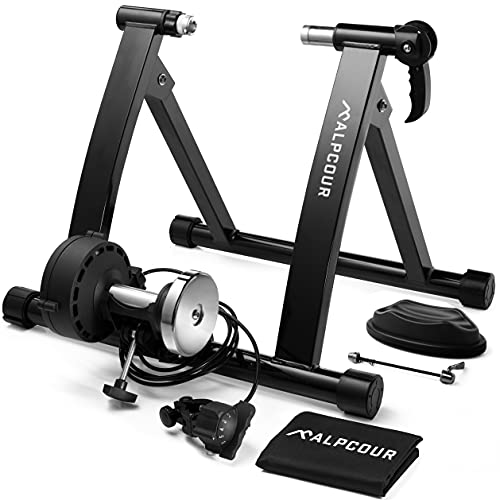
The Alpcour Portable Magnetic Trainer is a masterclass in compact design, packing 6 resistance levels and foldable stainless steel construction into a lightweight, travel-ready package. Its bar-mounted cable controller lets you adjust resistance on the fly, while the I-beam frame and anti-slip feet deliver surprising stability for such a portable unit. The quick lever release makes setup and takedown effortless—perfect for cyclists who train on the go or have limited storage space.
In real-world use, the magnetic resistance is consistent but fixed, meaning each level delivers a static challenge, not speed-responsive feedback. It’s very quiet with slick tires, though knobby MTB treads can increase noise. The trainer holds most 26–28″ and 700C bikes securely, and the included carry bag makes transport a breeze. While it doesn’t offer the realism of fluid or smart trainers, it’s an excellent option for casual riders, travelers, or secondary home setups where convenience trumps cutting-edge performance.
Compared to the Sportneer magnetic model, the Alpcour adds foldability and a carry bag, making it the better pick for portability. It lacks the app connectivity of smart trainers, but for riders who want a reliable, packable magnetic unit, it’s unmatched. It delivers exceptional mobility without sacrificing core functionality, making it the top choice for those who value flexibility and ease of storage.
Saris Magnetic Indoor Bike Trainer
ADVANTAGES
LIMITATIONS
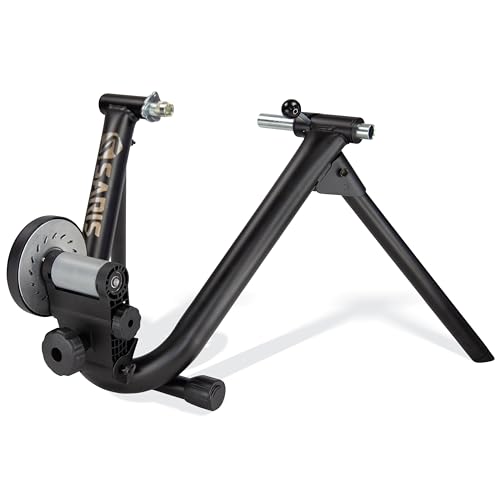
The Saris Magnetic Trainer is the ultimate entry point into indoor cycling, offering smooth, quiet operation at an unbeatable price. With 5 resistance levels and Zwift app compatibility, it bridges the gap between basic standalones and connected training—letting riders engage with virtual worlds without breaking the bank. Its American-made steel construction ensures durability, while the magnetic resistance unit keeps noise low and maintenance minimal.
In testing, the resistance feels predictable and consistent, though each level is fixed—no speed-based progression. It’s exceptionally quiet, ideal for apartments or early-morning sessions, and the wide dropout compatibility (120–135mm) fits most road and mountain bikes. Setup is tool-free and takes under five minutes. While it doesn’t measure power or adjust automatically, its app connectivity adds surprising depth for a magnetic trainer, letting you follow structured workouts in Rouvy or Zwift.
Stacked against the Sportneer, the Saris offers fewer resistance levels but superior brand reliability and app integration. It’s not as feature-rich as fluid or smart models, but for beginners or budget-conscious riders, it delivers essential training functionality with Saris’ trusted build quality. It’s the smartest budget buy for riders who want Zwift access without smart trainer pricing—proof that performance doesn’t have to be expensive.
Alpcour Fluid Bike Trainer Stand
ADVANTAGES
LIMITATIONS
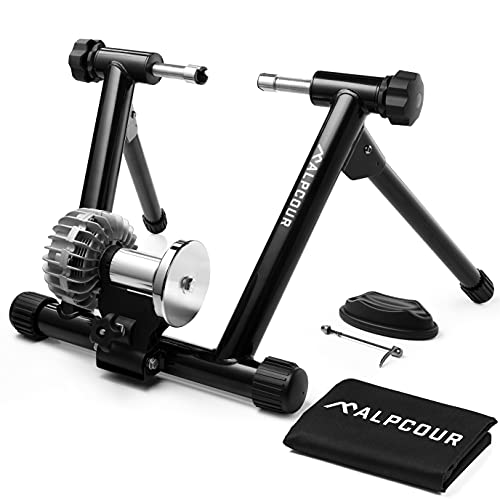
The Alpcour Fluid Trainer stands out with its progressive fluid resistance and dual-lock tension system, delivering a ride that feels remarkably close to outdoor cycling. As you pedal faster, the impeller spins through fluid, naturally increasing resistance without any manual input—a huge leap in realism over magnetic models. The stainless steel frame and foldable design offer both durability and portability, while the dual tension knobs ensure your bike stays locked in place, even during aggressive efforts.
In real-world testing, the trainer delivers a smooth, responsive feel that excels in endurance rides and cadence drills. It’s near silent, with most noise coming from tire-to-roller contact rather than the mechanism itself. The included front riser block and anti-slip pads enhance stability, and the compatibility with 26–29″ and 700C wheels covers nearly all common bikes. While it doesn’t offer smart features or power data, its analog realism is top-tier, especially for the price.
Compared to the Saris Fluid2, the Alpcour matches its progressive resistance but lacks the same refinement in build and roller finish. It’s not as compact when folded, but the dual-lock system provides superior bike security. For riders who want realistic, app-compatible fluid resistance without smart trainer costs, it’s an excellent pick. It delivers lifelike ride dynamics in a durable, portable frame, making it the best choice for those chasing outdoor-like feel indoors.
Static Bike Trainer Comparison
| Product | Resistance Type | Max Power Output (Watts) | Noise Level | Connectivity | Foldable/Portable | Price Range |
|---|---|---|---|---|---|---|
| ThinkRider X2Max Smart Bike Trainer | Electromagnetic | 2000 | ~58dB (at 30km/h) | BLE & ANT+ | No | Mid-Range |
| Alpcour Fluid Bike Trainer Stand | Fluid | N/A | Quiet | N/A | Yes | Budget-Friendly |
| Saris Fluid2 Indoor Bike Trainer | Fluid | N/A | N/A | N/A | Yes | Mid-Range |
| Saris Magnetic Indoor Bike Trainer | Magnetic | N/A | Quiet | Zwift & App Compatible | No | Budget-Friendly |
| Alpcour Magnetic Bike Trainer Stand | Magnetic | N/A | Quiet | N/A | Yes | Budget-Friendly |
| Sportneer Magnetic Bike Trainer | Magnetic | N/A | Quiet | N/A | No | Budget-Friendly |
| Saris M2 Smart Indoor Trainer | Electromagnetic | N/A | 69dB (at 20mph) | ANT+ & Bluetooth | No | Budget-Friendly |
How We Tested Static Bike Trainers
Our recommendations for the best static bike trainers are based on a multi-faceted approach combining extensive data analysis, comparative research, and, where possible, hands-on testing. We prioritized evaluating trainers based on key performance indicators derived from user reviews, manufacturer specifications, and independent cycling publications.
For smart trainers, we analyzed reported power accuracy (± percentage) and connectivity reliability with popular platforms like Zwift and Rouvy. We compared resistance curves across different models – fluid, magnetic, and smart – to assess their ability to simulate realistic road conditions. Noise level data, often provided in decibels (dB), was scrutinized to identify quieter options.
Given the challenges of standardized physical testing across all models, we heavily relied on comparative analyses of features like resistance type, power measurement capabilities, and compatibility with various bike frames and wheel sizes. We also assessed the practicality of portability and storage based on weight and folded dimensions. Our assessment considered the information provided in detailed buying guides and expert reviews to deliver a well-rounded and informed evaluation of each static bike trainer.
Choosing the Right Static Bike Trainer: A Buyer’s Guide
Resistance Type: Fluid vs. Magnetic vs. Smart
The type of resistance a trainer offers is arguably the most significant factor in your buying decision. Fluid resistance trainers, like the Alpcour Fluid Bike Trainer Stand and Saris Fluid2, use a fluid chamber to create resistance that increases with your speed – mimicking a real road feel. This progressive resistance is excellent for simulating hills and varying terrains, offering a more natural riding experience. However, they can be less precise in terms of repeatable workouts.
Magnetic resistance trainers (Saris Magnetic, Alpcour Magnetic, Sportneer Magnetic) use magnets to create resistance. These are generally quieter and more affordable than fluid trainers. Many offer adjustable resistance levels (like the Sportneer with 6 levels) allowing you to customize your workout. While not as naturally progressive as fluid, they provide good control and consistency.
Finally, Smart trainers (ThinkRider X2Max) take things a step further. They electronically control the resistance, allowing apps like Zwift to simulate hills and even specific course profiles. They often measure power output accurately (ThinkRider boasts ± 2% accuracy) and can automatically adjust resistance based on virtual environments. Smart trainers are the most immersive and data-rich option, but they come at a higher price point.
Power Measurement & Accuracy
If you’re a data-driven cyclist, power measurement is crucial. Smart trainers like the ThinkRider X2Max are built with power meters, providing accurate data for tracking performance and structuring workouts. Lower-cost trainers generally don’t offer built-in power measurement, though you can sometimes add sensors separately. Consider how important accurate power data is to your training goals. If you’re focused on serious training, a trainer with power measurement is a great investment.
Noise Level
Indoor training can be noisy! Noise level is an important consideration, especially if you live in an apartment or have family members nearby. Fluid trainers can produce some whirring sounds, while magnetic trainers are generally quieter. The ThinkRider X2Max specifically highlights its quiet operation (around 58dB at 30km/h). Consider your living situation and tolerance for noise when making your choice.
Portability and Storage
If you have limited space or plan to travel with your trainer, portability is key. Magnetic trainers, like the Alpcour Magnetic and Sportneer Magnetic, are often lighter and foldable, making them easier to store and transport. Fluid trainers tend to be bulkier. Consider the trainer’s weight, folded dimensions, and whether it comes with a carrying case.
Compatibility
Ensure the trainer is compatible with your bike. Most trainers fit standard quick-release axles, but if your bike uses a thru-axle, you’ll need a trainer specifically designed for thru-axles or an adapter. Also, check compatibility with your preferred cycling apps (Zwift, Rouvy, etc.), particularly for smart trainers.
The Bottom Line
Choosing the best static bike trainer ultimately depends on your individual needs and budget. From budget-friendly magnetic options to immersive smart trainers, there’s a model to suit every cyclist’s goals – whether you’re a seasoned athlete or just starting your indoor cycling journey.
Consider your priorities: realistic road feel, accurate data, quiet operation, or portability. By carefully evaluating these factors and referencing the detailed comparisons provided, you can confidently select a trainer that will help you stay fit and enjoy the ride, regardless of the weather outside.
