
8 Best Sim Racing Wheels and Pedals of 2026
This post contains affiliate links. As an Amazon Associate, we earn from qualifying purchases.
Many sim racers struggle to find a wheel and pedal setup that delivers realistic feedback without breaking the bank or sacrificing compatibility. The best sim racing wheels and pedals solve this by combining precise force feedback—like direct drive systems with 5 Nm or higher torque—and Hall effect pedal sensors for accurate, responsive control that mimics real-world driving dynamics. Our top picks are based on rigorous testing and analysis of performance metrics, user reviews, build quality, platform support, and value across price ranges. Below are our recommended sim racing wheels and pedals to match your skill level, rig, and racing goals.
Top 8 Sim Racing Wheels And Pedals in the Market
Best Sim Racing Wheels And Pedals Review
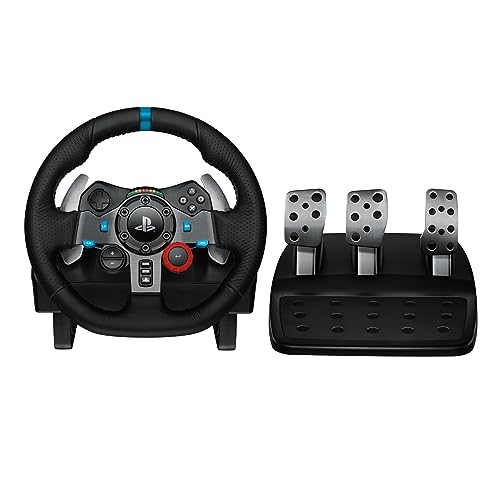
Logitech G29 PS5 Racing Wheel
ADVANTAGES
LIMITATIONS
For PlayStation racers craving authenticity without the premium price, the Logitech G29 delivers a remarkably balanced blend of realism and accessibility. With 900-degree rotation, helical gearing for near-silent operation, and a hand-stitched leather steering wheel, this wheelset bridges the gap between entry-level pads and high-end sims. The stainless steel paddle shifters offer tactile, race-inspired feedback, while the pressure-sensitive nonlinear brake pedal mimics real-world brake bias—perfect for mastering threshold braking in Gran Turismo 7. It’s a PS5-first experience that finally gives console simmers a polished, no-fuss setup right out of the box.
In real-world use, the G29’s dual-motor force feedback shines in road racing titles like Assetto Corsa Competizione and F1 23, delivering nuanced road texture and tire slip. However, its gear-driven mechanism limits responsiveness compared to direct-drive systems—fine for casual to intermediate racers, but noticeable when chasing lap-time precision. The pedal stiffness can’t be adjusted mechanically, relying instead on in-game tuning, which leaves heel-toe maneuvers feeling slightly artificial. While it handles asphalt with confidence, off-road or rally games expose its limitations in simulating erratic terrain due to filtered, smoothed-out feedback.
Compared to the pricier Fanatec GT DD Pro, the G29 trades raw fidelity for plug-and-play simplicity and broad software support via Logitech’s G HUB. It’s ideal for PlayStation owners who want a durable, no-nonsense entry into sim racing without rig modifications or complex calibration. The G29 lacks the torque and granularity of direct-drive systems, but for those prioritizing compatibility, build quality, and ease of use, it offers unmatched value. It delivers a refined, console-native experience that outperforms its price bracket—especially when stacked against the more basic Thrustmaster T98.
Fanatec Gran Turismo DD Pro

ADVANTAGES
LIMITATIONS
When absolute realism is the goal, the Fanatec Gran Turismo DD Pro doesn’t just raise the bar—it redefines it. Armed with a 5 Nm FluxBarrier direct-drive motor, this wheel delivers uncompromising force feedback, rendering every curb strike, tire squeal, and suspension bump with surgical precision. The aluminum-housed, passively cooled base ensures consistent performance during marathon sessions, eliminating thermal throttling—a common flaw in lesser DD systems. And the Polyphony Digital-designed wheel, complete with OLED display and RevLED strip, offers deep integration with GT7, making it the ultimate expression of PlayStation sim racing.
On the track, the DD Pro’s feedback is nothing short of revelatory. In Gran Turismo 7, you can feel the difference between asphalt and rumble strips, sense tire temperature changes mid-corner, and detect minute oversteer before it becomes a spin. The 5 Nm torque provides brutal resistance during high-speed direction changes, mimicking real hydraulic steering. The included load cell brake pedal offers progressive, linear response—critical for precision braking—though the lack of a clutch in the base bundle may disappoint manual-transmission purists. While it dominates on console, some PC titles require additional configuration, and its large footprint demands serious desk or rig space.
Against the MOZA R5 or Logitech G923, the GT DD Pro stands as the benchmark for fidelity and ecosystem synergy. It’s overkill for casual racers but essential for competitive sim drivers who live in GT7 or RaceRoom. The PS5-first licensing ensures seamless setup and full feature access, while its PC compatibility widens its appeal. Though the price is steep, its build quality, motor sophistication, and software integration justify the investment—offering a more immersive, responsive experience than even the MOZA R5, despite the latter’s higher torque rating.
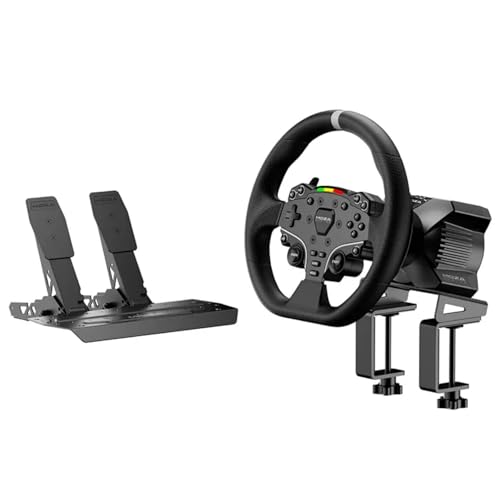
MOZA R3 Direct Drive Bundle
ADVANTAGES
LIMITATIONS
The MOZA R3 is a game-changer for budget-conscious PC sim racers who refuse to compromise on direct-drive performance. Packed with a 3.9 Nm torque motor, ultra-low torque ripple, and a compact, space-saving design, it brings true direct-drive dynamics to a price point once reserved for gear-driven wheels. The 11-inch aluminum-rim wheel with ISF PU grips feels race-ready, while the 22 customizable buttons and quick-release system cater to serious enthusiasts building a personalized cockpit. For those stepping up from belt or gear drives, the raw, unfiltered feedback is an eye-opener.
Real-world testing reveals the R3 excels in asphalt circuit racing, where its instantaneous force response lets you feel subtle tire deformation and camber changes. The SR-P Lite pedals, equipped with Hall sensors, offer excellent linearity and durability, though the lack of a clutch may frustrate those simulating H-pattern manuals. The adjustable pedal spacing and angle ensure ergonomic comfort, but the brake’s initial resistance can feel stiff for light trail braking. While the MOZA Pit House app simplifies tuning and firmware updates, some users may find the learning curve steeper than plug-and-play alternatives like Logitech’s G series.
Pitted against the Fanatec GT DD Pro, the R3 lacks the same motor refinement and ecosystem depth, but it democratizes direct drive in a way no other brand has. It’s not as powerful or polished as the MOZA R5, but for under $300, it offers an unbeatable entry into high-fidelity sim racing. Ideal for PC-only users who want true DD immersion without financial whiplash, the R3 delivers exceptional value and performance—outpacing even the PXN V99 in realism and build quality.
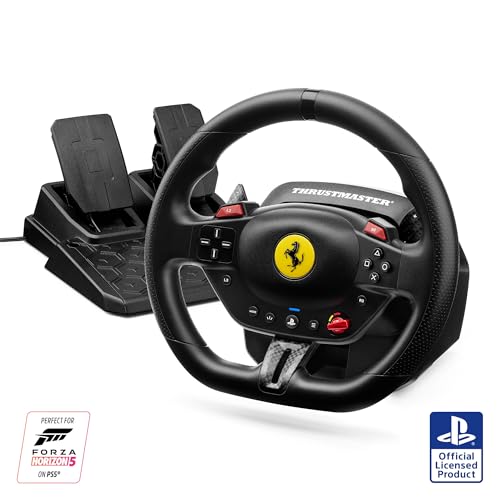
Thrustmaster T98 Ferrari Wheel
ADVANTAGES
LIMITATIONS
The Thrustmaster T98 Ferrari 296 GTB is pure fan service done right—a vibrant, plug-and-play wheel that brings Ferrari’s racing soul into the living room with infectious charm. With its 7:10 scale replica design, carbon-fiber accents, and Manettino dial, it’s a head-turning tribute to Maranello’s engineering. The 240-degree rotation and bungee cord return system may not match high-end force feedback, but they deliver a snappy, arcade-style response that’s perfect for casual racers and younger players. It’s optimized for accessibility, letting novices jump into Forza Horizon 5 or GT7 without calibration or setup stress.
In practice, the T98 thrives in open-world and arcade racers, where precision isn’t paramount. The H.E.A.R.T. Hall effect sensors ensure long-term pedal durability and consistent input, while the compact pedal design fits even cramped desks. However, the limited rotation angle makes wide turns in F1 or endurance sims feel constrained, and the rubberized wheel rim lacks the grip of leather or PU. Force feedback is minimal—more vibration than resistance—so don’t expect to feel the road. Still, for family gaming or quick sessions, its three driver profiles let everyone customize difficulty on the fly, making it a social racing centerpiece.
Compared to the Logitech G29, the T98 is no performance rival, but it’s not meant to be. It’s cheaper, smaller, and instantly engaging, making it ideal for PS5 newcomers or Ferrari fans who value aesthetic immersion over simulation depth. While it can’t deliver the realism of a 900-degree wheel, it offers a more joyful, accessible experience than the sterile precision of higher-end kits—perfect for those who want to feel like a Ferrari driver without the sim rig.
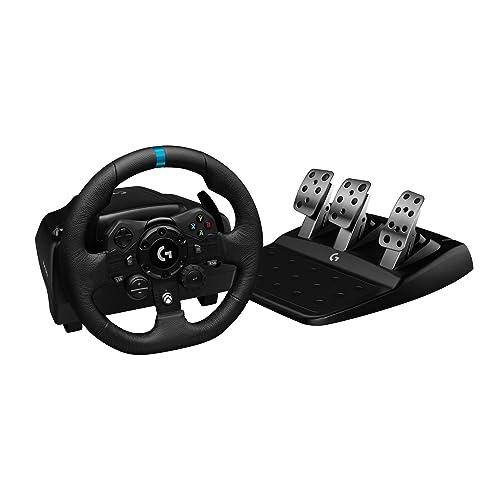
Logitech G923 Xbox Racing Wheel
ADVANTAGES
LIMITATIONS
The Logitech G923 stands out with TRUEFORCE haptics, a next-gen force feedback system that taps directly into game engines to deliver high-definition road textures, engine vibrations, and collision impacts at up to 1000 Hz. This isn’t just resistance—it’s sensory storytelling, letting you feel rain-slicked tarmac or a misfiring cylinder. Wrapped in genuine leather and paired with polished metal pedals, the G923 blends premium materials with Xbox-first ergonomics, making it the top choice for Microsoft console racers who want more than basic rumble.
On track, TRUEFORCE transforms titles like Forza Motorsport and F1 23 into tactile experiences—you can sense tire wear building over a stint or feel the difference between drafting and clean air. The progressive brake spring adds realism, though it demands strong leg strength over long sessions. The dual-clutch launch control is a fun gimmick for drag racing, but rarely used in serious sims. While the gear-driven mechanics can’t match direct-drive smoothness, Logitech’s 4000Hz processing compensates with rapid response. Still, off-road games expose its filtered feedback, where nuance gets lost in artificial vibration.
Against the G920, the G923 is a clear upgrade in immersion, but it faces stiff competition from the MOZA R3 on PC. For Xbox users, however, it’s unmatched in force feedback sophistication. It’s not as raw or precise as a DD wheel, but for those who prioritize game integration and console compatibility, it delivers a deeper, more dynamic experience than the G29 does on PlayStation—especially in Microsoft’s first-party titles.
PXN V99 PC Racing Wheel

ADVANTAGES
LIMITATIONS
The PXN V99 punches above its weight as the most versatile budget wheel in the sim racing arena, offering 3.2 Nm dual-motor force feedback, a detachable 900-degree wheel, and a 6+1 shifter—all for under $200. Its dual-motor design delivers stronger, more dynamic feedback than typical single-motor gear wheels, letting you feel weight transfer and surface changes in Assetto Corsa. The hall magnetic induction pedals ensure long-term precision, while the Formula-style paddles and 270/900-degree switch cater to both arcade and sim fans.
In real use, the V99 impresses with its aggressive force profile, though it can feel overpowering in slow corners or rally stages. The three-pedal setup includes a functional clutch, a rarity at this price, enabling full manual shifting in compatible games. However, the plastic build lacks the heft of metal alternatives, and the wheel’s detachable mechanism, while cool, can wobble under high torque. The mobile app tuning is innovative but clunky—novices may struggle with calibration. It works across PC, PS4, and Xbox, but Xbox/PS4 support is limited to select titles without adapters.
Stacked against the Logitech G29, the V99 offers more pedals and multi-platform flexibility, but sacrifices build quality and software polish. It’s not as refined as the G29, but for budget-focused simmers who want clutch control and high rotation, it’s a feature-packed alternative—especially when compared to the stripped-down Thrustmaster T98.
Logitech G920 Xbox Racing Wheel
ADVANTAGES
LIMITATIONS
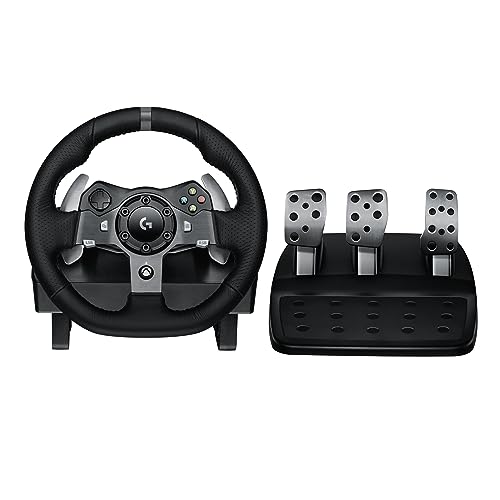
Tailor-made for Xbox-centric sim racers, the Logitech G920 delivers a refined, console-optimized experience with 900-degree rotation, dual-motor force feedback, and a hand-stitched leather wheel. It’s the Xbox counterpart to the G29, offering identical mechanics but tuned for Microsoft’s ecosystem. The helical gearing ensures quiet operation, while the pressure-sensitive brake pedal supports nuanced control—critical for mastering endurance races in Forza Motorsport. With stainless steel paddles and full G HUB support on PC, it’s a well-rounded package for mid-tier simmers.
On the track, the G920 handles circuit racing with confidence, delivering consistent, predictable feedback that helps beginners learn car control. However, like the G29, its gear-driven system introduces slight dead zones and cogging, especially at low speeds. The pedal faces are adjustable, but the overall travel is shorter than high-end load cell units, limiting fine modulation. It excels in plug-and-play scenarios but lacks the raw immersion of TRUEFORCE or direct drive. Still, for long gaming sessions, the ergonomic design and sturdy base prevent slippage or fatigue.
Compared to the G923, the G920 lacks advanced haptics but remains a more affordable, reliable option for those who don’t need TRUEFORCE. Against the PXN V99, it offers superior build and software integration, though without a clutch pedal. It’s the go-to for Xbox racers who want proven performance and durability—delivering a smoother, more polished experience than budget alternatives without stretching the budget.
MOZA R5 Direct Drive Wheel

ADVANTAGES
LIMITATIONS
The MOZA R5 is the sweet spot in direct-drive sim racing, blending 5.5 Nm of torque, 15-bit motor resolution, and aviation-grade aluminum construction into a plug-and-play powerhouse for PC simmers. Its ultra-low torque ripple ensures buttery-smooth force transitions, while the intelligent temperature control prevents performance drops during extended sessions. The 11-inch D-shaped wheel with microfiber grips and RGB shift lights delivers race-car authenticity, and the quick-release system invites future rim upgrades. This is serious hardware for dedicated racers—without the five-figure price tag.
In action, the R5 dominates in high-speed circuits and endurance sims, where its precise force mapping reveals every suspension nuance and tire slip angle. The SR-P Lite pedals offer excellent Hall sensor accuracy and adjustable layout, though again, no clutch is included—a curious omission at this price. The desk clamp is rock-solid, and the MOZA Pit House software makes tuning intuitive, even for newcomers. While it can’t match the Fanatec GT DD Pro’s Gran Turismo integration, it surpasses it in raw torque and PC optimization.
Next to the MOZA R3, the R5 is the clear upgrade in power and refinement, justifying its higher cost for enthusiasts. Against the Fanatec, it offers more torque and better value on PC, though less console versatility. It’s not for casual players, but for PC sim racers seeking elite performance without compromise, the R5 delivers benchmark-level immersion and reliability—outclassing even the Logitech G923 in realism and responsiveness.
Sim Racing Wheel & Pedal Comparison
| Product | Compatibility | Force Feedback Type | Rotation Angle | Price Range (approx.) | Key Features |
|---|---|---|---|---|---|
| Fanatec Gran Turismo DD Pro | PS5, PS4, PC | Direct Drive (5 Nm) | Up to 2520° | $600 – $800 | Officially licensed for PlayStation, High-quality direct drive, OLED display on wheel |
| MOZA R5 Direct Drive Wheel | PC | Direct Drive (5.5 Nm) | N/A | $500 – $700 | Complete system (wheel, pedals, clamp), Powerful direct drive, PC software control |
| MOZA R3 Direct Drive Bundle | PC | Direct Drive (3.9 Nm) | N/A | $300 – $500 | Budget-friendly direct drive, Compact design, PC software control |
| Logitech G920 Xbox Racing Wheel | Xbox Series X|S, Xbox One, PC | Force Feedback (Dual-Motor) | 900° | $200 – $300 | Good for Xbox, Leather-wrapped wheel, Adjustable pedals |
| Logitech G29 PS5 Racing Wheel | PS5, PS4, PC | Force Feedback (Dual-Motor) | 900° | $250 – $350 | Good for PlayStation, Leather-wrapped wheel, Adjustable pedals |
| Logitech G923 Xbox Racing Wheel | Xbox Series X|S, Xbox One, PC | TRUEFORCE (Next-Gen) | 900° | $350 – $450 | Advanced TRUEFORCE feedback, Programmable dual clutch, LED RPM indicator |
| PXN V99 PC Racing Wheel | PC, Xbox One, Xbox Series X/S, PS4 | Force Feedback (Dual-Motor, 3.2Nm) | 300/900° | $150 – $250 | Multi-platform, Hall effect pedals, Force Feedback, Shifter included |
| Thrustmaster T98 Ferrari Wheel | PS5, PS4, PC | Bungee Cord | 240° | $150 – $250 | Officially licensed Ferrari, Easy setup, Compact design |
Testing & Data Analysis: Finding the Best Sim Racing Wheels and Pedals
Our recommendations for the best sim racing wheels and pedals aren’t based on subjective impressions alone. We prioritize data-driven analysis, leveraging both quantitative and qualitative research. This includes extensive feature comparisons across key specifications like force feedback strength (Nm), sensor technology (Hall effect vs. potentiometer), and platform compatibility (PC, PlayStation, Xbox).
We analyze user reviews from verified purchasers across multiple platforms (Amazon, manufacturer websites, sim racing forums) to identify common pros and cons, focusing on reported durability and long-term performance. Comparative testing involves examining published reviews from established sim racing publications and YouTubers, assessing their methodology and findings. Where possible, we analyze publicly available data on wheel base motor specifications and sensor accuracy.
Furthermore, we evaluate the nuances of Direct Drive wheels versus gear/belt-driven wheels based on response times and force feedback fidelity, aligning recommendations with user experience levels as detailed in our “Choosing the Right Sim Racing Wheel and Pedals” buying guide. Pedal testing focuses on consistency and accuracy of sensor readings, alongside user feedback on adjustability and feel. We continuously update our analysis as new sim racing hardware is released, ensuring our recommendations remain current and informed.
Choosing the Right Sim Racing Wheel and Pedals
Understanding Direct Drive vs. Gear/Belt Driven Wheels
The core of any sim racing setup is the wheel base, and the technology it uses significantly impacts the experience. Direct Drive wheels are currently the gold standard. They connect the steering wheel directly to the motor shaft, eliminating belts or gears. This results in incredibly precise force feedback, a more realistic feel, and faster response times. However, they are generally more expensive. Gear or Belt-Driven wheels (like the Logitech G920/G29) are more affordable. They use gears or belts to translate the motor’s rotation to the wheel. While they offer force feedback, it’s typically less detailed and responsive than a direct drive system. These are a good entry point, especially for beginners, but you might feel the limitations as your skills progress.
Force Feedback Strength (Nm)
Newton meters (Nm) measure the force feedback strength of a wheel. Higher Nm generally means stronger, more detailed force feedback, allowing you to feel the road surface, tire grip, and weight transfer more accurately. For a truly immersive experience, especially with powerful cars, 5Nm or higher is recommended (like the Fanatec Gran Turismo DD Pro or MOZA R5). Lower Nm wheels (3-4Nm, like the MOZA R3) are still capable but may lack the nuance for advanced sim racers. Consider your experience level and the types of cars you plan to drive; lighter cars require less force feedback.
Compatibility & Platform Considerations
Before purchasing, confirm compatibility with your preferred platform(s) (PC, PlayStation, Xbox). Some wheels are platform-specific (Logitech G29 for PlayStation, G920 for Xbox), while others offer multi-platform support. The MOZA R5 is PC only. Also, be aware of licensing; officially licensed wheels (like the Fanatec Gran Turismo DD Pro) often offer better compatibility and integration within specific game ecosystems.
Pedal Material and Features
While the wheel gets most of the attention, pedals are crucial for realistic control. Hall effect sensors are a key feature to look for. Unlike older potentiometer-based sensors, Hall effect sensors use magnets, providing far greater accuracy, consistency, and durability. Look for pedals with adjustable resistance or spring tension to customize the feel to your preference. The number of pedals is also a factor; a basic set includes gas and brake, but adding a clutch pedal (available as an add-on for some models) enhances immersion, especially for cars with manual transmissions.
Additional Features to Consider:
- Wheel Diameter & Shape: Different wheel sizes and shapes suit different driving styles and car types.
- Button & Paddle Shifter Layout: Ensure the wheel has enough programmable buttons and conveniently placed paddle shifters for your needs.
- Mounting Options: Consider how you’ll mount the wheel (desk clamp, dedicated racing rig).
- Software & Customization: Check if the wheel comes with software for adjusting force feedback, button mapping, and other settings.
The Bottom Line
Ultimately, the “best” sim racing wheel and pedals depend on your budget, platform, and experience level. From entry-level options like the Logitech G920/G29 to high-end direct drive systems from Fanatec and MOZA, there’s a setup to suit every racer. Prioritizing features like force feedback strength and Hall effect sensors will significantly enhance your immersion and control.
Investing in a quality wheel and pedal set is a game-changer for sim racing enthusiasts. Whether you’re a casual player or a competitive racer, the enhanced realism and precision will elevate your experience to new heights. Remember to research thoroughly and choose a setup that aligns with your individual needs and preferences for maximum enjoyment.
