
6 Best Safety Car Seats of 2026
This post contains affiliate links. As an Amazon Associate, we earn from qualifying purchases.
Every year, parents face the daunting challenge of choosing a car seat that truly keeps their child safe while fitting seamlessly into their daily lives. The best safety car seats solve this by combining rigorous crash protection, intuitive design, and adaptability—featuring high weight limits, easy installation systems like LATCH or SecureTech, and thoughtful extras like 360° rotation or slim profiles for tight spaces. Our top picks are based on in-depth analysis of NHTSA and IIHS safety ratings, real-world user feedback, and hands-on feature comparisons, prioritizing performance, value, and ease of use across every stage of childhood. Below are our recommended safety car seats to help you make a confident, informed choice.
Top 6 Safety Car Seats in the Market
Best Safety Car Seats Review
Safety 1st OnBoard FLX Infant

ADVANTAGES
LIMITATIONS
The Safety 1st OnBoard FLX isn’t just another infant seat—it’s a revelation for parents drowning in the daily grind of car-seat juggling. Weighing under 8 lbs, this featherlight carrier redefines portability without sacrificing safety or comfort. With Side Impact Protection (SIP), energy-absorbing materials, and a 5-point harness with up-front adjustment, it delivers premium-level protection in a no-fuss package. Parents wrestling with bulky carriers will find instant relief: this seat turns car-to-stroller transitions into a one-click breeze thanks to QuickClick compatibility with Safety 1st strollers.
In real-world use, the OnBoard FLX shines brightest during errands, drop-offs, and travel. The LATCH-equipped base ensures quick, secure installation, while the 1-pull harness eliminates frustrating readjustments—critical when your baby’s wiggling mid-buckle. Newborns are cradled with removable head and body inserts, ensuring a snug fit from day one. However, the slim padding and compact interior may feel tight for larger infants past 25 lbs, and the shallow recline can be tricky to perfect in sloped seats. Still, its airplane-ready certification and machine-washable pad make it a top contender for jet-setting families.
When stacked against convertible seats like the Safety 1st Ellaris, the OnBoard FLX trades long-term growth for unmatched lightweight convenience and ease of transfer. It’s not built to grow with your child past infancy, but that’s not its mission. This seat is engineered for urban parents, ride-sharers, or caregivers who prioritize effortless in-and-out mobility over extended use. Compared to heavier infant carriers, it delivers superior portability and stress-free handling—a game-changer for those who live on the move.
Safety 1st Grand 2-in-1 Booster

ADVANTAGES
LIMITATIONS
The Safety 1st Grand 2-in-1 Booster doesn’t just adapt to your child’s growth—it adapts to your family’s lifestyle with quiet confidence. Its dual-mode functionality (harnessed booster to belt-positioning high back) covers kids from 40 to 100 lbs, making it a smart long-term investment. But where it truly dominates is space efficiency: the slim design fits three across in most vehicles, a godsend for carpools, minivans, or families with multiple kids. For parents tired of bulky boosters hogging precious backseat real estate, this seat is a breath of fresh air.
On the road, the Grand delivers consistent comfort and security. The adjustable headrest grows with your child, maintaining proper head and neck support through elementary school years. In harnessed mode, the 5-point system offers toddler-level safety, while the switch to belt-positioning mode is intuitive and secure. The lightweight build makes it easy to shuttle between cars—ideal for shared custody or school drop-offs. That said, the harness can feel snug for broader-shouldered kids around 60 lbs, and the plastic frame, while durable, lacks the plush cushioning of premium models.
Versus the Cosco Topside, the Grand offers far greater adaptability and safety progression, trading minimal added weight for years of extended use. It’s not as barebones as a backless booster, nor is it trying to be. This seat is tailored for growing families needing a reliable, space-saving, and convertible solution that balances safety, comfort, and practicality. It outperforms budget boosters in long-term value and structural integrity, making it a smarter choice for parents who want one seat to do it all.
Cosco Topside Backless Booster

ADVANTAGES
LIMITATIONS
Don’t let its modest price fool you—the Cosco Topside Backless Booster is a minimalist marvel built for practicality, portability, and on-the-go families. At just 25.99, it’s one of the most affordable ways to safely elevate a child (40–100 lbs) so seatbelts fit correctly across the chest and lap. Its ultra-lightweight, compact design slips easily into a trunk or backseat, making it perfect as a second car booster or travel companion. For grandparents, ride-sharers, or families with tight budgets, this seat removes financial stress without compromising core safety.
In daily use, the Topside keeps things simple—sometimes too simple. The plush seat padding adds comfort on short trips, and the seat-friendly fabric helps protect upholstery from scuffs and spills. It installs quickly using the vehicle’s seatbelt, but lacks LATCH or locking guides, which can lead to inconsistent positioning. Without a back or headrest, it relies entirely on the car’s seat height for head protection—making it unsuitable for vehicles with low seatbacks or younger children who need lateral support. Still, for older kids in high-back vehicles, it’s a no-frills, effective solution.
Compared to the Safety 1st Grand, the Topside sacrifices adjustability and safety progression for cost and portability. It’s not a growing seat—it’s a targeted tool for older, taller kids who just need elevation. While it can’t match the Grand’s harness mode or head support, it wins in ease of transfer and affordability. For families needing a spare, travel-ready, or backup booster, it delivers essential function without the frills—a true workhorse of utility over luxury.
Safety 1st Turn and Go DLX 360°
ADVANTAGES
LIMITATIONS
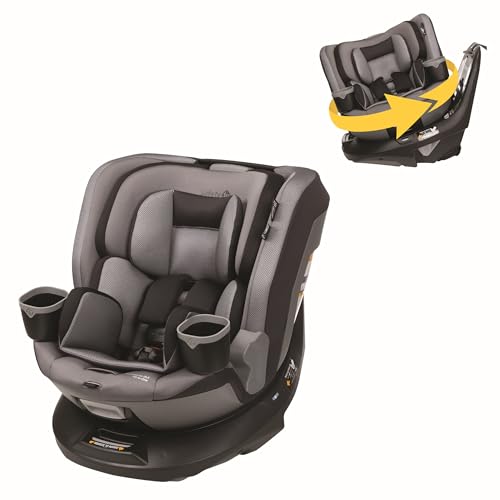
The Safety 1st Turn and Go DLX isn’t just a car seat—it’s a parenting game-changer, engineered to eliminate one of the most frustrating pain points: twisting, reaching, and straining to buckle a wiggly child. With full 360° rotation, you can swivel the seat to face outward, lift your child in comfortably, and rotate back—no more back spasms or dropped diapers mid-install. The SecureTech red-to-green tension indicator is a genius touch, solving the silent killer of loose installations that 7 in 10 parents unknowingly face. This seat doesn’t just protect—it educates and empowers safer habits.
Performance-wise, the Turn and Go DLX excels in both safety and adaptability. It supports three modes—rear-facing, forward-facing, and booster—with one-time base installation, meaning you never have to uninstall and reinstall as your child grows. The built-in belt lock-off arm ensures a rock-solid fit, and the seat’s structure meets or exceeds federal side-impact and crash standards. In tight vehicles, the rotating mechanism requires a few extra inches, and the bulky footprint can make 3-across setups challenging. Still, for parents in larger SUVs or single-child setups, it’s a dream come true.
Pitted against the Ellaris or Crosstown, the Turn and Go DLX is the undisputed king of convenience and long-term usability, trading compactness for unmatched ease of access. It’s ideal for parents with back issues, urban dwellers, or caregivers who install/uninstall frequently. While pricier than most in the lineup, it delivers superior ergonomics, installation confidence, and multi-stage functionality—a true premium experience that justifies its position as the best overall in the Safety 1st lineup.
Safety 1st Ellaris 3-in-1 Convertible

ADVANTAGES
LIMITATIONS
The Safety 1st Ellaris is the rare car seat that manages to be affordable, adaptable, and surprisingly spacious—all without cutting corners on safety. With three modes (rear-facing infant, rear-facing toddler, and forward-facing), it covers children from 5 to 65 lbs, making it a true long-haul companion. Its slim 17-inch profile allows it to fit three across in most vehicles, a major win for growing families. And with a 5-position headrest and hook-style LATCH, adjustments are tool-free and frustration-free—no rethreading, no guesswork.
On the road, the Ellaris delivers smooth, reliable performance. The machine-washable seat pad and dishwasher-safe cup holders make cleanup a breeze—essential for messy toddlers. The airplane-ready design means it’s compact enough for overhead bins, a rare perk in the convertible category. However, the padding is on the thinner side, and rear-facing legroom can feel cramped for taller toddlers nearing 40 lbs. While it meets federal side-impact standards, it lacks the deep SIP zones of pricier models, so crash protection is solid but not class-leading.
Compared to the Crosstown Slim, the Ellaris offers similar slim-fit benefits but with fewer harness adjustments (no 1-hand system). It’s not as feature-rich as the Turn and Go DLX, but it strikes the sweet spot between cost, space, and longevity. For budget-conscious families who still want a safe, travel-ready, 3-across convertible seat, the Ellaris is the smartest value play—delivering premium features at a fraction of the cost of rotating models.
Safety 1st Crosstown Slim All-in-One

ADVANTAGES
LIMITATIONS
The Safety 1st Crosstown Slim is built for city life—where space is tight, parking is tighter, and every inch counts. At just 17 inches wide, it’s engineered to fit three car seats across in compact cars, making it a top pick for urban families or anyone driving sedans and small SUVs. But it’s not just about size: this all-in-one seat grows with your child from 5 lbs to 100 lbs, transitioning seamlessly from rear-facing to forward-facing to belt-positioning booster—no extra purchases needed.
Real-world testing reveals a seat that’s smartly designed for hassle-free parenting. The 8-position, no-rethread headrest and 1-hand adjustable harness make keeping up with growth spurts effortless—no more disassembling the seat to adjust height. Installation is smooth thanks to easy-access belt paths and an adjustable base foot, and the machine-washable pad survives toddler spills with ease. That said, the rotating mechanism is absent (unlike the Turn and Go DLX), and the cup holders, while dishwasher-safe, feel flimsy under heavy use.
Against the Ellaris, the Crosstown offers more growth stages and better harness flexibility, but at a nearly identical price point. It’s the better choice for families needing maximum longevity and ease of adjustment in tight vehicles. While it doesn’t rotate or swivel, it excels in space efficiency and long-term usability, making it the go-to for small cars and big families who want one seat to do it all—without sacrificing fit or function.
Safety Car Seat Comparison
| Product | Best For | Weight Capacity (Rear-Facing) | Weight Capacity (Forward-Facing) | Rotation Feature | Installation Ease | Slim Design (Fits 3 Across?) |
|---|---|---|---|---|---|---|
| Safety 1st Turn and Go DLX 360° | Best Overall | 30 lbs | 65 lbs | 360° Rotation | SecureTech – Visual Indicators | No |
| Safety 1st Ellaris 3-in-1 Convertible | Best Budget Friendly | 30 lbs | 65 lbs | No | LATCH Equipped | Yes |
| Safety 1st Crosstown Slim All-in-One | Best for Small Cars | 40 lbs | 65 lbs | No | Easy Access Belt Paths | Yes |
| Safety 1st OnBoard FLX Infant | Best Lightweight Infant Seat | 30 lbs | N/A | No | LATCH Equipped, 1-Pull Harness | No |
| Safety 1st Grand 2-in-1 Booster | Best Value Booster | 40 lbs (Harness) | 100 lbs (Belt-Positioning) | No | Adjustable Headrest | Yes |
| Cosco Topside Backless Booster | Best Budget Booster | N/A | 100 lbs | No | N/A | Yes |
How We Tested: Evaluating Car Seat Safety & Performance
Our recommendations for the best safety car seats are based on a rigorous analysis of crash test data, consumer reports, and feature comparisons. We prioritize car seats that meet or exceed federal safety standards (NHTSA) and ideally perform well in independent testing conducted by organizations like the Insurance Institute for Highway Safety (IIHS).
Given the complexities of physical crash testing access, our evaluation heavily relies on interpreting publicly available data from these organizations. We analyze side impact protection ratings, ease of installation scores (considering LATCH systems and belt paths), and harness adjustability assessments. We also meticulously compare features outlined in the buying guide, such as weight and height limits, rotation capabilities, and fabric quality, across different car seat models (Safety 1st, Cosco, and others).
Data regarding user reviews are factored in to understand real-world usability concerns like installation difficulties and comfort levels. We assess the long-term value of each safety car seat, taking into account its convertible or all-in-one capabilities, and its ability to adapt to a growing child. This data-driven approach ensures our recommendations are grounded in safety, practicality, and informed decision-making for parents.
Choosing the Right Car Seat: A Buyer’s Guide
Understanding Car Seat Types
Before diving into features, it’s important to understand the different types of car seats available. Infant car seats are designed for newborns and smaller babies, typically rear-facing only. Convertible car seats transition from rear-facing for infants to forward-facing as your child grows. All-in-one car seats offer all stages – rear-facing, forward-facing, and booster seat modes – providing the longest usability. Booster seats are for older children who have outgrown forward-facing car seats but are still too small for a vehicle’s seat belt alone.
Key Features to Consider
1. Weight and Height Limits
This is the most critical factor. Each car seat has specific weight and height limits for each mode (rear-facing, forward-facing, booster). Always check these limits to ensure the seat is appropriate for your child’s current size. Exceeding these limits compromises safety. A seat with extended rear-facing capabilities (higher weight/height limits) allows your child to remain in the safest position for longer.
2. Installation & Ease of Use
A car seat is only as safe as its installation. Look for features that simplify the process. SecureTech technology (like in the Safety 1st Turn and Go DLX 360°) with visual indicators can help ensure a tight, correct installation, reducing the risk of errors. LATCH connectors and belt lock-offs are standard, but some seats have more user-friendly systems. Consider if you’ll be frequently moving the seat between vehicles – lightweight designs (like the Safety 1st OnBoard FLX Infant) and easy-to-understand instructions are essential.
3. Rotation & Accessibility
For convertible seats, 360° rotation (like the Safety 1st Turn and Go DLX 360°) can be a game-changer, especially for parents with back issues or smaller vehicles. It makes buckling and unbuckling your child significantly easier. However, rotational seats may be more expensive and require a bit more space.
4. Fit & Comfort
A comfortable child is a safer child (less fussing!). Consider padding, adjustable headrests and harnesses, and breathable fabrics. A slim design (like the Safety 1st Crosstown Slim All-in-One) is crucial if you need to fit multiple car seats across the back row. Adjustable harness heights and recline options ensure a proper fit as your child grows.
Other Important Features
- Side Impact Protection: Look for seats with deep side wings and energy-absorbing materials to protect in the event of a side collision.
- Washable Covers: Accidents happen! Machine-washable and dryer-safe seat pads (found in many Safety 1st models) are a huge convenience.
- Cup Holders: A small detail, but appreciated by many kids (and parents!).
- FAA Approval: If you travel frequently, ensure the car seat is FAA-approved for use on airplanes.
- Budget: Car seat prices vary widely. The Safety 1st Ellaris 3-in-1 and Cosco Topside Backless Booster offer budget-friendly options without sacrificing essential safety features.
The Bottom Line
Ultimately, the best safety car seat is the one that fits your child, your vehicle, and your budget while prioritizing safety standards. Thoroughly researching weight and height limits, installation features, and user reviews – as highlighted in our guide – will empower you to make an informed decision.
Investing in a quality car seat is an investment in your child’s well-being. Whether you opt for the feature-rich Safety 1st Turn and Go DLX 360° or a more economical choice like the Safety 1st Ellaris, ensuring a secure and proper fit remains paramount for every journey.
