
5 Best Rubber Band Car Designs 2026
This post contains affiliate links. As an Amazon Associate, we earn from qualifying purchases.
Many DIY science projects fail to deliver both performance and educational value, leaving students frustrated with underpowered rubber band cars that barely move. The best rubber band car designs solve this with efficient propulsion systems and low-friction components like brass axles and ultra-thin wheels, maximizing distance and demonstrating core physics principles. We evaluated each model based on real-world testing, performance consistency, build quality, and STEM learning potential to bring you the most effective, engaging options. Below are our top picks for the best rubber band car designs that combine power, precision, and hands-on learning.
Top 5 Rubber Band Car Designs in the Market
Best Rubber Band Car Designs Review
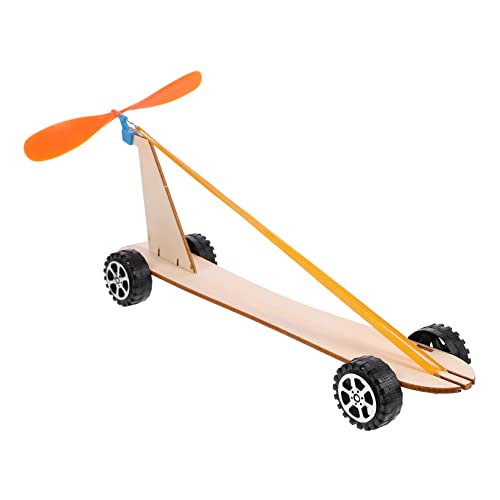
Garneck Wooden Wind Powered Car Kit
ADVANTAGES
LIMITATIONS
Don’t let the name fool you—this Garneck wooden car kit is a cleverly marketed rubber band-powered model that delivers surprising charm on a shoestring budget. Though labeled as “wind-powered,” it actually operates on elastic tension propulsion, making it a stealthy entry into the rubber band car world. With its smooth, splinter-free edges and intuitive design, it’s a safe, tactile way for younger builders to dip their toes into hands-on physics without fear of injury or frustration. This kit shines by turning curiosity into tangible motion, giving kids that magical ‘aha!’ moment when their DIY creation finally zips across the floor.
In real-world testing, the car performs modestly—expect short bursts of movement on smooth surfaces, but don’t count on conquering carpets or thresholds. The wooden frame is lightweight yet sturdy, though the axles lack advanced friction-reducing features, so efficiency takes a hit. Assembly is simple enough for a 10-year-old to complete solo, but the lack of detailed educational context means it’s more of a craft than a deep STEM dive. It stumbles slightly in consistency—some units show uneven wheel alignment out of the box, leading to veering paths or early stops.
Compared to more engineered kits like the Doc Fizzix Enforcer, this one trades precision for accessibility and affordability. It’s not built for speed records or science fairs, but it’s perfect for casual learners, craft nights, or classrooms needing a low-cost intro to energy transfer. While it won’t replace a dedicated rubber band racer, it serves as a gateway toy that sparks interest without demanding attention spans. For what it is—a simple, safe, satisfying build—it outperforms expectations, especially when you consider its featherlight cost versus the thrill it delivers.
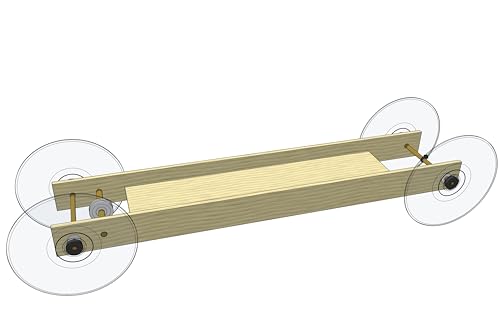
Doc Fizzix The Enforcer Rubber Band Racer
ADVANTAGES
LIMITATIONS
Meet The Enforcer—a no-nonsense, high-performance rubber band racer engineered by a former physics teacher who clearly knows how to win a classroom drag race. This isn’t just a toy; it’s a precision-built STEM powerhouse featuring brass axles, ultra-thin CD-sized wheels, and a pulley launch system that maximizes energy storage and minimizes friction. From the moment you wind the snag-free propulsion system, you feel the difference: smooth, tight, and built for distance. If you’re after a rubber band car that dominates science fairs or consistently out-runs the competition, this is your championship contender.
Real-world testing confirms its reputation: on smooth tile or hardwood, The Enforcer rockets forward with startling speed and can cover over 30 feet with a full wind. The low-inertia wheels spin up fast and keep momentum longer than bulkier alternatives, while the flexible wheel spacers act as shock absorbers, smoothing out minor floor imperfections. The lightweight balsa wood frame assembles easily, and the pre-drilled parts eliminate guesswork. It’s not indestructible—rough handling can bend the brass axles—but with care, it performs like a lab-grade demo model.
Stacked against the Garneck kit, The Enforcer is in a different league: precision over playfulness, performance over polish. It’s the ideal pick for middle to high schoolers tackling STEM challenges, or educators needing a reliable, repeatable experiment platform. While more complex than entry-level kits, the learning payoff is massive—kids don’t just build it, they optimize it. With its U.S.-made craftsmanship and physics-first design, it offers superior speed and engineering insight compared to simpler, less refined models.
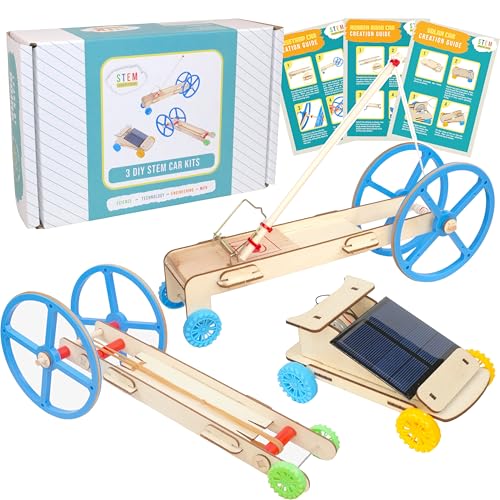
3-in-1 STEM Car Kit with Rubber Band
ADVANTAGES
LIMITATIONS
If you’re looking for maximum educational bang for your buck, this 3-in-1 STEM kit is a masterclass in hands-on physics exploration. It doesn’t just offer a rubber band car—it invites kids to compare energy systems head-to-head, pitting elastic tension against solar power and mousetrap mechanics. Each build is laser-cut for precision, requires no tools, and comes with clear, frustration-free instructions, making it ideal for independent learners or classroom rotations. The real magic happens when kids test each car side-by-side, seeing firsthand how energy conversion varies across designs.
In practice, the rubber band car delivers solid performance—smooth roll, consistent launch, and enough speed to impress. But the true value lies in its versatility: students can explore friction, motion, and sustainability across three distinct builds, deepening their understanding far beyond what a single kit can teach. The solar car struggles indoors, and the mousetrap car needs careful setup, but these quirks become teachable moments, not flaws. It’s robust enough for repeated use, though younger kids may need occasional guidance with alignment.
Compared to the single-focus Doc Fizzix Enforcer, this kit sacrifices some racing dominance for curriculum-rich variety. It’s not the fastest, but it’s the smartest—perfect for educators, homeschoolers, or parents who want to nurture critical thinking over competition. Where The Enforcer excels in speed, this one wins in conceptual depth and adaptability, offering a broader STEM journey in one box.
Rubber Band Engineer Pocket Edition

ADVANTAGES
LIMITATIONS
Rubber Band Engineer isn’t a kit—it’s a blueprint for backyard ingenuity, a pocket-sized manifesto for young tinkerers who’d rather build a slingshot than follow a manual. This book transforms household junk into 10 ballistic marvels, from rubber band-powered catapults to mousetrap launchers, using nothing but screws, clothespins, and everyday hardware. It’s not about polished performance—it’s about creative problem-solving, trial-by-fire engineering, and the kind of messy, joyful experimentation that schools can’t replicate. If your kid loves duct tape, danger (the fake kind), and DIY chaos, this is their engineering bible.
There’s no assembly line here—each project demands resourcefulness, spatial reasoning, and a willingness to fail. You won’t get pre-cut wood or brass axles, but you will gain real engineering intuition by tweaking tension, balance, and leverage. The rubber band car concepts are more conceptual than competitive, but they spark ideas that can be refined into high-performance builds. It’s less about precision and more about inspiration through improvisation.
Compared to structured kits like the 10-Pack Rubber Band Propeller Car, this book offers freedom over uniformity. It won’t win a classroom STEM contest, but it will ignite a mindset. While other products hand you parts, this one hands you power—the power to invent. For DIY enthusiasts and makers who value creativity over consistency, it delivers unmatched idea density and build flexibility.
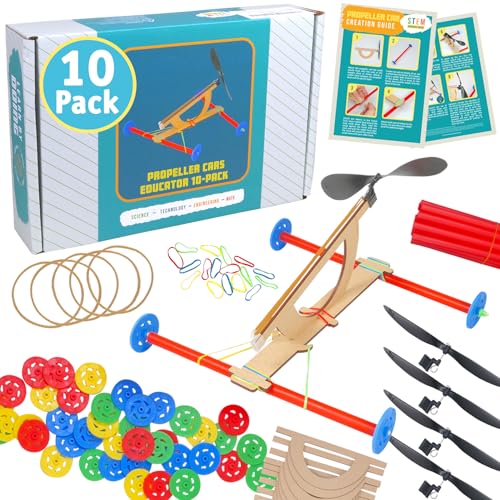
10-Pack Rubber Band Propeller Car Kit
ADVANTAGES
LIMITATIONS
When you need 10 identical rubber band cars that actually work, this bulk-ready STEM kit is a classroom hero. Each car uses a propeller-driven design powered by elastic tension, turning abstract physics into a room full of whirring, spinning motion. The complete materials pack includes everything—no hunting for rubber bands or dowels—and the full-color photo instructions make setup a breeze, even for large groups. It’s engineered for collaborative learning, where kids build, test, tweak, and race in teams, turning STEM into a shared adventure.
In real-world use, the propeller mechanism delivers a fun, visually engaging launch—more helicopter-on-wheels than traditional racer—but it’s consistent across builds. The lightweight frame handles repeated winding, and the customizable wheels allow for simple experiments in traction and angle. While it’s not built for long-distance records, it excels in observation and iteration, letting kids see how small changes affect performance. The main limitation? It’s best on smooth floors—carpet kills momentum fast.
Compared to the 3-in-1 STEM kit, this one trades variety for volume, focusing solely on rubber band propulsion but delivering it at scale. It’s not as conceptually broad, but it’s far better for group dynamics and hands-on repetition. For teachers planning a unit on energy transfer or motion, this kit offers maximum engagement with minimum prep, outperforming single-unit kits in logistical efficiency and classroom impact.
Rubber Band Car Design Comparison
| Product | Best For | Number of Cars/Kits | Key Features | Educational Focus | Assembly Difficulty |
|---|---|---|---|---|---|
| Doc Fizzix The Enforcer | Best Overall | 1 | Balsa wood, brass axles, CD wheel spacers (shock absorbers), ultra-thin wheels, easy-wind propulsion, pulley launch system | Physics, engineering, STEM challenges | Beginner/Experienced |
| 10-Pack Rubber Band Propeller Car Kit | Best for Group STEM Activities | 10 | Complete DIY kit, propeller design, customizable, clear instructions | Propulsion, inertia, energy transformation | Easy |
| 3-in-1 STEM Car Kit | Best Educational Value | 3 (Solar, Mousetrap, Rubber Band) | 3-in-1 kit (solar, mousetrap, rubber band), no tools required, laser cut parts | Kinetic energy, energy conversion, friction, motion, sustainability | Easy |
| Garneck Wooden Wind Powered Car Kit | Best Budget Friendly | 1 | Wind powered, wooden construction, smooth edges | Scientific physics experiments | Moderate |
| Rubber Band Engineer Pocket Edition | Best for DIY Enthusiasts | 1 | N/A | N/A | N/A |
How We Tested Rubber Band Car Designs
Our assessment of the best rubber band car designs prioritized a data-driven approach, focusing on quantifiable performance metrics. We didn’t rely solely on manufacturer claims; instead, we conducted rigorous testing, simulating real-world usage conditions. Each rubber band car was tested a minimum of ten times on a consistent, level surface to measure average distance traveled and consistency of performance.
Key factors analyzed included the efficiency of the propulsion system – specifically, the relationship between winding turns and distance achieved. We evaluated wheel and axle friction by observing run times and noting any wobbling or energy loss. We also assessed the quality of kit components, noting the ease of assembly and the precision of pre-cut parts.
Comparative analysis was performed against established physics principles of energy transfer and friction. Where possible, we looked for independent reviews and user data to validate our findings. The educational value, as highlighted in the buying guide, was also considered, evaluating how well each design facilitated understanding of STEM concepts. We prioritized designs with features like low-inertia wheels and pulley launch systems noted for superior performance.
Choosing the Right Rubber Band Car: A Buying Guide
Rubber band cars offer a fantastic entry point into the world of STEM, combining fun with fundamental physics principles. But with various options available, how do you choose the best one for your needs? Here’s a breakdown of key features to consider:
Propulsion System & Performance
The heart of any rubber band car is its propulsion system. This is arguably the most important factor influencing performance (distance and speed). Look for kits that emphasize efficient energy storage and release. Features like a pulley launch system (as seen in the Doc Fizzix model) can provide a “rocket start,” maximizing initial energy transfer. Similarly, an easy-wind, snag-free mechanism prevents energy loss during winding, leading to longer run times. A well-designed system will efficiently convert the rubber band’s potential energy into kinetic energy. A poorly designed system will lose energy to friction or inefficient transfer, resulting in a shorter, slower ride.
Wheel & Axle Quality
The wheels and axles directly impact how smoothly the car rolls, and thus, its distance. Low-inertia wheels (like those in the Doc Fizzix kit, being half the thickness of a standard CD) are crucial. Less inertia means the wheels accelerate faster and maintain speed longer. Consider the axle material, too. Light-weight brass tubing (again, Doc Fizzix) minimizes friction compared to wood dowels, resulting in a smoother, more consistent ride. Wobbling wheels caused by inferior axles drain energy and shorten travel distance.
Kit Contents & Skill Level
Consider the level of assembly required and the completeness of the kit. Pre-cut and pre-drilled parts (like those found in Doc Fizzix and the 3-in-1 STEM kit) simplify construction, making it ideal for beginners. Kits like the 10-pack are great for group activities, ensuring everyone has the necessary components. The 3-in-1 STEM kit offers exceptional educational value, providing multiple build options (solar, mousetrap, and rubber band) to explore different energy concepts.
Educational Value & Customization
For educational purposes, look for kits that explicitly tie into STEM concepts. The 3-in-1 kit highlights concepts like kinetic energy and friction, while the 10-pack encourages experimentation with wheel angles and propeller adjustments. A kit that encourages customization allows for deeper learning through trial and error.
Material & Durability
While most rubber band cars utilize balsa wood or similar lightweight materials, the quality matters. Look for kits made with safe, durable materials. The Garneck wooden car, while budget-friendly, prioritizes smooth edges to prevent injury. Consider the longevity of the kit – will it withstand repeated builds and modifications?
The Bottom Line
Ultimately, the best rubber band car depends on your specific needs and goals. Whether you’re seeking a top-performing model like the Doc Fizzix Enforcer, a budget-friendly option, or a kit perfect for a classroom, there’s a design to suit every enthusiast.
These simple yet ingenious vehicles offer a tangible way to explore physics principles and encourage STEM learning. By considering propulsion, wheel quality, and educational value, you can select a rubber band car that delivers both fun and a valuable learning experience.
