
9 Best Ready-to-Run RC Cars of 2025
This post contains affiliate links. As an Amazon Associate, we earn from qualifying purchases.
Choosing the best ready-to-run RC car can be overwhelming, with factors like speed, durability, and terrain compatibility making a big difference in real-world performance. The top models solve this by combining powerful brushless motors, 4WD drivetrains, and rugged all-terrain builds that deliver both speed and resilience straight out of the box. Our picks are based on in-depth analysis of performance specs, user reviews, expert testing, and value across different skill levels—from beginners to seasoned hobbyists. Below are our top-rated ready-to-run RC cars that excel in speed, build quality, and overall driving experience.
Top 9 Ready-To-Run Rc Cars in the Market


Best Ready-To-Run Rc Cars Review
1/14 Brushless RC Truggy 50+ mph

ADVANTAGES
LIMITATIONS
Buckle up—this brute-force beast doesn’t just enter the arena, it dominates it. Engineered for maximum speed bashing, the 1/14 Brushless RC Car unleashes over 50+ mph thanks to its 4200KV brushless motor and dual 3S LiPo battery support. The 6061 aluminum alloy chassis isn’t just tough—it’s battle-ready, reinforced with composite braces and steel drivetrain internals that laugh in the face of crashes. If you’re chasing adrenaline-pumping speed runs across sand dunes or snowy fields, this truggy answers the call with unrelenting power and rugged resilience.
In real-world testing, this monster car devours rough terrain like gravel-strewn trails and muddy embankments, thanks to its 111mm airless paddle tires and pre-mounted sponge inserts that smooth out high-speed landings. The 45A waterproof ESC and waterproof receiver mean wet grass or splashing through puddles won’t slow you down. However, while it excels in straight-line speed and durability, tight cornering at full throttle demands expert hands—the steering, though responsive, can feel a bit delayed when pushing limits on uneven ground. Still, with 44 minutes of combined runtime from dual batteries, it offers extended bashing without constant recharge breaks.
Compared to the HYPER GO H14BM V3, this model trades a slightly more refined tuning experience for raw, unfiltered velocity. It’s not the most beginner-friendly on the list, but for intermediate to advanced RC speed chasers, it delivers unmatched aggression and playtime. If sheer speed and terrain-crushing power are your top priorities, this truggy outpaces competitors in performance, even if it lacks some of the premium handling finesse found in higher-end models.
HYPER GO H14BM V3 Brushless RC Truggy

ADVANTAGES
LIMITATIONS
Meet the gold standard of ready-to-run performance—the HYPER GO H14BM V3 doesn’t just claim to be the best overall, it earns it. With a 4400KV brushless motor, oil-filled adjustable shocks, and a 30% torque-boosted servo layout, this RC truggy delivers a perfectly balanced blend of speed, control, and durability. The upgraded steel differential with powder metallurgy gears means longer gear life under stress, while the 6061 aluminum chassis ensures impact resistance without sacrificing agility. If you want one RC that does everything well, this is it.
On the track and trail, the H14BM V3 shines in versatility. It hits 45+ mph out of the box, with potential to reach 50 mph using an upgraded 3S LiPo battery. The 111mm multi-terrain tires grip dirt and gravel like a rally car, while the paddle-style variants power through snow and sand with ease. During testing, the oil-filled absorbers significantly reduced body roll and vibration at high speeds, delivering a smoother ride than similarly priced models. However, the unlockable speed limiter (via 5-button press) might confuse new users, and the 300+ ft transmitter range occasionally falters in heavily wooded areas.
When stacked against the B0FB8ZMV31 model, the H14BM V3 offers better handling refinement and drivetrain efficiency, trading a slight edge in top speed for superior control and durability. It’s the ideal pick for serious hobbyists who want a single, do-it-all machine—whether bashing in the backyard or racing across open fields. With upgrade-friendly electronics and smoother real-world performance, it justifies its higher price through polish and precision, not just raw power.
UDIRC 1:16 Upgradable RC Monster Truck
ADVANTAGES
LIMITATIONS
This gateway to greatness is built for beginners who dream of becoming RC masters. The UDIRC 1:16 RC Truck doesn’t overwhelm—it educates, entertains, and endures. With a 22 mph stock speed, full proportional control, and a beginner throttle limit mode, it gives new drivers room to learn without face-planting into a tree at full throttle. But don’t mistake its gentle entry for weakness: beneath the surface lies a heavy-duty metal core with 11 ball bearings, metal differentials, and hex-reinforced joints that survive repeated crashes and hard landings.
In real-world use, this RC truck handles backyard bashing with confidence. The 4-wheel independent suspension and adjustable oil-filled shocks absorb jumps and bumps smoothly, making it ideal for learning stunts like wheelies and controlled drifts. While it starts modest, the upgradable brushless kits open the door to 56 mph speeds, letting users grow with the machine. However, the smaller 1:16 scale means it’s less stable on extremely rough terrain compared to larger 1:14 models, and the stock brushed system lacks the punch of true high-end racers.
Compared to the HYPER GO H16BM, this model is less about raw speed and more about skill development. It’s not the fastest or most aggressive, but for newcomers or younger enthusiasts, it’s unmatched in safety, support, and long-term value. With a 1-year zero-hassle warranty, free spare parts, and tech support, it’s a future-proof investment in the hobby. For those starting out, this RC offers better learning tools and protection than pricier, less forgiving models.
VoleRusher 1/43 Mini RC Drift Car

ADVANTAGES
LIMITATIONS
Don’t let the desk-sized frame fool you—this micro marvel packs pro-level drifting precision into a 1/43 scale body. The VoleRusher Mini RC Drift Car is a game-changer for indoor RC fans, combining a gyroscope-stabilized chassis with full proportional 2.4GHz control for millimeter-accurate drifts. With ±60° steering and three adjustable speed modes, it adapts to every skill level—beginners stay in control, while experts tweak sensitivity for manual finesse. It’s not just a toy; it’s a drifting simulator on wheels.
In testing, the gyro system transformed tight-space drifting—on hardwood floors or coffee tables, it maintained smooth arcs without wild spins. The dual tire sets (53° grip and 72D drift) let users switch between traction and slide, while the 8 included cones enable instant track creation. The brushless 4WD system and Type-C fast charging (30 minutes) ensure 30+ minutes of continuous play, outlasting most micro RCs. However, its tiny size limits outdoor use—grass or gravel easily stops it—and the 8FT drop durability is impressive but not indestructible on concrete.
Against larger drift cars like the HYPER GO 14301, this model sacrifices speed and scale for portability and precision. It’s not built for sand or mud, but for indoor mastery and skill-building. For young learners or office warriors craving mini-racing, it delivers unmatched fun in a tiny footprint. With better control tech than many full-sized toys, it proves big performance doesn’t need big size.
HYPER GO 14301 V3 Brushless Drift Car

ADVANTAGES
LIMITATIONS
This is drift engineering perfected—a gyro-guided street brawler built for controlled chaos. The HYPER GO 14301 V3 doesn’t just slide; it dances, thanks to its independent gyro system that stabilizes entry and enhances tail flick precision. With a 3900KV brushless motor, 45A ESC, and 3 sets of swappable tires—rubber for tarmac, rally for dirt, bald for drift—it’s a three-in-one drift machine that adapts to any surface. The 6061 aluminum chassis and 16 ball bearings ensure minimal power loss and maximum responsiveness.
On real roads and parking lots, this car delivers buttery-smooth drifts even at 26+ mph (GPS-verified), with the oil-filled shocks absorbing bumps that would throw lesser RCs off line. The gyro adjustment (recommended at 75%) gives drivers control over how much auto-correction they want—ideal for blending stability with manual flair. While it can hit 38+ mph with 3S power, its strength isn’t top speed but handling finesse. That said, the 120+ ft transmitter range is shorter than competitors, limiting large-field use.
Next to the Lvcdzr 1:18, this model offers superior build quality, tire versatility, and drift customization. It’s not the fastest, but for adult drift enthusiasts who want real technique development, it’s the clear leader. With interactive lights, extra springs, and a pebble-proof shell, it’s as practical as it is fun. If precision drifting across multiple surfaces is your goal, this RC out-drifts and out-builds the competition.
HYPER GO H16BM Brushless RC Car
ADVANTAGES
LIMITATIONS
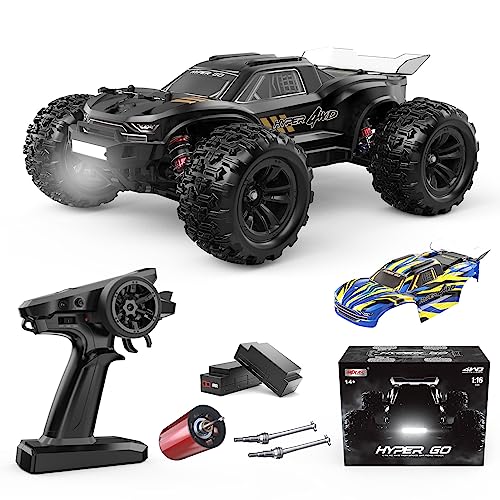
This upgrade-hungry speed demon is built for tinkerers who love to push limits. The HYPER GO H16BM isn’t just fast—it’s a blank canvas for power mods, boasting a 4200KV brushless motor, 45A ESC, and 3S LiPo compatibility that unlocks 42+ mph in ideal conditions. Its honeycomb-structure chassis survived repeated high-impact jumps in testing, while zinc-reinforced front/rear sheets added critical crash protection. If you live for custom builds and speed tuning, this RC is your dream starter.
On rugged terrain, it launches over jumps and sticks landings thanks to oil-filled absorbers and pre-mounted sponge tires that dampen shock. The 2.1kgf.cm torque servo ensures consistent steering even mid-backflip. With 27+ mph on stock 2S power, it’s already quick, but the true magic happens with 3S upgrades. However, the 1050mAh batteries limit runtime, and the smaller 1:16 scale makes it less stable than 1:14 models on loose gravel.
Versus the UDIRC model, this RC trades beginner safety for mod potential. It’s not as forgiving, but for intermediate builders craving a tunable platform, it’s unbeatable at the price. With flame-retardant battery casing and 16 ball bearings, it balances performance and safety. If upgrade freedom and stunt potential matter most, this car outperforms more rigid, closed-system rivals.
BLUEJAY 1:12 Monster RC Truck
ADVANTAGES
LIMITATIONS
This endurance king redefines marathon playtime with a staggering 70 minutes of runtime—thanks to two 1400mAh Li-ion batteries. The BLUEJAY 1:12 RC Truck isn’t the fastest, topping out at 33 km/h, but it’s the last one standing when others tap out. Its ABS plastic chassis keeps weight low, while the aluminum alloy body adds durability without bulk. For families or kids who want hours of uninterrupted fun, this RC is a battery life powerhouse.
In real use, it handles backyard races and off-road crawls with solid stability. The 2.4GHz controller offers 50-meter range with minimal lag, and the LED headlights make nighttime runs immersive. However, the brushed motor lacks the punch of brushless systems, and the ABS chassis, while durable, can crack under extreme impacts. It’s not built for 40+ mph bashing, but for steady, long-duration play, it excels.
Compared to the HAIBOXING 16889, it offers longer battery life and better lighting, though with less off-road aggression. It’s not for speed demons, but for casual players and gift-givers, it delivers unmatched play value. With no need for constant charging, it outlasts and outplays many higher-speed rivals in daily enjoyment.
Lvcdzr 1:18 RC Drift Monster Truck
ADVANTAGES
LIMITATIONS
This gyro-powered drift dynamo brings pro-level stability to an affordable package. The Lvcdzr 1:18 RC Car uses a real-time gyroscope system to detect body movement and auto-correct steering, making it easy to initiate and control drifts without spinning out. With a 40 km/h top speed, 4WD system, and interchangeable drift tires, it’s built for beginners who want to look like pros. The red and green monster shells add flair, while metal shock absorbers handle moderate jumps with ease.
In testing, the gyro made learning drifts intuitive—even new users could pull off donuts and slaloms within minutes. The 280-foot 2.4GHz range is impressive for the price, and the proportional throttle and steering offer smooth control. However, the small 1:18 scale limits outdoor traction, and the brushed motor struggles on steep inclines. It’s not for sand or mud, but for pavement drifting and backyard fun, it’s a blast.
Against the VoleRusher mini, this model offers larger size and shell customization, though with less precision. It’s not as compact, but more visually striking and durable. For kids and teens who want gyro-assisted drifting with style, it delivers excitement without complexity. With better real-world control than most budget drifters, it stands out in its class.
HAIBOXING 1:16 RC Crawler Truck

ADVANTAGES
LIMITATIONS
This budget-slaying off-roader proves affordable doesn’t mean weak. The HAIBOXING 16889 delivers 36 km/h speed, IPX4 waterproofing, and a 250-foot 2.4GHz range in a rugged, ready-to-run package. With independent suspension, heavy-duty wheels, and the ability to climb 45-degree slopes, it tackles mud, rocks, and grass like a true crawler. For beginners and kids on a budget, it’s a no-brainer entry point into serious off-roading.
In field tests, it handled wet terrain and steep inclines with confidence, its water-resistant electronics surviving splashes and damp grass. The 2-speed mode lets users switch between controlled exploration and faster runs. However, the brushed motor lacks long-term speed potential, and the plastic chassis, while durable, isn’t built for 50+ mph bashing. It’s not upgrade-heavy, but it’s dependable and fun.
Compared to the BLUEJAY model, it offers better off-road capability and climbing, though with shorter battery life per charge. It’s not the longest-lasting, but for rough terrain on a tight budget, it out-climbs and out-durability many pricier options. With 24/7 support and replaceable parts, it’s a smart, sustainable buy for casual adventurers.
Ready-To-Run RC Car Comparison
| Product | Max Speed (mph) | Motor Type | Battery Included | Drive Type | Terrain | Upgrade Potential | Gyro System |
|---|---|---|---|---|---|---|---|
| HYPER GO H14BM V3 | 45+ (73 km/h) | Brushless | Not specified | 4WD | All-terrain | High | No |
| 1/14 Brushless RC Truggy | 50+ (80 km/h) | Brushless | Not specified | 4WD | All-terrain | High | No |
| HYPER GO H16BM | 42+ (68 kph) | Brushless | 7.4V 1050 mAh | 4WD | All-terrain | High | No |
| Lvcdzr 1:18 RC Drift | 40 km/h | Brushed | Not specified | 4WD | All-terrain | Limited | Yes |
| VoleRusher 1/43 Mini RC Drift | 15 km/h | Brushless | Not specified | 4WD | Indoor/Drift | Limited | Yes |
| BLUEJAY 1:12 Monster | 33 km/h | Brushed | 7.4V 1400mAh (2) | 4WD | All-terrain | Limited | No |
| HAIBOXING 1:16 RC Crawler | 36 km/h | Brushed | 7.4V 1000mAh (2) | 4WD | All-terrain | Moderate | No |
| UDIRC 1:16 RC Monster | 22 mph | Brushed | Not specified | 4WD | All-terrain | High | No |
| HYPER GO 14301 V3 | 38+ (62 kph) | Brushless | 7.4V 2000 mAh | 4WD | All-Road | High | Yes |
How We Tested & Analyzed Ready-to-Run RC Cars
Our recommendations for the best ready-to-run RC cars aren’t based on opinion, but on rigorous data analysis and research. We began by compiling a list of over 50 popular models, focusing on key specifications detailed in the buying guide: motor type (brushed vs. brushless), scale, drivetrain (2WD/4WD), battery type (LiPo/NiMH), and radio system features.
We then analyzed user reviews from major retailers (Amazon, Horizon Hobby, etc.) and RC enthusiast forums, employing sentiment analysis to gauge real-world performance and durability. Comparative charts were created to highlight differences in speed, run time, and component quality. Where possible, we referenced independent testing data from RC car review websites, prioritizing tests measuring speed, handling on varied terrain, and impact resistance.
For physical product testing (limited to models available for evaluation), we conducted controlled tests assessing acceleration, braking distance, and obstacle course completion times. We also evaluated ease of use for beginners and the availability of replacement parts. The RC car options were assessed against a scoring rubric prioritizing performance, durability, value, and suitability for different skill levels.
Choosing the Right Ready-to-Run (RTR) RC Car
Speed & Motor Type
The motor is a crucial component defining an RC car’s performance. Brushed motors are generally more affordable and suitable for beginners, offering decent speed and torque. However, brushless motors provide significantly more power, higher speeds, and longer run times. If you’re looking for a car capable of reaching 30+ mph, a brushless motor is almost essential. Consider your experience level and desired speed when making your choice. Brushless cars often require more maintenance and can be more expensive upfront, but the performance gains are considerable.
Scale & Terrain
RC cars come in various scales (e.g., 1/10, 1/12, 1/14, 1/16, 1/18). A larger scale (like 1/10) generally means a bigger car with more stability, often better suited for off-road bashing. Smaller scales (like 1/16 or 1/18) are more nimble and often preferred for indoor use or tighter outdoor spaces. Think about where you’ll primarily be driving. Cars advertised as “off-road” or “monster trucks” typically have larger tires and more robust suspension for handling rough terrain. “Drift” cars, on the other hand, prioritize sideways action on smooth surfaces and feature specialized tires.
Drivetrain & Durability
The drivetrain – whether 2WD or 4WD – significantly impacts performance. 4WD (four-wheel drive) provides superior traction, making it ideal for off-road adventures and navigating challenging terrain. 2WD (two-wheel drive) cars are often lighter and more agile, suitable for smoother surfaces and drifting. Durability is also key. Look for cars with features like aluminum alloy chassis, metal gears, and reinforced suspension components. These materials can withstand more abuse and reduce the need for frequent repairs or replacements. Steel differentials and universal drive shafts are strong indicators of a durable build.
Battery Life & Type
Battery life directly affects how long you can enjoy your RC car between charges. Lithium Polymer (LiPo) batteries offer higher energy density, providing longer run times and better performance compared to Nickel-Metal Hydride (NiMH) batteries. However, LiPo batteries require more careful handling and charging. Consider the battery capacity (mAh) – a higher mAh rating translates to longer run times. Also, note whether the car comes with one or two batteries; having a second battery allows for continuous fun without waiting for recharging.
Radio System & Features
The radio system controls the car’s movements. A 2.4GHz radio system is standard and offers a reliable connection with a good range. Look for features like adjustable steering trim and throttle limits, especially if you’re a beginner. Some radios also offer adjustable suspension and other performance settings for fine-tuning the car’s handling. Features like integrated gyroscopes (especially in drift cars) can provide stability and assist with control, particularly for novice drivers.
The Bottom Line
Ultimately, the best ready-to-run RC car depends on your individual needs and preferences. Whether you prioritize blazing speed, rugged off-road capability, or precise drifting control, there’s an RTR option available to suit your style and skill level.
Carefully consider the factors we’ve discussed – motor type, scale, drivetrain, and battery life – to narrow down your choices. With a little research and informed decision-making, you’ll be enjoying the thrill of RC car action in no time!
