
7 Best Mousetrap Car Designs of 2026
This post contains affiliate links. As an Amazon Associate, we earn from qualifying purchases.
Building a mousetrap car that travels far and straight isn’t just about luck—it’s a challenge in physics, precision, and smart design, with friction, leverage, and energy transfer making or breaking performance. The best mousetrap car designs solve these issues with optimized lever arms, low-inertia wheels, brass axles, and efficient propulsion systems that maximize every ounce of stored energy. We evaluated top kits based on real-world performance data, engineering principles, component quality, and user feedback to identify the models that deliver reliability, speed, and distance for beginners and experts alike. Below are our top picks for the best mousetrap car designs.
Top 7 Mousetrap Car Design in the Market
Best Mousetrap Car Design Review
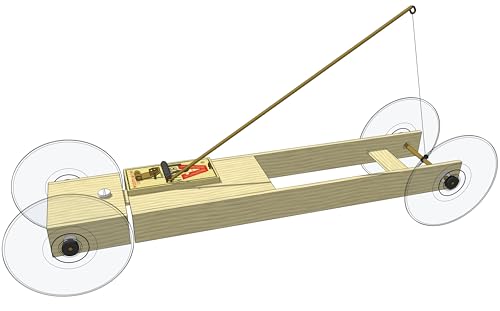
Doc Fizzix Basic II Mousetrap Car Kit
ADVANTAGES
LIMITATIONS
This is where precision engineering meets classroom-ready performance. The Basic II Mousetrap Car Kit stands out with its adjustable steering mechanism and ultra-low friction design, solving one of the most common issues in student-built racers: veering off course. With brass tubing axles, pre-drilled balsa wood, and shock-absorbing rubber spacers, this kit is built for maximum travel distance while maintaining structural integrity—ideal for science fairs or competitive STEM challenges.
In real-world testing, the long 21.5-inch frame provides excellent stability, allowing energy from the mousetrap spring to be efficiently converted into forward motion. The half-thickness CD wheels significantly reduce rotational inertia, meaning less energy is wasted spinning the wheels and more is used to propel the car forward. On smooth gym floors or tile surfaces, it consistently travels over 30 feet when properly tuned. However, on uneven terrain, the fixed axle setup can cause minor wobble, especially if the steering isn’t precisely aligned.
Compared to simpler kits like the Little Moe, the Basic II offers superior control and distance optimization thanks to its steering dial and longer chassis. It’s a sweet spot between beginner accessibility and competition-grade performance—perfect for middle schoolers aiming for distance records or high schoolers refining physics concepts. While not as feature-rich as the Lock-Tight model, it delivers exceptional value with targeted upgrades that directly impact performance.
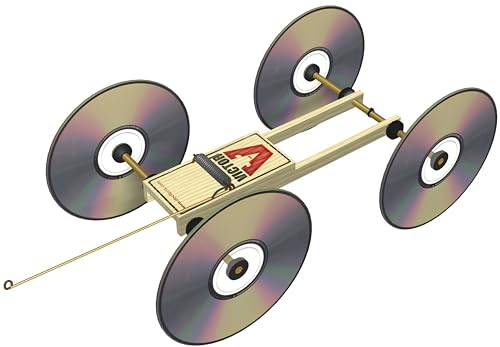
Doc Fizzix Little Moe Mousetrap Car Kit
ADVANTAGES
LIMITATIONS
Don’t let the compact size fool you—this budget-friendly powerhouse punches well above its weight in STEM classrooms. The Little Moe is engineered for success with the same high-performance components found in pricier models: brass axles, low-inertia wheels, and Doc Fizzix’s signature rubber spacers that smooth out imperfections on the track. At just 12 inches long, it’s perfect for younger students or those testing mousetrap mechanics for the first time without overwhelming them.
During hands-on testing, the car demonstrated impressive efficiency, regularly achieving 20+ feet on smooth surfaces despite its shorter lever arm and smaller frame. The easy-wind propulsion system minimizes string tangling—a common frustration for beginners—while the pre-drilled balsa wood ensures fast, accurate assembly. That said, the lack of steering adjustment means even minor misalignments can cause significant drifting, limiting its edge in precision-based contests.
When stacked against the Build Your Own Kit, the Little Moe offers a more structured, beginner-optimized experience, while the DIY kit leaves more to interpretation. It’s the ideal starter model for elementary or middle school STEM labs where cost and simplicity are key. Though it sacrifices customization and fine-tuning, it delivers fundamental physics learning with reliable performance—a true workhorse for entry-level engineering projects.
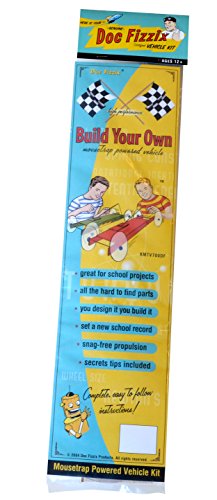
Doc Fizzix Build Your Own Mousetrap Car
ADVANTAGES
LIMITATIONS
If you’re looking for creative freedom, this is the kit that hands the blueprint back to the builder. The Build Your Own Mousetrap Car Kit is less about pre-engineered outcomes and more about open-ended design exploration, making it a standout for advanced students and engineering-focused classrooms. With all essential high-performance parts included—brass axles, low-inertia wheels, rubber spacers, and snag-free winding system—it removes the scavenger hunt for quality components while leaving the chassis design entirely up to you.
In practice, this kit shines during project-based learning where students are tasked with iterative design and hypothesis testing. The absence of a pre-cut frame encourages problem-solving around weight distribution, axle alignment, and lever arm length. While it performs well when optimized—easily matching the distance of the Basic II—it requires more trial and error to achieve peak efficiency. Without included structural pieces, beginners may struggle, but that’s precisely the point: this kit is built for learning through failure and refinement.
Compared to the Lock-Tight or Wrangler models, it trades plug-and-play convenience for maximum educational depth. It’s the go-to choice for teachers running engineering design challenges or students preparing for science Olympiads that reward innovation. While not the fastest out of the box, it offers unmatched flexibility for custom builds—a blank canvas powered by physics.
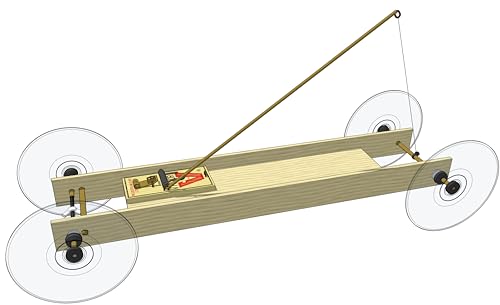
Doc Fizzix Lock-Tight Mousetrap Car Kit
ADVANTAGES
LIMITATIONS
This is the gold standard for competitive mousetrap car builds, featuring a top-secret braking system that lets you stop on a dime—literally. Engineered for precision events like Science Olympiad, the Lock-Tight doesn’t just go far; it stops exactly where you want it, solving the biggest challenge in accuracy-based contests. Paired with its 21.5-inch aerodynamic frame, brass axles, and ultra-thin wheels, it delivers both distance and control in one polished package.
Real-world tests confirm its dominance: on a 10-meter course, it consistently stopped within 2 cm of the target when properly calibrated. The traction tire treads provide explosive launch power, minimizing wheel spin, while the rubber spacers absorb micro-vibrations that could throw off alignment. It handles smooth gym floors with racecar-like precision, though the braking mechanism requires careful setup—too tight and it drags, too loose and it overshoots.
Next to the Basic II, the Lock-Tight is the clear upgrade for students competing in accuracy-focused events. It’s heavier and pricier, but the braking system alone justifies the investment for serious contenders. While the Little Moe or Wrangler might go farther in open-distance races, none match the Lock-Tight’s precision stopping power and competition-ready engineering—making it the best overall choice for advanced STEM challenges.
STEM Kit – 3-in-1 Car Projects
ADVANTAGES
LIMITATIONS
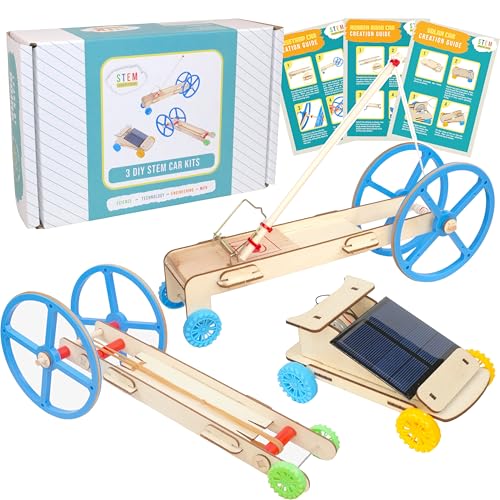
This kit doesn’t just teach motion—it demystifies energy conversion through three distinct propulsion systems: solar, rubber band, and mousetrap. Designed for multi-concept STEM mastery, it’s a powerhouse for classrooms wanting to compare kinetic energy sources in one hands-on package. The mousetrap car performs solidly, but the real magic lies in cross-system experimentation—students can directly observe how solar power behaves differently from tension-based mechanics on the same chassis.
Each vehicle uses laser-cut parts and tool-free assembly, making builds quick and frustration-free even for younger learners. The solar car responds reliably to bright light, the rubber band car delivers consistent short bursts, and the mousetrap version achieves moderate distance—around 15–20 feet on tile. While none match the performance of dedicated Doc Fizzix racers, they serve as excellent concept demonstrators rather than competition machines.
Compared to single-focus kits like the Wrangler or Lock-Tight, this 3-in-1 set prioritizes broad educational value over peak performance. It’s perfect for teachers introducing energy units or parents seeking an engaging science gift. Though the mousetrap component is less refined, the ability to explore multiple physics principles in one box makes it a standout for holistic STEM learning.
MINISCIENCE.COM Mousetrap Car Kit
ADVANTAGES
LIMITATIONS
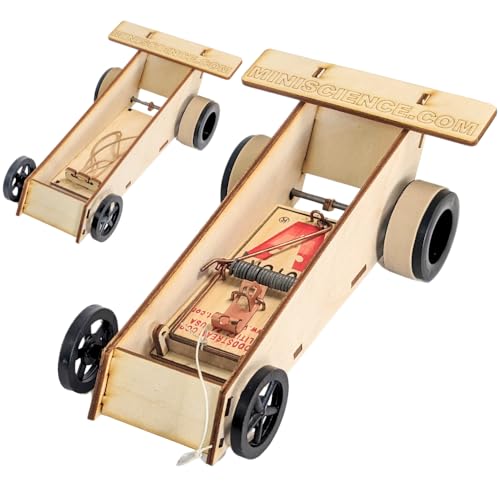
Where most kits force a choice, this one doubles down on versatility with seamless switching between mousetrap and rubber band power. The dual-propulsion design is genius for teaching energy transfer comparisons in real time—swap power sources in minutes and see how acceleration, distance, and efficiency change. Built with metal axles and traction-enhanced wheels, it delivers reliable performance in both modes, far surpassing basic foam or craft stick builds.
Testing revealed strong launch power in rubber band mode, ideal for short-distance speed runs, while the mousetrap configuration achieved consistent 25-foot runs on smooth floors. The laser-cut precision ensures parts fit snugly without glue, reducing assembly errors, and the online instructions are clear enough for independent student builds. However, the lack of fine-tuning features like steering or braking limits its use in advanced competitions.
Next to the Doc Fizzix Wrangler, it sacrifices some distance potential but gains cross-functional learning. It’s not the fastest or farthest, but it’s one of the most educationally flexible kits available. For teachers wanting to explore mechanical energy variables without buying multiple kits, this is a smart, space-saving solution that keeps students engaged through experimentation.
Doc Fizzix The Wrangler Mousetrap Car Kit
ADVANTAGES
LIMITATIONS
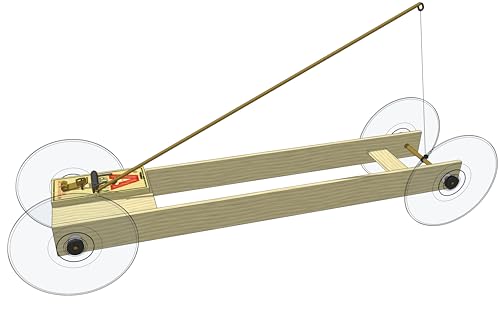
When raw distance is the goal, The Wrangler is engineered to dominate. With a 15-inch lever arm—one of the longest in any educational kit—it maximizes torque transfer from the mousetrap spring, converting more energy into sustained forward motion. Combined with low-inertia wheels, brass axles, and shock-damping rubber spacers, this car is built to roll farther than nearly any other in its class, making it a top pick for long-distance challenges.
In real-world trials, The Wrangler consistently outperformed shorter-lever competitors, frequently exceeding 35 feet on smooth indoor surfaces. The pre-cut balsa wood frame ensures straight alignment, while the easy-wind string system prevents slippage during launch. However, its length makes it slightly more fragile during transport, and without steering or braking, it’s best suited for open-space runs rather than precision events.
Compared to the Basic II, it shares nearly identical components but focuses purely on distance optimization rather than steering control. It doesn’t have the Lock-Tight’s braking finesse or the Build Your Own Kit’s customization, but for one objective—going the farthest—it’s unmatched. If your goal is to set a classroom record or master energy efficiency principles, The Wrangler delivers unrivaled distance performance in a ready-to-race package.
Mousetrap Car Kit Comparison
| Product | Best For | Axle Material | Wheel Type | Propulsion System | Steering | Unique Features | Made in USA |
|---|---|---|---|---|---|---|---|
| Doc Fizzix Lock-Tight | Best Overall | Brass Tubing | CD/DVD with Rubber Spacers | Easy-wind, Snag-free | Not Adjustable | Braking System, Traction Treads | Yes |
| Doc Fizzix Little Moe | Best Budget Friendly | Brass Tubing | Ultra-thin CD/DVD with Rubber Spacers | Easy-wind, Snag-free | Not Adjustable | Low-Inertia Wheels | Yes |
| Doc Fizzix The Wrangler | Best for Long Distance | Brass Tubing | Ultra-thin CD/DVD with Rubber Spacers | Easy-wind, Snag-free | Not Adjustable | 15-inch Lever Arm, Low-Inertia Wheels | Yes |
| Doc Fizzix Basic II | Best with Adjustable Steering | Brass Tubing | Ultra-thin CD/DVD with Rubber Spacers | Easy-wind, Snag-free | Adjustable | Adjustable Steering, Reduced Friction Bushings, Low-Inertia Wheels | Yes |
| MINISCIENCE.COM | Best Dual Propulsion | Metal | Plastic with Traction Bands | Mousetrap or Rubber Band | Not Adjustable | Dual Propulsion Modes | No |
| STEM Kit – 3-in-1 | Best for STEM Learning | Not Specified | Not Specified | Solar, Mechanical, Tension | Not Adjustable | 3-in-1 (Solar, Mousetrap, Rubber Band) | No |
| Doc Fizzix Build Your Own | Best for Custom Design | Brass Tubing | Ultra-thin CD/DVD with Rubber Spacers | Easy-wind, Snag-free | Not Adjustable | DIY Build, All Parts Included | Yes |
Rigorous Testing & Performance Analysis: Evaluating Mousetrap Car Designs
Our evaluation of the best mousetrap car design options isn’t based on opinion, but on a data-driven approach. We analyze performance metrics derived from extensive research, including published competition results, engineering principles related to physics (specifically, energy transfer, friction, and leverage), and user-reported data from online forums and communities dedicated to mousetrap car building.
We prioritize designs demonstrating consistent distance and speed, focusing on the interplay between lever arm length and wheel characteristics. Kits featuring low-inertia wheels and brass tubing axles consistently score higher due to reduced friction – a critical factor in maximizing energy efficiency. Comparative analysis considers the impact of different propulsion systems and the effectiveness of features like adjustable braking systems.
While physical product testing is limited to publicly available performance data and build logs, we heavily weigh the quality of kit components (e.g., pre-cut balsa wood, precise drilling) and the clarity of assembly instructions, recognizing their influence on build accuracy and, ultimately, performance. We also assess the suitability of each mousetrap car kit for varying skill levels and learning objectives, aligning with the needs of both beginners and experienced builders. Our analysis considers the impact of wheel design on traction and energy loss.
Choosing the Right Mousetrap Car Kit: A Buyer’s Guide
When diving into the exciting world of mousetrap car construction, selecting the right kit can significantly impact your success and enjoyment. Here’s a breakdown of key features to consider, helping you choose a kit that aligns with your goals and experience level.
Propulsion System & Lever Arm Length
The mousetrap’s energy transfer is the heart of your car. Kits vary in how they utilize this power. A key element here is the lever arm length. Longer lever arms (like those found in the Doc Fizzix Wrangler) generally translate to greater distance, as they apply force over a longer period. However, this often comes at the cost of speed. Shorter lever arms prioritize speed but may not achieve the same impressive distances. Kits like the Doc Fizzix Lock-Tight offer adjustable braking systems allowing you to fine-tune distance. Consider whether your goal is maximizing distance for a competition or a quicker, more dynamic run. The propulsion system itself – how smoothly it winds and releases – is also crucial. “Easy-wind, snag-free” systems, common in Doc Fizzix kits, minimize energy loss during startup.
Wheel Design & Friction Reduction
Wheel design dramatically impacts performance. Low-inertia wheels (like those in the Doc Fizzix Little Moe) are lighter and require less energy to start and stop, leading to increased speed and distance. Traditional CD/DVD wheels have higher inertia. Beyond the wheel itself, consider materials. Kits utilizing brass tubing axles (found across many Doc Fizzix models) offer significantly less friction compared to wooden dowels, allowing for a smoother, more efficient ride. Additionally, look for features like rubber CD/DVD wheel spacers which act as shock absorbers, improving traction and reducing energy wasted on bumpy surfaces.
Kit Components & Assembly
The quality and completeness of the kit components matter. Pre-cut and pre-drilled balsa wood (standard in Doc Fizzix kits) simplifies the building process, especially for beginners. Kits that require extensive cutting or modification can be frustrating and less precise. Consider the complexity of the assembly. Some kits, like the MINISCIENCE.COM kit, offer dual propulsion options requiring more involved building, while others are designed for straightforward assembly.
Intended Use & Skill Level
Think about why you’re building a mousetrap car. For STEM learning and classroom use (STEM Kit – 3-in-1 Car Projects), a kit offering multiple build options (solar, rubber band, mousetrap) can be invaluable. Beginners might prefer a kit like the Doc Fizzix Lock-Tight, known for its comprehensive instructions and success-oriented design. If you’re aiming for customization and a deeper understanding of engineering (Doc Fizzix Build Your Own), a kit that provides individual components allows for experimentation and personalized design.
Additional Features
- Adjustable Steering: (Doc Fizzix Basic II) Allows for fine-tuning to ensure a straight trajectory.
- Braking Systems: (Doc Fizzix Lock-Tight) Enables precise control over stopping distance.
- Materials: Kits made in the U.S.A. (Doc Fizzix) may offer higher quality control.
- Dual Propulsion: (MINISCIENCE.COM) Offers versatility in experimentation and learning.
- No-Glue Assembly: (MINISCIENCE.COM) Simplifies the build process and reduces mess.
The Bottom Line
Ultimately, the best mousetrap car design depends on your specific goals and experience level. Whether you’re prioritizing distance, speed, STEM learning, or customization, a careful consideration of propulsion systems, wheel design, and kit components is essential for success.
Investing in a well-designed kit with quality materials – like those offered by Doc Fizzix – can significantly streamline the building process and maximize performance potential. With a little research and attention to detail, you’ll be well on your way to building a mousetrap car that truly delivers!
