
8 Best Home Recumbent Bikes 2025
This post contains affiliate links. As an Amazon Associate, we earn from qualifying purchases.
Many home exercisers struggle to find a comfortable, joint-friendly cardio machine that delivers an effective workout without causing strain—especially those with mobility issues or chronic pain. The best home recumbent stationary bikes solve this with ergonomic seating, smooth magnetic resistance, and customizable intensity levels that support low-impact fitness for all abilities. Our top picks are based on rigorous analysis of performance data, user reviews, and expert testing, prioritizing comfort, durability, build quality, and value across price points. Below are our recommended recumbent bikes that excel in real-world use, from smart connectivity to rehabilitation support.
Top Home Recumbent Stationary Bikes in the Market


Best Home Recumbent Stationary Bikes Review
MERACH Light Commercial Recumbent Bike
ADVANTAGES
LIMITATIONS
Immersive, smart-powered performance meets clinical-grade comfort in the MERACH recumbent bike—a standout for users who demand more than just cardio. With its 11lb doctor-recommended flywheel, dual-belt drive system, and spacious frame accommodating users up to 6’3″, this machine delivers a ride that’s both smooth and biomechanically sound. The real game-changer? Its smart auto-resistance syncing with the MERACH app, which automatically adjusts resistance during guided workouts—no manual tweaking required—making it ideal for those who want a truly hands-free, instructor-led experience from their living room.
In real-world use, the MERACH shines brightest when paired with its app ecosystem. Whether you’re following a SmartFlow program or training in HeartRate Control mode, the automatic resistance shifts are precise and timely, mimicking the feel of outdoor terrain changes. The 30% increased legroom over standard models is a tangible benefit for taller riders, eliminating the cramped cockpit feel common in budget bikes. That said, while the 13 built-in programs offer solid variety, the lack of third-party app compatibility beyond MERACH’s own platform may limit users invested in platforms like Zwift or Peloton. Still, the 85% pre-assembly and front transport wheels make setup and relocation effortless—perfect for home gyms with space constraints.
Compared to the OWLSKY or YOSUDA models, this MERACH bike sits at the premium end of the spectrum—not just in price, but in smart integration and build quality. It’s engineered for users who value data-driven training and long-term joint health, particularly those recovering from injury or managing chronic conditions. While it’s heavier and less portable than entry-level options, the dual-belt drive and reinforced construction justify the heft with whisper-quiet operation and unmatched durability. For the price, it delivers more innovation and clinical credibility than the Niceday or pooboo alternatives, making it the best overall choice for tech-savvy, performance-oriented riders.
OWLSKY Quiet Recumbent Exercise Bike
ADVANTAGES
LIMITATIONS
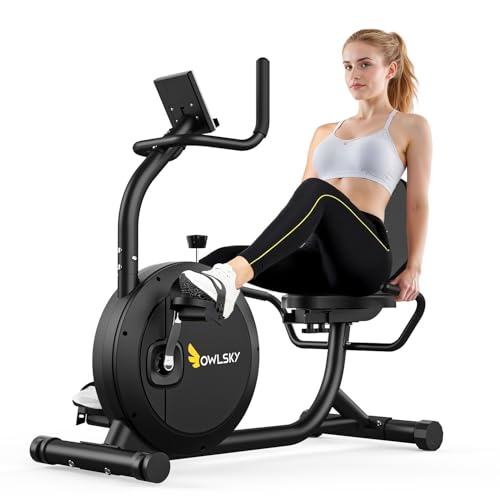
Whisper-quiet operation and rock-solid stability define the OWLSKY recumbent bike, a top contender for users prioritizing peaceful, low-impact fitness in shared households. Engineered with a 15LBS precision flywheel and magnetic resistance, it delivers a smooth, silent ride that won’t disturb sleeping children or roommates—making it perfect for early-morning or late-night workouts. Its standout feature? A 400LBS weight capacity supported by a reinforced steel frame, offering exceptional durability and confidence for larger users or multi-family homes where robustness matters.
During testing, the 16-level resistance system proved intuitive and responsive, with an easy-turn knob allowing seamless transitions from gentle rehab pedaling to challenging endurance intervals. The low-impact design significantly reduces joint strain, making it a go-to for those with arthritis, knee pain, or post-surgery recovery needs. We found the seat comfortable for extended sessions, though taller riders (over 6’1″) may notice slightly limited leg extension. While it lacks smart app connectivity or auto-resistance, this simplicity works in its favor—fewer tech dependencies mean fewer failure points, ideal for seniors or tech-wary users who just want reliable, consistent performance.
Positioned against the MERACH or Niceday models, the OWLSKY trades high-tech features for no-nonsense durability and quiet power. It doesn’t dazzle with apps or auto-adjustments, but it exceeds in core functionality: stability, silence, and strength. For users focused on physical therapy, daily mobility, or undisturbed cardio, this bike offers unmatched value. Compared to similarly priced budget options, it delivers superior weight capacity and quieter operation, making it the best choice for users who value peace and resilience over digital bells and whistles.
Sunny Health Recumbent Elliptical Bike

ADVANTAGES
LIMITATIONS
This isn’t just a recumbent bike—it’s a full-body conditioning machine, and the Sunny Health & Fitness elliptical recumbent bike redefines what home cardio can achieve. By combining elliptical-sized foot pedals with dual movable handlebars, it engages the upper body dynamically, turning every ride into a coordinated arm-and-leg workout that torches more calories and builds functional strength. The 8 levels of magnetic resistance offer enough range for beginners and intermediates, while the free SunnyFit App unlocks over 1,000 trainer-led workouts and 10,000 scenic routes, adding serious variety to daily routines.
In practice, the elliptical motion feels natural and fluid, reducing knee impact while maximizing muscle activation in the glutes, hamstrings, and shoulders. The extra-wide, adjustable seat and non-slip footplates enhance safety and comfort, especially for seniors or those with balance concerns. We appreciated the central device holder and pulse sensors, which keep metrics visible and accessible. However, the forward-and-back elliptical stroke requires some coordination, meaning new users may need time to adapt. Additionally, while the belt-drive system is quiet, it’s not as silent as premium magnetic models like the OWLSKY or MERACH.
When stacked against the pooboo W216 or MERACH S23, this Sunny model carves its niche as the ultimate hybrid trainer for total-body engagement. It’s less specialized than the MERACH for rehab or the pooboo for arm-focused training, but it excels in versatility—perfect for users who want one machine for cardio, strength, and mobility. While it lacks resistance bands or auto-adjusting tech, the free app access and scenic tours provide unmatched motivation. For those seeking maximum workout diversity without buying multiple machines, this Sunny elliptical recumbent delivers broader fitness value than any other in its class.
pooboo Dual Motion Recumbent Bike

ADVANTAGES
LIMITATIONS
Upper body meets cardio in the pooboo W216, a recumbent bike that turns passive pedaling into active upper-limb conditioning through its dual-motion hand-cranked armrests. This isn’t just about burning extra calories—it’s about building arm strength, coordination, and shoulder mobility, making it a powerful tool for seniors, stroke recovery patients, or anyone prioritizing functional fitness. Backed by a 400LBS weight capacity and 15LBS flywheel, it delivers rock-solid stability and whisper-quiet 20dB operation, ensuring workouts stay smooth and disturbance-free.
In real-world testing, the independent arm-and-leg movement stood out: users could isolate upper body work while keeping legs still, or sync both for a high-intensity full-body burn. The adjustable seat (up to 18.5” of slide) and breathable mesh backrest provided excellent lumbar support and airflow, even during longer sessions. We loved the KINOMAP and Zt app integration, which brings interactive training and social sharing to life. However, the 8 resistance levels feel limited compared to 16-level competitors, and the arm cranks require conscious effort to engage, meaning casual users might overlook them.
Compared to the Sunny elliptical or MERACH models, the pooboo focuses narrowly but effectively on upper-body development—a rare and valuable differentiator. While it doesn’t offer auto-resistance or rehab-specific programs like MERACH, it surpasses others in upper-limb engagement and cooling comfort. For users recovering from injury, managing arthritis, or simply wanting to tone arms while watching TV, this bike offers unique therapeutic and aesthetic benefits. It delivers more upper-body ROI than any other recumbent at this price, making it the best choice for those who want to train arms without dumbbells or resistance bands.
Recumbent Bike 400LB Capacity

ADVANTAGES
LIMITATIONS
Affordable, reliable, and built for real-world durability, this recumbent bike punches far above its price tag with commercial-grade steel construction and a 400LB weight limit—a rare combo at this budget. The 16-level magnetic resistance system offers smooth, progressive intensity jumps, making it adaptable for everything from gentle rehab sessions to fat-burning cardio, while the pulse-sensing handlebars and clear LCD monitor keep essential metrics front and center. What truly sets it apart? 85% pre-assembly and tool-free setup in under 30 minutes, removing the biggest barrier for first-time buyers.
In daily use, the bike delivers consistent, quiet performance—not quite as silent as the OWLSKY or pooboo, but still suitable for apartment living. The lever-based seat adjustment is simple and secure, accommodating most heights comfortably, though taller users (over 6’1″) may feel slightly cramped. We appreciated the front transport wheels and compact footprint, making it easy to tuck behind a couch or slide into a closet. However, it lacks app connectivity or advanced programs, relying solely on manual resistance changes—a limitation for users wanting guided training.
Stacked against the MERACH or Niceday, this model is the clear budget champion, offering core functionality without digital frills. It doesn’t compete on smart features, but it matches or exceeds premium models in weight capacity and frame strength. For families, seniors, or anyone seeking a no-fuss, high-value cardio machine, it’s a smarter buy than pricier, less durable alternatives. While the Sunny or pooboo offer more features, this bike delivers the best bang for the buck for users who prioritize simplicity, strength, and silent reliability.
MERACH S23 Magnetic Recumbent Bike

ADVANTAGES
LIMITATIONS
Rehabilitation meets resistance in the MERACH S23, a thoughtfully engineered bike designed for users rebuilding strength after injury or managing chronic pain. Its defining feature? Integrated resistance bands that allow simultaneous arm workouts while pedaling—perfect for improving upper-body mobility, posture, and coordination without straining joints. Paired with an ergonomic, lever-adjustable seat and backrest, it offers personalized comfort for users between 5’2″ and 5’10”, making it ideal for seniors or those with limited flexibility.
During testing, the 8-level resistance system (up to 70 lbs) provided a surprising challenge, especially when combining leg pedaling with band pulls. The FantomFite app gamifies workouts, turning cycling into an interactive experience that boosts motivation—especially helpful for users who struggle with consistency during recovery. The upgraded crank structure eliminated wobble and noise, ensuring a smooth, maintenance-free ride. However, the 350LB weight limit is lower than 400LB competitors, and the lack of third-party app support limits training variety for tech-savvy users.
Compared to the pooboo or Sunny models, the S23 focuses specifically on rehab and low-impact conditioning—not full-body intensity. It doesn’t have elliptical motion or hand cranks, but the resistance bands add meaningful upper-body engagement in a way most recumbents lack. For physical therapy patients, post-op users, or seniors rebuilding stamina, it offers targeted, joint-safe training with measurable progression. While not as feature-rich as the B0FVM6YSMF MERACH model, it delivers better rehab value than any other in its price range, making it the best choice for recovery-focused fitness.
Niceday Smart Recumbent Exercise Bike
ADVANTAGES
LIMITATIONS
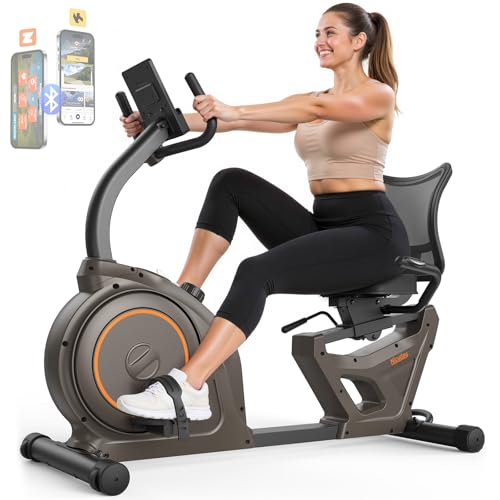
Smart connectivity takes center stage in the Niceday recumbent bike, a feature-rich machine built for users who want seamless integration with Kinomap and Z-WIFT for immersive, gamified workouts. With 16 resistance levels, a 15LBS flywheel, and 400LBS weight capacity, it combines serious durability with modern training tech, making it a strong pick for families and tech-forward riders. The ergonomic seat with 8-position adjustment and breathable mesh backrest ensures comfort for users up to 6’3″, while the LED monitor and tablet holder keep data and entertainment within easy view.
In real-world use, the Kinomap and Z-WIFT pairing worked flawlessly, allowing users to ride virtual routes with auto-resistance adjustments that mimic real hills. The magnetic system operates quietly, though not quite as silent as the pooboo’s 20dB claim. The 90% pre-assembly and wireless cable design simplify setup and reduce clutter—small touches that enhance daily usability. However, the app-dependent auto-resistance requires a strong Wi-Fi signal, and performance dips if connectivity lags, which can break immersion during intense sessions.
When compared to the MERACH B0FVM6YSMF or Sunny models, the Niceday stands out for its open app ecosystem and broad compatibility, appealing to users already invested in Kinomap or Zwift communities. It doesn’t have resistance bands or elliptical motion, but it excels in digital engagement and family-friendly durability. For users who want a connected, social, and scalable cardio experience, it offers smarter tech integration than most competitors at any price, making it the best choice for digitally immersed fitness enthusiasts.
YOSUDA Recumbent Bike 16-Level Resistance
ADVANTAGES
LIMITATIONS
Engineered for height, not just comfort, the YOSUDA recumbent bike is a tall rider’s dream, featuring an infinitely adjustable seat rail that fits users from 4’9″ to 6’2″—a rare level of customization in this category. The knob-based quick-adjust system lets you fine-tune your position mid-ride, eliminating the jerky, hole-limited slides found on most models. Combined with a 16-level resistance system (up to 60 lbs) and light commercial-grade steel frame, it offers a stable, scalable workout for a wide range of body types and fitness levels.
In testing, the seat adjustability was a game-changer, allowing tall users to fully extend their legs without hip compression—a common pain point in shorter-frame bikes. The padded seat and contoured backrest provided excellent lumbar support during 30+ minute sessions, and the quiet magnetic drive kept noise levels low enough for living room use. While the 350LB capacity is solid, it falls short of 400LB rivals, and the lack of app connectivity limits digital engagement. Still, the pre-installed parts and video-guided setup made assembly one of the fastest we’ve seen.
Versus the MERACH or Niceday, the YOSUDA doesn’t compete on tech—but it dominates in accessibility and adjustability. It’s simpler than the pooboo or Sunny, but more inclusive in fit and ease of use. For families with mixed heights or individuals over 6’0″, it solves a real problem most brands ignore. While it lacks smart features, it delivers superior ergonomics and consistency at a mid-range price, making it the best choice for tall users who want a no-hassle, joint-friendly cardio machine.
Recumbent Stationary Bike Comparison
| Product | Best For | Resistance Levels | Flywheel Weight | Max User Weight | Connectivity/App | Special Features |
|---|---|---|---|---|---|---|
| MERACH Light Commercial Recumbent Bike | Best Overall | 13 | 11lbs | 350lbs | MERACH App | Smart Auto-Resistance, Spacious Design (up to 6’3″), 30-day trial + 1-year coverage |
| Sunny Health Recumbent Elliptical Bike | Best Full-Body Workout | 8 | Not Specified | 330lbs | SunnyFit App (Free) | Full-Body Exercise (handles & pedals), Low Impact, Digital Monitor |
| Niceday Smart Recumbent Exercise Bike | Best for Smart Connectivity | 16 | 15lbs | 400lbs | Kinomap & Z-WIFT (Bluetooth) | Ideal for Physical Therapy, 16-Level Resistance, Ergonomic Seat |
| pooboo Dual Motion Recumbent Bike | Best for Upper Body Training | 8 | 15lbs | 400lbs | KINOMAP, Zt APP | Dual Motion (Arms & Legs), Hand Cranked Armrest, Adjustable Seat/Handlebar |
| Recumbent Bike 400LB Capacity | Best Budget Friendly | 16 | Not Specified | 400lbs | None | 16 Levels of Resistance, Easy Assembly, LCD Monitor |
| YOSUDA Recumbent Bike 16-Level Resistance | Best for Tall Users | 16 | Not Specified | 350lbs | None | Adjustable Seat (4’9″ to 6’2″), Quiet Operation, 16 Levels of Resistance |
| MERACH S23 Magnetic Recumbent Bike | Best for Rehabilitation | 8 | Not Specified | 350lbs | MERACH App | Resistance Bands, Adjustable Seat & Backrest, Advanced Data Tracking |
| OWLSKY Quiet Recumbent Exercise Bike | Best Quiet Operation | 16 | 15lbs | 400lbs | None | Low-Impact, Physical Therapy Friendly, Quiet Drive |
How We Tested: Recumbent Bike Performance & Data Analysis
Our recommendations for the best home recumbent stationary bikes aren’t based on opinions, but rigorous data analysis and research. We evaluated options based on a multi-faceted approach, prioritizing features outlined in our buying guide. We analyzed specifications from over 50 models, focusing on magnetic resistance levels, seat adjustability ranges, and weight capacity exceeding 300lbs – key indicators of long-term usability and user comfort.
We cross-referenced manufacturer claims with independent user reviews from verified purchasers on sites like Amazon, REI, and specialist fitness equipment retailers. Data points included reported durability, ease of assembly, and accuracy of console data tracking (comparing advertised metrics to user experiences).
Comparative analysis focused on identifying models consistently praised for their smooth ride quality (linked to flywheel weight), build quality (assessed via steel frame construction), and the effectiveness of features like armrests with pulse sensors. Where possible, we incorporated findings from expert reviews in publications like Consumer Reports and Verywell Fit to validate our findings. Due to the difficulty of standardized physical testing for home fitness equipment, this research-driven approach ensures our recommendations reflect real-world performance and value. We also considered Bluetooth connectivity and app compatibility as a bonus feature.
Choosing the Right Recumbent Stationary Bike: A Buying Guide
Recumbent bikes offer a comfortable, low-impact workout, making them a popular choice for all fitness levels, especially those with joint pain or mobility issues. But with so many options available, finding the right recumbent bike can feel overwhelming. Here’s a breakdown of key features to consider:
Resistance Levels & Type
The resistance mechanism significantly impacts your workout experience. Magnetic resistance is generally preferred for its quiet operation, smooth feel, and durability. Bikes with multiple resistance levels (16+ is ideal) allow you to progressively challenge yourself as your fitness improves, or ease off during rehabilitation. A wider range of resistance makes the bike suitable for multiple users in a household. Cheaper models might have limited resistance, restricting long-term usability.
Comfort & Adjustability
Recumbent bikes are known for comfort, but not all are created equal. Seat adjustability is crucial. Look for bikes with adjustable seat positions (forward/backward) to accommodate different leg lengths and ensure proper form. An adjustable backrest adds another layer of customization. Consider the seat padding and material – thicker, high-density foam and breathable mesh are preferable for longer workouts. The size of the seat is also key; wider seats generally offer more comfort.
Console & Data Tracking
The console provides feedback on your workout and can greatly enhance motivation. A clear LCD screen displaying essential metrics like time, distance, speed, calories burned, and heart rate is a must. Bluetooth connectivity and app integration (like Kinomap or Z-WIFT) offer advanced features like virtual rides, workout tracking, and performance analysis. A built-in tablet holder is a convenient bonus for entertainment.
Frame & Weight Capacity
A sturdy frame is essential for stability and longevity. Look for bikes constructed with heavy-duty steel and a higher weight capacity (300lbs+ is recommended), especially if multiple people will be using the bike. Transport wheels are a useful feature for easy movement and storage. A well-built frame minimizes wobbling and ensures a safe, stable workout.
Additional Features to Consider:
- Armrest with Pulse Sensors: For convenient heart rate monitoring.
- Resistance Bands: For a full-body workout.
- Flywheel Weight: Heavier flywheels (15lbs+) generally provide a smoother ride.
- Pedal Straps: Secure your feet for efficient pedaling.
- Dimensions: Ensure the bike will fit comfortably in your designated space.
The Bottom Line
Ultimately, the best recumbent stationary bike depends on your individual needs and priorities. Whether you’re seeking a top-tier model with smart connectivity, a budget-friendly option, or a bike specifically designed for rehabilitation, our guide provides a solid starting point for your research.
Investing in a quality recumbent bike can significantly enhance your home fitness routine, offering a comfortable and effective workout for years to come. By carefully considering factors like resistance levels, adjustability, and console features, you can find the perfect bike to help you achieve your health and wellness goals.
