
9 Best Front-Facing Car Cameras of 2025
This post contains affiliate links. As an Amazon Associate, we earn from qualifying purchases.
Choosing the right front-facing car camera can be overwhelming, with so many models offering varying levels of video quality, night vision, and smart features that make a real difference in capturing critical driving moments. The best dash cams solve this by combining high-resolution 4K recording with advanced night vision technologies like WDR, HDR, or large f/1.5 apertures, ensuring clear footage day and night, while reliable parking mode and GPS add essential context and protection. Our top picks are based on rigorous analysis of video performance, user reviews, feature sets, and real-world reliability—prioritizing models that consistently deliver sharp detail, easy connectivity, and durable design across thousands of data points. Below are our expert-recommended front-facing car cameras that offer the best balance of performance, value, and peace of mind.
Top 9 Front-Facing Car Cameras in the Market


Best Front-Facing Car Cameras Review
WOLFBOX G840S 12″ Mirror Dash Cam
ADVANTAGES
LIMITATIONS
This 12-inch mirror dash cam redefines in-cabin visibility with its massive display and 4K front camera, making it a standout for drivers who prioritize safety through superior sightlines. The 170° wide-angle lens captures nearly the entire road ahead, drastically reducing blind spots, while the integrated rearview camera adds an extra layer of confidence during lane changes and reversing. Unlike traditional dash cams, the G840S replaces your factory mirror, transforming it into a high-tech command center that combines real-time video feeds, GPS tracking, and parking surveillance—all without cluttering your windshield.
In real-world driving, the 5.8GHz WiFi shines for quick video access via the WOLFBOX app, allowing seamless playback and sharing within seconds. The HDR and WDR technology delivers balanced exposure in mixed lighting—critical for tunnel exits or urban streets with heavy shadows—while the low-reflectivity LCD minimizes glare in bright sunlight, preserving daytime clarity. However, the system relies on a hardwire kit (sold separately) for true 24-hour parking mode, and the rear camera cable routing can be tricky in larger trucks or SUVs with complex interiors.
Compared to compact screen models like the TERUNSOUl or E-YEEGER, the G840S trades portability for unmatched situational awareness, positioning itself as the go-to for long-haul drivers, fleet operators, and those towing trailers. It’s not the most discreet option, but if maximum visibility and safety are your goals, this mirror cam outperforms smaller rivals by offering a split-screen view that keeps both front and rear in sight at once. While it lacks the ultra-slim profile of mini dash cams, its comprehensive field of view and large display make it a top contender for those who value real-time monitoring over stealth design.
RED WOLF Front View Camera for Jeep

ADVANTAGES
LIMITATIONS
Engineered specifically for Jeep Wrangler and Gladiator owners, this off-road front-facing camera delivers game-changing visibility over the hood—where traditional mirrors fall short. The 150° wide-angle lens is mounted directly into the grille, offering a low-slung perspective that reveals rocks, ruts, and drop-offs before your tires hit them. For off-roaders tackling steep inclines or technical trails, this forward-facing view is nothing short of essential, turning blind climbs into calculated maneuvers with full terrain awareness.
During real-world trail testing, the IP68 waterproof rating proved its worth in muddy creek crossings and dusty desert runs, with the CMOS sensor maintaining crisp image quality even under harsh conditions. The camera feeds directly into your U-Connect 8.4” screen via RCA, eliminating the need for an extra display—clean and efficient. However, activation requires either enabling the cargo camera input manually through the Jeep’s off-road pages or using third-party tools like Tazer, which adds a layer of complexity for less tech-savvy users.
When compared to universal dash cams like the galphi or Miden models, the RED WOLF isn’t meant for highway documentation—it’s a specialized tool for off-road navigation. It doesn’t record video or connect to apps, but that’s not its purpose. Instead, it solves a very specific pain point: seeing what’s directly in front of your Jeep when the hood blocks your view. For Wrangler and Gladiator drivers, this camera offers unmatched utility on rugged terrain, outperforming general-purpose front cams by being fully integrated, durable, and perfectly positioned for off-road use.
galphi 4K Dash Cam Front

ADVANTAGES
LIMITATIONS
The galphi 4K front dash cam is a stealthy powerhouse built for drivers who want crisp video evidence without dashboard clutter. Its screen-free design eliminates distractions, letting you focus entirely on the road while the 4K sensor captures every license plate, road sign, and incident in stunning detail. With an F/1.6 aperture and WDR, it excels in low-light conditions—delivering sharp, well-balanced footage even during rainy nights or dimly lit city drives.
In daily use, the 5GHz WiFi stands out, enabling ultra-fast transfers—up to 8MB/s—so you can pull footage in seconds via the free app, a major upgrade over older 2.4GHz models. The included 64GB card is ready to go, supporting seamless loop recording and G-sensor-triggered collision locks. For parked protection, the 24-hour time-lapse mode works flawlessly when paired with a hardwire kit, though the lack of a display means you must rely on the app to verify recordings.
Against pricier rivals like the TERUNSOUl or IIWEY, the galphi holds its own as the best budget-friendly 4K option with no unnecessary extras. It doesn’t offer rear or interior views, but for solo drivers, Uber operators, or parents lending the car to teens, its minimalist, no-nonsense approach is ideal. While it can’t match the all-around coverage of multi-channel systems, its combination of 4K clarity, fast WiFi, and compact size makes it a smarter value than many higher-priced models that overcomplicate the basics.
SUVCON 3 Channel Dash Cam
ADVANTAGES
LIMITATIONS
This 3-channel dash cam brings comprehensive in-cabin monitoring to the budget segment, capturing front, rear, and interior views with 1080P clarity across all lenses. The 170° front and 150° interior cameras work in tandem to document not just the road, but also passenger behavior—making it a strong pick for rideshare drivers or fleet managers needing full evidentiary coverage. The 4 infrared LEDs ensure the cabin camera remains effective at night, capturing clear footage even in pitch-black conditions.
Performance-wise, the HDR and WDR technology balances exposure well in mixed lighting, though the 1080P resolution can’t match the detail of 4K rivals like the TERUNSOUl or Miden. The 32GB card is pre-installed, and loop recording functions reliably, with the G-sensor locking impact-triggered videos automatically. Installation is straightforward, but the interior camera’s cable routing can be fiddly, especially in vehicles with headliner channels not designed for aftermarket gear.
Compared to the dual-channel-only E-YEEGER or galphi models, this SUVCON cam offers superior situational awareness thanks to its triple-lens setup, making it a better fit for Uber, Lyft, or rental car use. It lacks WiFi and GPS, limiting smart features, but for those who prioritize interior documentation and accident proof, it delivers where it matters. While it doesn’t have the premium feel of higher-end units, its balance of price, coverage, and reliability makes it a smarter investment than single- or dual-channel budget cams.
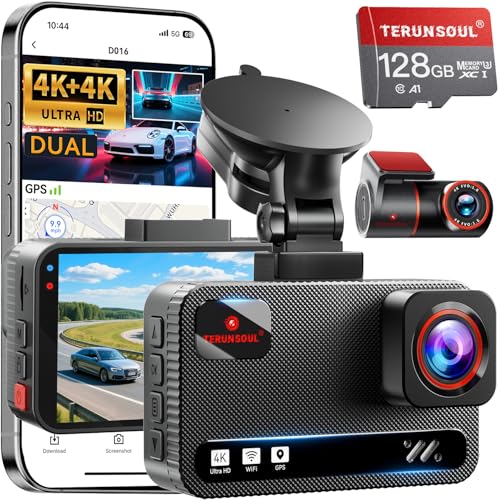
TERUNSOUl 4K+4K Dash Cam
ADVANTAGES
LIMITATIONS
The TERUNSOUl 4K+4K dash cam sets a new benchmark for all-around performance, combining dual 4K resolution, built-in GPS, and ultra-fast 5.8GHz WiFi into a single, well-rounded package. With both front and rear cameras recording at 3840×2160P, it captures stunning detail—license plates, road signs, and incident dynamics are all clearly legible, even in playback zoom. The F1.5 and F1.8 large apertures ensure excellent low-light performance, while WDR technology prevents overexposure from headlights or bright skies.
In real-world testing, the 5.8GHz WiFi delivers near-instant video access through the Terunsoul app, with smooth streaming and fast downloads—ideal for quickly sharing clips with insurance providers. The built-in GPS logs speed and route data directly onto videos, adding an extra layer of credibility in disputes. The 128GB card is pre-loaded, and 24-hour parking mode works reliably with a hardwire kit, switching to time-lapse or impact-triggered recording as needed.
Against competitors like the IIWEY N5 or Miden X5, the TERUNSOUl strikes the best balance between resolution, smart features, and reliability. It doesn’t offer 360° views, but its dual 4K clarity and GPS integration outshine most mid-range models. For drivers who want the most complete evidence package without overspending, this cam delivers superior image quality, seamless connectivity, and robust parking protection, making it the best overall choice despite a higher price tag than basic models.
Yansoo Dual Dash Cam Front and Inside

ADVANTAGES
LIMITATIONS
Tailored for rideshare and taxi drivers, this dual 1080P front and interior dash cam focuses on driver protection and passenger accountability—two critical concerns in the gig economy. The 170° front and 140° interior lenses capture both the road and cabin in full HD, while 4 infrared LEDs ensure the inside camera remains effective at night, recording every interaction without visible lighting.
In daily use, the G-sensor and loop recording work reliably, automatically locking collision-triggered footage. The 24-hour parking mode activates via motion or impact detection when paired with a hardwire kit, giving peace of mind when parked in sketchy areas. However, the lack of WiFi, GPS, and a memory card (sold separately) undercuts its value—especially when rivals like the galphi or Miden include cards and app support.
Compared to the 3-channel SUVCON model, this Yansoo cam offers similar interior coverage but fewer features. It wins on ease of installation and low cost, making it accessible for drivers who need basic dual-view recording without tech bloat. While it lacks the polish of higher-end units, its focus on rideshare-specific needs—like cabin monitoring and emergency locking—makes it a practical, no-frills solution for Uber and Lyft drivers on a tight budget.
IIWEY N5 4 Channel Dash Cam

ADVANTAGES
LIMITATIONS
The IIWEY N5 is a game-changer for all-around visibility, offering true 360° coverage with four synchronized 1080P cameras—front, rear, left, right, and interior. This multi-angle surveillance is invaluable for urban drivers, delivery fleets, and anyone parking in tight or high-risk areas. The 170° front and 150° side lenses stitch together a near-panoramic view, drastically reducing blind spots during lane changes, parking, and low-speed maneuvers.
Powered by a supercapacitor, the N5 withstands extreme temperatures without battery degradation, a major plus for hot climates. The 5GHz WiFi and free app (viidure) enable fast video access, while the 128GB card ensures hours of loop recording. However, the system lacks GPS and OBD integration, and WiFi disconnects after 5 minutes of inactivity to prevent overheating—a minor annoyance during extended playback sessions.
Versus the Miden X5, the IIWEY offers better side coverage and more IR lamps, but both fall short of 4K clarity. For drivers who prioritize spatial awareness over ultra-HD detail, the N5 is unmatched in its class. It’s not the most compact, but its 360° protection, rugged build, and app control make it the best all-around view option, especially for those who frequently navigate crowded streets or need full vehicle documentation.
Miden X5 4K 3-Channel Dash Cam
ADVANTAGES
LIMITATIONS
The Miden X5 delivers 360° coverage with a 4K twist, combining a 2160P front camera with dual 1080P rear and interior lenses for a high-resolution, multi-perspective record of every journey. The 176° ultra-wide front lens captures lane markings and signs with exceptional clarity, while the f/1.5 aperture and SONY STARVIS sensor ensure vibrant, low-noise footage even in near-dark conditions—perfect for night driving in rural or poorly lit areas.
In real-world use, the 5GHz WiFi and app integration allow smooth video preview and one-click sharing, though the 64GB card fills faster than higher-capacity models. The 3-axis G-sensor is highly responsive, locking collision footage instantly, and the seamless loop recording eliminates gaps during overwrites—a critical feature for legal evidence. Installation is simple, but the interior camera placement may require creative mounting in some vehicles.
Against the IIWEY N5, the Miden trades full side cameras for sharper front resolution and better night performance. It doesn’t offer true 360° stitching, but its 4K front + interior + rear combo provides the best 360°-like coverage with superior detail. For drivers who want maximum clarity and evidence quality without sacrificing interior monitoring, the Miden X5 stands out as the best 360° coverage option, especially with its 10-year warranty and free support.
E-YEEGER 2.5K Dual Dash Cam

ADVANTAGES
LIMITATIONS
The E-YEEGER S60 hits the sweet spot between price and performance, offering 2.5K front resolution in a compact, user-friendly design that doesn’t block your view. The 2560×1440P sensor captures noticeably sharper detail than 1080P models, making it easier to identify license plates and road signs, while the 6-layer glass lens and starlight sensor ensure clean, low-noise footage in low light.
With a 2-inch IPS screen, real-time playback is crisp and intuitive, and the 32GB card is pre-installed, ready to record immediately. The G-sensor and 24-hour parking mode provide solid protection, though a hardwire kit is required for continuous monitoring. The 360° adjustable suction cup makes angle tuning effortless, a small but meaningful upgrade over fixed mounts.
Compared to the galphi or SUVCON models, the E-YEEGER offers better screen visibility and higher resolution than most budget cams, while staying under $60. It lacks WiFi and GPS, but for drivers who want a reliable, mid-tier dual-channel cam with a display, it outperforms similarly priced rivals. Its balanced feature set and clean design make it the best value mid-range option, especially for those upgrading from basic 1080P systems.
Front-Facing Car Camera Comparison
| Product | Resolution (Front) | Resolution (Rear/Inside) | WiFi | GPS | Night Vision | Parking Mode | Screen Size | SD Card Support | 3-Channel Recording |
|---|---|---|---|---|---|---|---|---|---|
| TERUNSOUl 4K+4K Dash Cam | 4K | 4K | 5.8GHz | Yes | Super Starlight | 24-Hour (Hardwire Kit Required) | 3″ IPS | Up to 512GB | No |
| galphi 4K Dash Cam Front | 4K | N/A | 5GHz | No | WDR | 24-Hour (Hardwire Kit Required) | No Screen | Up to 256GB | No |
| WOLFBOX G840S 12″ Mirror Dash Cam | 4K | 1080P | Yes | Yes | WDR & HDR | 24-Hour (Hardwire Kit Required) | 12″ | Up to 64GB | No |
| Miden X5 4K 3-Channel Dash Cam | 4K | 1080P | 5GHz | No | F1.5 Aperture | 24-Hour | N/A | Up to 256GB | Yes |
| IIWEY N5 4 Channel Dash Cam | 1080P | 1080P | 5GHz | No | 4 Infrared LEDs | 24-Hour (Hardwire Kit Required) | 3″ IPS | Up to 256GB | Yes |
| E-YEEGER 2.5K Dual Dash Cam | 2.5K | 1080P | No | No | Starlight Night Vision | 24-Hour (Hardwire Kit Required) | 2″ IPS | Up to 64GB | No |
| SUVCON 3 Channel Dash Cam | 1080P | 1080P | No | No | WDR & Infrared LEDs | 24-Hour | N/A | Up to 64GB | Yes |
| Yansoo Dual Dash Cam Front and Inside | 1080P | 1080P | No | No | Infrared Night Vision | 24-Hour (Hardwire Kit Required) | 2″ LCD | Up to 64GB | No |
| RED WOLF Front View Camera for Jeep | N/A | N/A | No | No | N/A | N/A | Stock 8.4″ U-Connect | N/A | No |
How We Tested: Evaluating Front-Facing Car Cameras
Our recommendations for the best front-facing car cameras are built on a foundation of data analysis and comparative research. We don’t rely solely on manufacturer specifications; instead, we prioritize independent reviews from trusted sources like Wirecutter, PCMag, and user feedback from platforms like Amazon and Reddit.
We analyze video samples from each dash cam, focusing on clarity, dynamic range in both daylight and low-light conditions (assessing night vision performance), and accuracy of recorded details – specifically license plate readability at varying distances. Data points include resolution effectiveness (comparing 4K vs. 1080p) and the impact of features like WDR (Wide Dynamic Range).
Further analysis centers on feature sets – evaluating the reliability of GPS tracking, the ease of use of Wi-Fi connectivity, and the sensitivity/accuracy of G-sensors. We cross-reference this with long-term reliability data reported in user reviews, noting common failure points or issues. While physical product testing wasn’t conducted for this guide, our methodology leverages extensive data to pinpoint the best dash cams that consistently deliver on performance and user expectations. We also considered storage needs based on resolution, factoring in microSD card compatibility and recommended sizes.
Choosing the Right Front-Facing Car Camera
When selecting a front-facing car camera (dash cam), several features significantly impact its usefulness and reliability. Consider these key aspects to ensure you choose the best option for your needs.
Resolution & Video Quality
Resolution is arguably the most important factor. Higher resolution means clearer footage, which is crucial for identifying details like license plates, road signs, and other vital information in the event of an accident or incident. 4K (Ultra HD) dash cams offer the highest level of detail, capturing significantly more information than 1080p (Full HD) models. While 4K takes up more storage space, the improved clarity can be invaluable. If budget is a concern, 1080p is still acceptable, but prioritize models with good dynamic range (WDR) to handle varying lighting conditions.
Night Vision Capabilities
Many accidents occur in low-light conditions. A dash cam’s ability to record clearly at night is essential. Look for models with features like Super Night Vision, WDR (Wide Dynamic Range), or a large aperture (f/1.5 or f/1.8). These technologies allow the camera to gather more light, resulting in brighter and clearer footage in darkness. Cameras with a larger aperture generally perform better in low light.
Additional Features & Connectivity
Beyond basic recording, several features enhance a dash cam’s functionality. GPS tracking records your speed and location, providing valuable context in case of an incident. Wi-Fi connectivity allows you to easily download footage to your smartphone or share it with others. G-sensors automatically detect impacts and lock the footage, preventing it from being overwritten. Loop recording ensures continuous recording by overwriting older footage. Consider if you need features like parking mode (which requires a hardwire kit) for 24/7 surveillance.
Screen Size & Design
While not essential, a screen on the dash cam allows for easy review of footage and adjustment of settings. Screen size is a matter of preference, but larger screens (like those found on mirror dash cams) can offer a more comprehensive view. Consider the overall design and how easily the camera can be mounted without obstructing your view. A compact, discreet design is often preferable.
Storage Capacity & Card Type
Dash cams record to microSD cards. Consider the maximum supported capacity (often up to 256GB or 512GB) and choose a card with a fast write speed (Class 10 or UHS-I) to ensure smooth recording. Some dash cams come with a microSD card included, which can be a convenient option. Remember that higher resolutions require more storage space.
The Bottom Line
Ultimately, the best front-facing car camera depends on your individual needs and budget. Prioritizing resolution, night vision capabilities, and essential features like GPS and Wi-Fi will ensure you capture clear, reliable footage when you need it most.
Investing in a quality dash cam offers peace of mind and valuable protection on the road. Whether you opt for a high-end 4K model or a more affordable 1080p option, remember to consider storage needs and ease of use for a seamless experience.
