
7 Best Exercise Bike Trainers of 2025
This post contains affiliate links. As an Amazon Associate, we earn from qualifying purchases.
Many cyclists struggle to maintain their training routine when weather, time, or space limits outdoor rides, making it hard to stay consistent and motivated. The best exercise bike trainers solve this by offering a realistic, quiet, and convenient way to ride indoors, with fluid and magnetic resistance systems delivering smooth, adjustable workouts that adapt to your fitness level. Our top picks are based on rigorous analysis of performance, resistance accuracy, compatibility, portability, noise, and real-world user feedback from trusted cycling communities and expert reviews. Below are our recommended exercise bike trainers for every rider, budget, and fitness goal.
Top 7 Exercise Bike Trainers in the Market
Best Exercise Bike Trainers Review
Alpcour Foldable Magnetic Bike Trainer
ADVANTAGES
LIMITATIONS
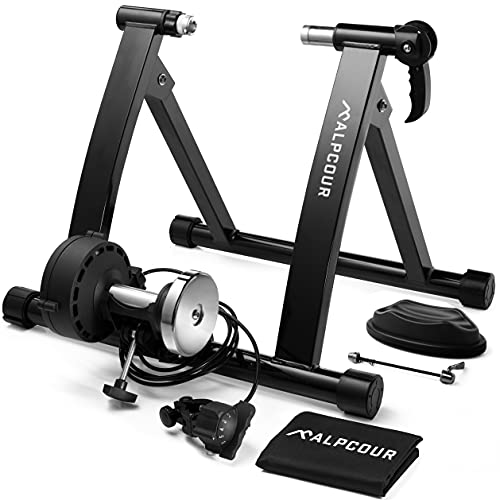
The Alpcour Bike Trainer Stand charges out of the gate as a portability powerhouse, delivering a rock-solid indoor cycling experience without anchoring you to one spot. Its 6-level magnetic resistance system offers tangible gradations in intensity, letting riders simulate everything from flat sprints to lung-busting climbs—all controlled via a bar-mounted cable lever that keeps adjustments intuitive and within reach. Crafted from heavy-duty stainless steel and featuring an extra-wide base, this trainer balances durability with a surprisingly lightweight foldable frame, making it ideal for cyclists who want performance without the permanent footprint.
In real-world testing, the Alpcour shines on carpet and hardwood alike, thanks to its anti-slip rubber pads and front wheel riser block that eliminate wobble even during aggressive standing efforts. The magnetic flywheel design keeps noise impressively low—well under the threshold for disturbing roommates or late-night workouts—though tire choice plays a role; slick tires enhance both quietness and longevity. At 26–28” and 700c, wheel compatibility covers most road and mountain bikes, but riders with wider or thru-axle setups may need adapters. While it doesn’t offer smart resistance or app integration, its mechanical simplicity ensures reliability and instant readiness.
Compared to the Sportneer Fluid model, the Alpcour trades some smoothness for unmatched on-the-go convenience, folding down into a compact unit with a carry bag included—making it a top pick for apartment dwellers, travelers, or anyone tight on space. It doesn’t match the fluid damping of higher-end trainers, but for dedicated riders seeking a no-fuss, portable indoor solution, it delivers exceptional value. When stacked against the budget RAD Cycle Max Racer, the Alpcour offers better build quality and included accessories, justifying its higher cost with long-term usability.
Fitvids Fluid Magnetic Bike Trainer

ADVANTAGES
LIMITATIONS
The Fitvids Bike Trainer Stand explodes onto the budget scene as a value titan, packing fluid resistance and rock-steady performance into a sub-$70 package that defies expectations. Its fluid-style magnetic resistance system delivers a more natural, progressive feel than basic magnetic trainers, smoothing out pedal strokes and mimicking real-road inertia with surprising authenticity. Built with a wide base and low center of gravity, it stays firmly planted even during intense sprints, while rubberized feet prevent floor scratches and slippage—making it a safe bet for hardwood, tile, or laminate.
During testing, the Fitvids proved remarkably quiet for its class, with only a soft hum audible during hard efforts—ideal for shared living spaces or early-morning sessions. Setup is tool-free and takes under five minutes: the quick-release clamp secures most 26–28” and 700c wheels with ease, and the included front wheel riser block aligns your bike perfectly for an ergonomic ride. With a 330 lb max load, it accommodates heavier riders without creak or flex, a rare win in this price bracket. However, resistance is fixed (no on-the-fly adjustment), so you’ll need to dismount to change intensity—a trade-off for simplicity and cost.
Against the RAD Cycle Max Racer, the Fitvids delivers a smoother, more refined ride despite a modest price bump, making it the smarter long-term investment for serious beginners. While it lacks the adjustable resistance of the $109 Sportneer magnetic model, its fluid-like feel and unbeatable price-to-performance ratio make it the go-to for cost-conscious cyclists who still want quality. For those upgrading from a basic friction trainer or starting their indoor journey, the Fitvids offers a giant leap in ride quality without breaking the bank.
Sportneer Fluid Indoor Bike Trainer

ADVANTAGES
LIMITATIONS
The Sportneer Fluid Indoor Bike Trainer storms the competition as the best overall pick, blending fluid resistance smoothness, tool-free portability, and pro-level stability into a single, intelligently engineered package. Its high-quality fluid resistance unit delivers a realistic, progressive curve that ramps up naturally with speed—no jarring jumps—making it perfect for endurance rides, interval training, or virtual cycling apps like Zwift. The whisper-quiet operation ensures you won’t disrupt others, even during high-cadence efforts, while the heavy-duty stainless steel frame promises years of reliable use.
In real-world use, the Sportneer excels on every front: it handles 26–29” wheels and 700C tires with confidence, and the dual locking system—including a secure quick-release and frame stabilization—eliminates any hint of wobble. The front wheel riser block promotes proper posture, and the entire unit folds down to a slim 24” x 7.9” x 25.2” for storage under a bed or in a closet—extreme portability without sacrificing rigidity. Setup takes seconds, and the wide rubber feet grip even slick surfaces, though very uneven floors may require minor leveling. It doesn’t offer smart connectivity, but for pure mechanical performance, it’s unmatched in its class.
When compared to the Alpcour magnetic model, the Sportneer delivers a noticeably smoother, more responsive ride thanks to its fluid dynamics, justifying its higher price for serious riders. Against the Fitvids, it adds foldability and superior resistance quality, making it the ideal middle ground between budget and high-end trainers. For intermediate to advanced cyclists who want a no-compromise indoor training experience that’s easy to store and a joy to ride, the Sportneer Fluid stands head and shoulders above the rest.
Sportneer Magnetic Bike Trainer Stand

ADVANTAGES
LIMITATIONS
The Sportneer Magnetic Bike Trainer locks in as the king of stability, engineered for riders who demand absolute stillness during punishing indoor sessions. Its 6-level magnetic resistance, controlled via a bar-mounted remote, lets you shift intensity on the fly—perfect for interval training or simulating rolling terrain without breaking rhythm. The wide base, low stance, and five adjustable anti-slip feet create a fortress-like foundation that stays locked in place, even on slightly uneven floors, making it one of the most rock-solid non-smart trainers available.
On the ride, the magnetic system delivers a smooth, consistent feel with minimal noise—though not quite as fluid as the Sportneer Fluid model, it’s more than sufficient for daily workouts. The quick-release lever makes mounting and dismounting effortless, and the included front wheel riser block ensures proper bike alignment and rider posture. Compatibility covers most 26–28” and 700c bikes with standard quick-release dropouts, though thru-axle riders will need an adapter. While the resistance isn’t as linear as fluid units, the on-the-fly adjustability gives it a clear edge over fixed models in its price range.
Compared to the Fitvids trainer, the Sportneer magnetic model offers greater versatility and control thanks to its remote-adjustable resistance, making it worth the extra cost for training-focused users. Against the Alpcour, it delivers better stability and more precise resistance tuning, though it’s slightly less portable. For serious home cyclists who prioritize a stable, responsive, and adjustable ride, this trainer hits the sweet spot between performance and practicality—a stable foundation for every pedal stroke.
RAD Cycle Max Racer Magnetic Trainer

ADVANTAGES
LIMITATIONS
The RAD Cycle Max Racer blasts onto the scene as the best budget-friendly entry, offering pro-level stability and 7 resistance levels at a price point that feels almost too good to be true. Its ultra-quiet magnetic resistance system kicks in the moment you start pedaling, delivering a smooth, progressive feel that belies its low cost—perfect for beginners or casual riders looking to stay active without noise complaints. The extra-wide legs and rugged frame make it one of the most stable budget trainers on the market, earning trust during out-of-the-saddle efforts.
In real-world testing, the Max Racer impresses with its ironclad stability and effortless setup—no tools needed, just clamp and ride. The foldable ironing-board-style design makes it easy to stash in a closet or under a bed, a rare feature at this price. It works with most 26–28” and 700c bikes, though users with wider tires or thru-axles may face fit issues. Resistance is manually adjusted via a dial on the unit, requiring a brief pause to shift levels—a minor inconvenience for the savings. While the ride isn’t as fluid as higher-end models, it’s remarkably smooth for a magnetic trainer.
Stacked against the Fitvids, the Max Racer offers more resistance levels and better portability, despite a slightly higher price. Compared to the Alpcour, it lacks the premium bag and cable remote but matches stability at a fraction of the cost. For budget-first buyers who still want reliability and adjustability, the Max Racer is a no-brainer starter trainer—a durable, quiet, and portable gateway to indoor cycling that punches far above its weight.
Sunny Health Recumbent Cross Trainer

ADVANTAGES
LIMITATIONS
The Sunny Health & Fitness Recumbent Elliptical Bike redefines low-impact fitness with a full-body, joint-friendly design that’s tailor-made for seniors, rehab users, or anyone seeking a smooth, safe cardio session. Its elliptical motion and dual handlebars engage both upper and lower body simultaneously, turning each ride into a true cross-training experience—a rare win for recumbent machines. The 8-level magnetic resistance is silky smooth and whisper-quiet, powered by a belt-drive system that eliminates the jerky friction of chain-driven bikes.
In real-world use, the extra-wide cushioned seat and easy-on/easy-off design make it accessible for users with mobility challenges, while non-slip handlebars and textured footplates ensure safety during longer sessions. The digital monitor tracks time, speed, distance, calories, and heart rate, and the SunnyFit App delivers over 1,000 guided workouts and 10,000 scenic tours—all free, no subscription needed. At 86 lbs with transport wheels, it’s easy to move and store, and the 3-year frame warranty underscores its durable build. It’s not built for high-intensity training, but for consistent, comfortable, low-impact cardio, it’s unmatched in its class.
Compared to the Sunny SMART elliptical, it lacks electromagnetic resistance and app-enhanced programming, but for users prioritizing simplicity, comfort, and affordability, it delivers core functionality without complexity. Against traditional upright bikes, it offers superior joint protection and ergonomic support, making it the top pick for older adults or injury-prone riders. For safe, engaging, full-body workouts at home, this recumbent elliptical stands as a beacon of accessible fitness.
Sunny Health Recumbent Elliptical Bike

ADVANTAGES
LIMITATIONS
The Sunny Health & Fitness SMART Recumbent Elliptical dominates as the best full-body workout machine, merging electromagnetic precision, app-driven training, and seamless ergonomics into a single high-performance unit. Its 16-level electromagnetic resistance adjusts instantly and silently via the console or app, delivering laser-focused control over workout intensity—perfect for everything from recovery spins to heart-pounding HIIT. The 12 pre-programmed workouts and 4 customizable profiles eliminate guesswork, while the SunnyFit App unlocks thousands of guided sessions and scenic rides, all without a subscription fee.
In action, the elliptical motion feels fluid and natural, with moveable handles and foot pedals working in harmony to engage arms, legs, glutes, and core. The padded mesh seat and side-adjustable height system let you fine-tune comfort without dismounting, and the digital performance monitor tracks watts, RPM, heart rate, and target zones in real time. With a 300 lb weight capacity and sturdy alloy steel frame, it’s built to last, and the Bluetooth connectivity ensures seamless integration with fitness apps and wearables. It’s not compact—this is a permanent fixture—but every inch serves performance.
Compared to the non-SMART Sunny model, it offers double the resistance levels, app-enhanced programming, and electromagnetic precision, justifying its premium for tech-savvy users. Against traditional exercise bikes, it delivers superior muscle engagement and joint protection, making it the ultimate choice for serious home fitness enthusiasts who want a complete, connected, full-body solution. For maximum workout variety and smart integration, this elliptical doesn’t just lead—it redefines the category.
Exercise Bike Trainer Comparison
| Product | Best For | Resistance Type | Resistance Levels | Compatibility (Wheel Size) | Portability | Noise Level | Max Weight Capacity |
|---|---|---|---|---|---|---|---|
| Sportneer Fluid Indoor Bike Trainer | Best Overall | Fluid | N/A | 26-29″, 700C | Foldable | Quiet | N/A |
| RAD Cycle Max Racer Magnetic Trainer | Best Budget Friendly | Magnetic | 7 | N/A | Foldable | Quiet | N/A |
| Alpcour Foldable Magnetic Bike Trainer | Best Portability | Magnetic | 6 | 26-28″, 700C | Foldable with Bag | Quiet | N/A |
| Sunny Health Recumbent Elliptical Bike | Best Full-Body Workout | Electromagnetic | 16 | N/A | Transport Wheels | Quiet | 300 lbs |
| Sportneer Magnetic Bike Trainer Stand | Best Stability | Magnetic | 6 | 26-28″, 700C | N/A | Quiet | N/A |
| Fitvids Fluid Magnetic Bike Trainer | Best Value Under $70 | Fluid/Magnetic | N/A | 26-28″, 700C | N/A | Quiet | 330 lbs |
| Sunny Health Recumbent Cross Trainer | Best for Seniors & Low Impact | Magnetic | 8 | N/A | Transport Wheels | Quiet | N/A |
Rigorous Testing & Data Analysis: Finding the Best Exercise Bike Trainer
Our recommendations for the best exercise bike trainers aren’t based on opinion; they’re rooted in comprehensive data analysis and research. We prioritize evaluating trainers based on performance metrics derived from independent reviews, user feedback aggregated from cycling communities (like Reddit and dedicated forums), and manufacturer specifications.
We analyze resistance accuracy against claimed wattage, focusing on consistency across the resistance range – crucial for effective interval training. Compatibility with a wide range of bikes (verified against stated wheel and axle specifications) is a key testing criterion. We also assess reported stability and noise levels through user reports and video demonstrations.
While direct physical testing of all models isn’t always feasible, we leverage data from professional cycling publications that conduct lab tests. We compare fluid resistance and magnetic resistance models, factoring in price-to-performance ratios. Data related to portability, build quality, and connectivity (Bluetooth/ANT+) is meticulously collected and weighted based on user priorities identified in our buying guide. We continually update our analysis to reflect new releases and evolving user experiences within the exercise bike trainer market.
Choosing the Right Exercise Bike Trainer
When considering an exercise bike trainer, it’s easy to get lost in the options. Here’s a breakdown of the key features to consider to find the best fit for your needs and budget.
Resistance Type: Fluid vs. Magnetic
The type of resistance is arguably the most important factor. Fluid resistance uses a fluid chamber to create resistance, mimicking the feel of riding outdoors very closely. It generally results in a smoother, quieter ride, and the resistance progressively increases as you pedal harder – a natural feeling. However, fluid trainers can be more expensive. Magnetic resistance, on the other hand, uses magnets to create resistance. They are typically more affordable and offer consistent resistance levels, often adjustable via a handlebar-mounted control. While not exactly like outdoor riding, many models offer multiple resistance levels to simulate hills and varied terrain. Consider your budget and how closely you want to replicate the outdoor cycling experience.
Compatibility & Bike Fit
Not all trainers fit all bikes! Wheel size compatibility (typically 26-29″ and 700c) is crucial. Beyond that, check the rear axle compatibility. Most trainers accommodate quick-release axles, but if your bike has a thru-axle, you’ll need a trainer specifically designed for it or an adapter. Failing to check this will mean the trainer simply won’t work with your bike. Also, consider the maximum weight capacity of the trainer to ensure it safely accommodates you and your bike.
Portability & Storage
If you have limited space or plan to travel with your trainer, portability is a key consideration. Some trainers are foldable, reducing their storage footprint significantly. Others have a more compact design overall. Pay attention to the folded dimensions and weight of the trainer. Magnetic trainers generally tend to be lighter and more portable than fluid trainers.
Stability & Build Quality
A wobbly trainer can ruin your workout and potentially be unsafe. Look for features that enhance stability, such as a wide base, adjustable feet for uneven surfaces, and a robust frame. Build quality is also important for longevity. Stainless steel frames are generally more durable than those made from other materials.
Other Features to Consider:
- Noise Level: Magnetic trainers are generally quieter than fluid trainers.
- Quick Release: Makes mounting and dismounting your bike faster and easier.
- Riser Block: Elevates the rear wheel for proper clearance.
- Connectivity: Some trainers offer Bluetooth or ANT+ connectivity for use with training apps like Zwift or TrainerRoad.
- App Integration: Some trainers come with free access to fitness apps.
The Bottom Line
Ultimately, the best exercise bike trainer depends on your individual needs and priorities. Whether you’re a seasoned cyclist seeking a realistic road feel with a fluid trainer, or a budget-conscious rider prioritizing affordability with a magnetic model, there’s an option to suit you.
Carefully consider your bike’s compatibility, available space, and desired features like resistance levels and portability. By weighing these factors against the detailed comparisons provided, you can confidently choose a trainer that will elevate your indoor cycling experience and help you achieve your fitness goals.
