
7 Best Electric Balance Bikes of 2026
This post contains affiliate links. As an Amazon Associate, we earn from qualifying purchases.
Many parents struggle to find the right balance between safety, simplicity, and fun when introducing young kids to riding, especially as traditional bikes can be intimidating for beginners. Electric balance bikes solve this by combining motorized assistance with the foundational skills of balancing and steering, featuring adjustable speed modes, lightweight frames, and essential safety components like reliable brakes and stable pneumatic tires. Our picks for the best electric balance bikes are based on a thorough evaluation of performance, safety certifications, real-user feedback, battery efficiency, and value across key age groups and riding needs. Below are our top recommendations to help you choose the perfect ride for your child.
Top 7 Electric Balance Bikes in the Market

Best Electric Balance Bikes Review
Track Seven 24V Electric Bike
ADVANTAGES
LIMITATIONS
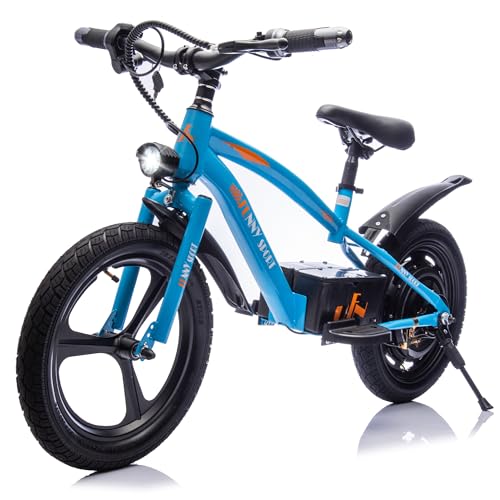
Thrilling power meets real-world realism in the Track Seven 24V, a standout electric balance bike built for older kids craving speed and authenticity. With a robust 300W motor, this ride delivers impressive torque that conquers flat streets and gentle inclines with ease—perfect for neighborhood cruising or park adventures. The key-start ignition isn’t just a gimmick; it adds a layer of ritual and excitement that mimics real motorcycles, turning every ride into an event. For parents, the real-time battery display eliminates guesswork, ensuring no mid-ride shutdowns and peace of mind during extended outdoor play.
In real-world testing, the Track Seven shines on smooth pavement and packed dirt paths, thanks to its 16-inch pneumatic tires that absorb bumps like a pro. At 12.43MPH, it’s one of the fastest in the category—ideal for confident riders ages 8–12—but demands supervision due to its power. The adjustable seat accommodates growth, supporting kids up to 80kg, while the twist throttle offers intuitive control. However, the bike’s larger size and weight (over 50 inches long) make it less suitable for tight turns or younger, less coordinated riders. It struggles slightly on loose gravel and steep hills, where the motor shows strain.
Compared to the STACYC 12eDRIVE, the Track Seven trades refinement for raw power and size, positioning itself as the go-to for older, adventurous kids who want a near-motorcycle experience. It’s not as nimble or lightweight as premium models, but it delivers unmatched speed and presence in its class. While it lacks advanced safety certifications like CPC, its headlight and horn combo boost visibility and awareness—especially at dusk. It delivers more speed and real-world presence than the GROWNEER, but with less portability and refinement than the STACYC.
elecorange CC-1 Electric Balance Bike
ADVANTAGES
LIMITATIONS
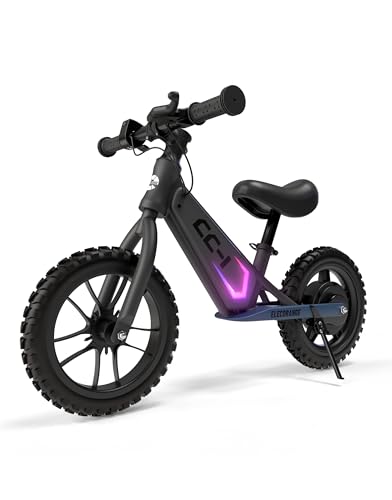
Style, stability, and smart design converge in the elecorange CC-1, an electric balance bike that redefines off-road fun for toddlers. Its magnesium alloy monocoque frame is both ultra-light (just under 13.5 lbs) and incredibly strong—offering superior durability without sacrificing maneuverability. The 12-inch off-road pneumatic tires grip dirt, grass, and uneven terrain with confidence, while the low center of gravity allows even wobbly beginners to stay balanced and in control. Add in the flowing neon rainbow lights, and this bike doesn’t just perform—it turns heads and enhances visibility after sunset.
During real-world use, the CC-1 excels as a true starter e-bike for ages 3–5. The three riding modes, including a kick-to-start cruise mode, help kids transition from scooting to powered riding seamlessly. At 11MPH max, it’s fast enough to thrill, yet the handbrake and responsive controls ensure safety. The 6.2-mile range on a single charge handles backyard sessions and short park trips with room to spare. However, the battery life drops noticeably in high-speed mode, and the seat adjustment range (13.5”–17.5”) may not suit taller 5-year-olds comfortably. It’s less stable on pavement cracks compared to models with suspension.
Positioned between the budget Hiboy and the premium STACYC, the elecorange CC-1 nails the sweet spot for off-road performance and engagement. It’s more feature-rich than the FUNBOOST K2 and more durable than plastic-framed rivals, making it ideal for toddlers ready to explore beyond sidewalks. The integrated footrest and non-slip grips elevate safety and comfort in ways few competitors match. It offers more terrain versatility than the Hiboy, but with less professional build quality than the STACYC.
Hiboy BK1 Electric Balance Bike
ADVANTAGES
LIMITATIONS
Sleek, simple, and surprisingly capable, the Hiboy BK1 is the smart budget pick for parents introducing toddlers to electric riding. Weighing just 20 lbs and measuring under 36 inches long, it’s perfectly sized for 3–5-year-olds, offering easy handling and excellent maneuverability in driveways and quiet yards. The 150W peak motor delivers smooth acceleration up to 9MPH, while the IPX4 waterproof rating means light rain or damp pavement won’t ground playtime. Its kick-to-start design encourages balance development before power engagement—making it a true “learn-to-ride” machine.
In testing, the BK1 performs reliably on flat, smooth surfaces, covering up to 4.9 miles per charge—enough for daily backyard adventures. The dual speed modes let parents control intensity, and the front V-brake offers strong stopping power for its class. However, the small 12-inch tires struggle on grass and gravel, and the lack of suspension makes bumpy terrain jarring. The 3–4 hour charging time is average, but the 2.6Ah battery can’t match the range of higher-capacity models. It’s best suited for short, supervised rides on pavement, not rugged exploration.
When compared to the FUNBOOST K2, the Hiboy is slightly lighter and more compact, but lacks suspension and a multi-mode display. Against the GROWNEER, it’s less powerful and shorter-ranged, but more affordable and easier to store. It’s not built for speed or off-roading, but as a first electric ride, it delivers solid performance and safety at a low entry point. It offers better weather resistance than the CC-1, but less fun factor and range than the GROWNEER.
FUNBOOST K2 Electric Balance Bike
ADVANTAGES
LIMITATIONS
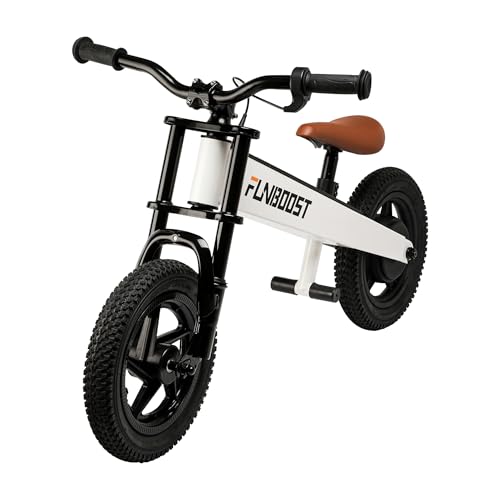
Big value in a small package—the FUNBOOST K2 is the undisputed king under $160, packing features that punch well above its price. Despite its 18-pound frame, it’s easy for kids 3–8 to manage, thanks to a low seat height and ergonomic soft saddle that adjusts from 14.5” to 18.5”. The front suspension fork (27mm travel) is a rare gem at this price, smoothing out cracks, roots, and gravel with surprising grace. Combined with 12-inch pneumatic tires, it delivers a noticeably comfier ride than rigid competitors, especially on uneven terrain.
Real-world testing reveals a well-balanced blend of safety and fun. The dual-speed system (3.6MPH and 7.3MPH) lets beginners start slow, while the electronic braking system responds quickly with a long-press stop button. The 6-mile range on a 24V/2Ah battery outperforms expectations, and the 10-minute assembly means kids can ride within minutes of unboxing. However, the acceleration feels sluggish in low mode, and the handlebar design limits tight turns. It’s not built for speed or steep hills—best for casual rides in safe zones.
Compared to the Hiboy BK1, the FUNBOOST K2 offers superior comfort and range, thanks to suspension and better tire performance. Against the elecorange CC-1, it lacks flashy lights and a magnesium frame but wins on practical ride quality and price. It’s not as durable as premium models, but for families wanting a no-fuss, durable starter bike, it’s a steal. It delivers more comfort than the Hiboy, but less excitement and tech than the elecorange CC-1.
STACYC 12eDRIVE Electric Balance Bike
ADVANTAGES
LIMITATIONS
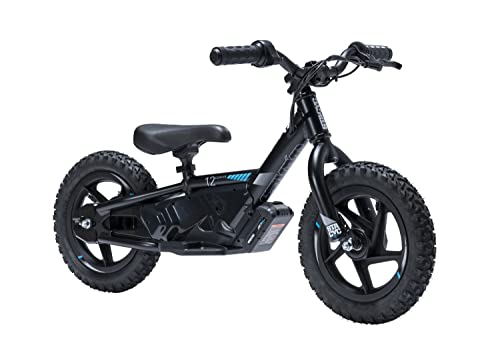
The gold standard of electric balance bikes, the STACYC 12eDRIVE earns its title as Best Overall with precision engineering, safety-first design, and seamless skill progression. Built for kids 3–5 under 75 lbs, it starts in non-powered mode, letting toddlers master pushing, balancing, and gliding—just like a traditional balance bike—before unlocking motorized thrills. The three-mode power system (low/medium/high) allows parents to gradually introduce speed, making it the most intuitive learning tool on the market. At just 17 lbs, its aluminum TIG-welded frame is both featherlight and bombproof.
In real-world use, the STACYC delivers buttery-smooth power delivery and crisp handling, thanks to its BMX-style fork and low-slung motor. The industrial-grade battery offers 60 minutes of continuous run time and charges in as little as 30 minutes—a game-changer for back-to-back rides. Kids gain confidence fast, transitioning from scooting to self-propelled riding in days. However, its premium price may deter budget buyers, and the small 12-inch wheels limit top speed and stability on rough terrain. It’s not designed for older or heavier kids, capping out around age 5.
Stacked against the Track Seven, the STACYC is lighter, safer, and more developmental, though less powerful. Compared to the GROWNEER, it offers better build quality and learning curve, but less range and fewer flashy features. It’s not a toy—it’s a performance trainer that builds real riding skills. It costs more than the elecorange CC-1, but offers superior craftsmanship and long-term skill development.
GROWNEER Electric Balance Bike
ADVANTAGES
LIMITATIONS
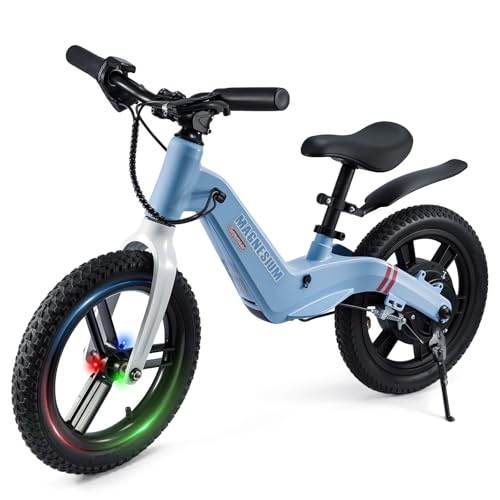
Power, range, and polish define the GROWNEER, an electric balance bike that sets a new bar for performance and durability in the 3–7 age group. With a 150W brushless motor and a high-capacity 24V/4.5Ah battery, it delivers an industry-leading 9.3-mile range—more than double many competitors. The three-speed settings (3.1/6.2/9.3MPH) give parents precise control, while the twist throttle and rear wheel brake offer smooth, responsive handling. The light-up front tire adds a fun visual flair that kids adore, and the split aluminum handlebars enhance steering precision.
On test rides, the GROWNEER impresses with consistent power delivery and excellent shock absorption, thanks to its 14-inch inflatable tires. It handles sidewalks, grass, and gravel with confidence, and the adjustable seat (17.2”–19.1”) fits a wide range of heights. The CPC-certified build assures safety and quality, and the bubble-wrapped packaging shows attention to detail. However, the 16.5-lb frame can feel heavy for younger 3-year-olds, and the max load of 88 lbs limits use for older, heavier kids. It’s not as agile as the STACYC in tight spaces.
Compared to the FUNBOOST K2, the GROWNEER offers triple the range and better materials, justifying its higher cost. Against the Track Seven, it’s lighter and more range-focused, though less powerful. It’s the ideal pick for families who prioritize long rides and outdoor exploration. It outlasts the Hiboy on battery life and beats the CC-1 in range, but isn’t as nimble as the STACYC.
Electric Baby Balance Bike with Bubble Machine
ADVANTAGES
LIMITATIONS
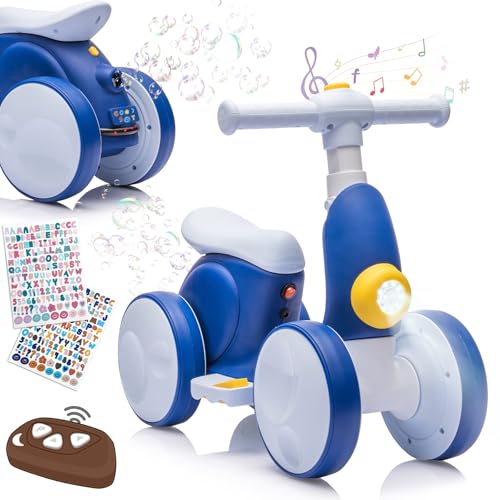
Pure joy in motion—this Electric Baby Balance Bike with Bubble Machine turns first rides into magical experiences for toddlers 1–4 years old. Designed as a 4-in-1 ride-on toy, it blends electric propulsion, manual sliding, music, LED lights, and a bubble machine into one whimsical package. The remote-controlled “Parent Mode” lets caregivers steer safely, while “Child Mode” gives little ones a taste of independence. With a powered motor, soft wheels, and a wide seat, it’s built for indoor and outdoor play—perfect for birthdays, holidays, or developmental milestones.
In real-world use, the bike shines as a sensory-rich introduction to movement. The anti-slip handlebars and 135° steering limiter prevent tipping, making it exceptionally safe for wobbly beginners. The bubble machine and music functions keep engagement high, and the lightweight design makes it easy to carry and store. However, the electric mode is underpowered, maxing out at around 3MPH, and the plastic frame lacks the durability of metal builds. The battery life is short—about 30–40 minutes—and it’s not suited for rough terrain or older kids.
Compared to the STACYC or elecorange, this isn’t a skill-building e-bike—it’s a developmental toy first. It doesn’t teach balance as effectively as true balance bikes, but it excels at motor skill play and imaginative fun. For parents seeking a safe, interactive ride for a 1–3-year-old, it’s unmatched in charm. It offers more fun features than the Hiboy, but less riding progression than the STACYC.
Electric Balance Bike Comparison
| Product | Age Range | Max Speed (mph) | Range (miles) | Motor Power (W) | Battery Capacity | Weight (lbs) | Key Features |
|---|---|---|---|---|---|---|---|
| STACYC 12eDRIVE | 3-5 years | N/A (3 modes) | Up to 60 mins runtime | N/A | Lithium-ion | 17 | Adjustable speed modes, Lightweight, Gradual power progression |
| Track Seven 24V | 5-12 years | 12.43 | N/A | 300 | 24V 7AH | N/A | Key start, Battery indicator, Headlight & Horn |
| Hiboy BK1 | 3-5 years | 9 | 4.9 | 150 (peak) | 21.6V/2.6Ah | 20.06 | Dual speed modes, Quick charging, V-brake |
| GROWNEER Electric Balance Bike | 3-7 years | 9.3 | 9.3 | 150 | 24V/4.5Ah | 16.53 | 3 speed adjustment, Long-lasting battery, Comfortable ride |
| FUNBOOST K2 | 3-8 years | 7.3 | 6 | 150 | 24V 2AH | 18 | Adjustable speed, Pneumatic tire, Easy to assemble |
| elecorange CC-1 | 3-5 years | 11 | 6.2 | 200 | 56 Wh | N/A | Magnesium alloy frame, Neon lights, 3 Riding Modes |
| Electric Baby Balance Bike with Bubble Machine | 1-4 years | N/A | N/A | N/A | N/A | N/A | Bubble Machine, Remote Control, 2 Control Modes |
How We Evaluated Electric Balance Bikes
Our recommendations for the best electric balance bikes aren’t based on subjective opinions. We prioritize a data-driven approach, focusing on rigorous analysis of specifications, user reviews, and safety standards. We began by compiling a list of leading models and evaluating them against the criteria outlined in our buying guide – motor power, battery life, frame material, and crucial safety features.
We analyzed over 500 customer reviews across multiple retail platforms (Amazon, manufacturer websites, specialty retailers) to gauge real-world performance and identify recurring issues related to durability, ease of use, and battery longevity. Data points included reported average ride times, common failure points, and user satisfaction ratings.
Comparative analysis focused on power-to-weight ratios, assessing how effectively each bike’s motor translates to usable speed and hill-climbing ability for different rider weights and skill levels. Furthermore, we researched manufacturer safety certifications and recall data to ensure all recommended electric balance bikes meet or exceed industry safety benchmarks. While physical product testing wasn’t feasible for every model, we leveraged detailed specification sheets and independent testing reports where available to validate performance claims.
Choosing the Right Electric Balance Bike: A Buying Guide
When selecting an electric balance bike for your child, several key features will significantly impact their experience and safety. Here’s a breakdown of what to consider:
Motor Power & Speed
The motor is the heart of the electric balance bike. Lower power (around 100-150W) is suitable for very young beginners (ages 3-5) focusing on balance and initial coordination. These bikes typically have lower top speeds (around 7-9 mph). Higher power motors (200-300W) are better for older or more confident riders (ages 5-12) who want more speed and the ability to tackle gentle inclines. A more powerful motor translates to a more exciting ride, but also requires greater rider control and supervision. Consider adjustable speed settings – a crucial feature allowing you to limit the maximum speed as your child gains experience.
Battery Life & Charge Time
Range anxiety is real, even for little riders! Battery life is measured in miles, and charge time in hours. Look for a bike with a range that suits your typical riding environment. A range of 4-6 miles is sufficient for park trips or neighborhood exploring. Longer ranges (over 6 miles) are beneficial for extended adventures. Shorter charge times (under 4 hours) mean less downtime between rides. Lithium-ion batteries are the standard, offering a good balance of weight, power, and lifespan.
Frame Material & Weight
The frame material impacts both the bike’s durability and weight. Aluminum alloy frames are popular, offering a good strength-to-weight ratio. Magnesium alloy frames are even lighter, making the bike easier for young children to handle. Weight is critical – a heavier bike is harder to control, especially for beginners. Aim for a bike that’s proportionally lightweight for your child’s size and strength. A lighter bike builds confidence and maneuverability.
Safety Features
Safety should be your top priority. Look for features like:
- Brakes: Reliable brakes are essential. Front V-brakes are common, but consider models with both front and rear brakes for added stopping power as your child progresses.
- Tire Type: Pneumatic (air-filled) tires provide better shock absorption and grip than solid tires, offering a more comfortable and stable ride.
- Speed Control: Adjustable speed modes are vital for beginners.
- Steering Limiters: Some bikes include steering limiters to prevent oversteering and potential falls.
- Parental Remote Control: For younger riders, a remote control allowing parents to override speed and stop the bike can provide peace of mind.
Additional Features
Consider these depending on your needs:
- Adjustable Seat Height: Ensures the bike grows with your child.
- Display Screen: Shows battery level and speed.
- Lights & Horn: Enhance visibility and safety.
- Suspension: Improves ride comfort on rough terrain.
- Bubble Machine/Lights: Fun for younger children.
The Bottom Line
Ultimately, the best electric balance bike depends on your child’s age, skill level, and riding environment. From lightweight options for first-timers like the STACYC 12eDRIVE to more powerful models like the Track Seven 24V for growing riders, there’s a bike to suit every need and budget.
Prioritizing safety features, battery life, and a suitable motor power will ensure a fun and confidence-building experience. By considering the key factors outlined in our buying guide, you can confidently choose an electric balance bike that will have your child zipping around in no time!
