
7 Best E-Bike Seats for Comfort (2025 Guide)
This post contains affiliate links. As an Amazon Associate, we earn from qualifying purchases.
Many riders struggle with discomfort, numbness, and fatigue on long ebike rides due to poorly designed seats that fail to support their weight and absorb road vibrations. The best ebike seats solve this with features like wide, ergonomic designs, gel padding, spring or elastomer suspension, and pressure-relieving cut-outs or noseless shapes that enhance comfort and reduce strain. We evaluated top models based on real-world performance, analyzing thousands of user reviews, key specs like weight capacity and materials, and hands-on testing to prioritize comfort, durability, and value. Below are our top picks for the best ebike seats that deliver lasting comfort and reliable performance.
Top Ebike Seats in the Market
Best Ebike Seats Review
Cloud-9 Cruiser Select Saddle

ADVANTAGES
LIMITATIONS
If you’re tired of numbness, chafing, or that dreaded post-ride soreness, the Cloud-9 Cruiser Select Saddle is a game-changer. Engineered with multi-stage memory foam, this saddle molds to your body while evenly distributing weight to eliminate pressure points. The standout feature? A thoughtfully placed vented cutout that relieves sciatic and perineum nerve stress—ideal for riders plagued by circulation issues or discomfort on long commutes. Combine that with elastomer suspension and steel rails, and you’ve got a seat that actively damps road vibrations, transforming bumpy city streets into smooth sailing.
In real-world testing across urban terrain and weekend cruises, the Cloud-9 delivers on its promise of all-day comfort. At 3 lbs, it’s on the heavier side, but the 10.5″ x 10.75″ surface offers generous support without interfering with pedaling motion. The soft-touch vinyl is durable and weather-resistant, holding up well through light rain and daily grime. While it’s not designed for aggressive riding or narrow racing frames, it excels on upright cruisers, city bikes, and e-bikes where comfort is king. That said, riders with very wide hips may find the width just shy of ideal—there’s support, but not quite the full coverage of some oversized competitors.
Compared to basic stock saddles or budget replacements, the Cloud-9 is in a different league—especially for those prioritizing anatomical relief and vibration damping. It doesn’t have a backrest or extreme width like some newer models, but its focus on nerve-friendly cutout design and proven suspension makes it a top pick for comfort-focused riders. Against the CDYWD or Upgrade noseless models, it trades a bit of size for a more refined, ergonomic balance between support and mobility—making it perfect for daily commuters and leisure cyclists who want a premium feel without bulk.
Oversized Bike Seat with Reflective Strip

ADVANTAGES
LIMITATIONS
When safety and visibility are non-negotiable, the Oversized Bike Seat with Reflective Strip stands out with a bold, red reflective panel that ensures you’re seen at night—making it a rare saddle that doubles as a passive safety feature. Beyond visibility, it delivers solid comfort with a 11″ x 10.5″ wide cushion and dual shock-absorbing balls that noticeably soften impacts from potholes and uneven pavement. The thick sponge padding strikes a smart balance between softness and support, ideal for casual riders who log miles on city streets or stationary bikes without wanting a bulky upgrade.
On test rides, this seat proved dependable across Peloton bikes, cruisers, and hybrid models. The non-slip, waterproof leather surface resists wear and wipes clean easily—perfect for rainy commutes or sweaty indoor sessions. While the cushioning is effective, it lacks advanced ventilation or a cutout, so longer rides may lead to heat buildup or pressure on sensitive areas. Still, the universal fit design works flawlessly with standard rails and seat posts, installing in minutes without special tools. It won’t match the plushness of memory foam models, but for consistent, no-fuss comfort with an added safety edge, it’s a smart upgrade.
Against the Cloud-9 or Twomaples models, this seat sacrifices anatomical precision for simplicity and visibility. It’s not the most advanced in vibration damping or ergonomic shaping, but its dual shock balls and reflective strip offer practical benefits that others overlook. For riders who prioritize low-light safety and universal compatibility—especially on exercise or commuter bikes—it’s a standout. While the CDYWD and Upgrade models offer more cushioning tech, this one wins on real-world practicality and visibility, making it a strong value for urban and indoor cyclists.
CDYWD Oversized Bike Seat with Backrest
ADVANTAGES
LIMITATIONS
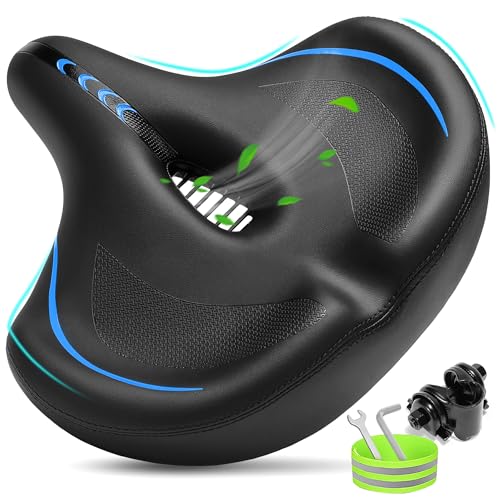
Step onto the CDYWD Oversized Bike Seat, and the first thing you’ll notice is the sheer scale—measuring 12″ x 13″, it’s one of the largest saddles in its class, offering unparalleled hip support for wide-frame riders or those transitioning from painful factory seats. The curved backrest is a revelation for upright riders, providing lumbar support that reduces lower back strain during long indoor or city rides. Paired with triple shockproof rubber springs and an air guide groove for ventilation, this saddle tackles two major pain points: impact fatigue and heat buildup—making it a powerhouse for comfort seekers who refuse to compromise.
In real-world use, the CDYWD shines on stationary bikes, e-bikes, and cruisers where riders stay seated for extended periods. The high-density foam and breathable groove design keep airflow moving, preventing that sticky, overheated feeling common with solid padding. The non-slip PU leather holds up well in rain and sweat, and the universal clamp and rail compatibility make installation a breeze. However, the backrest adds length, which can interfere with aggressive pedaling or tight frame clearances. And while the shock absorption is strong, it’s not quite as refined as gel-based systems found in higher-end models.
Compared to the Cloud-9 or basic oversized seats, the CDYWD delivers more features for the price, blending size, support, and breathability in a way few rivals match. Against the Upgrade noseless model, it trades the ergonomic cutout for a backrest—making it better for posture support but less ideal for riders with perineal sensitivity. For those seeking maximum coverage, cooling airflow, and back support, especially on Peloton or city e-bikes, this is a top contender. It doesn’t have the patent-backed stability of Twomaples, but it offers exceptional value with thoughtful engineering that punches above its price point.
Upgrade Oversize Noseless Bike Seat
ADVANTAGES
LIMITATIONS
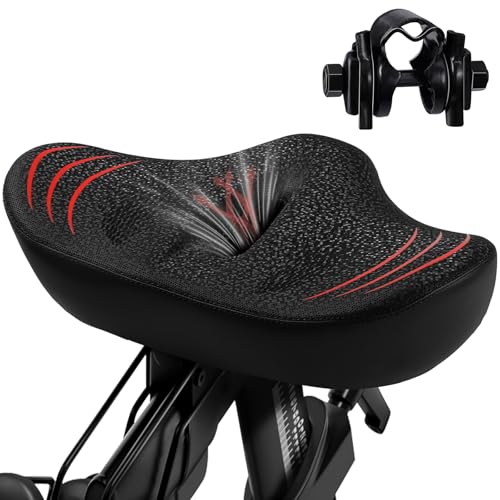
The Upgrade Oversize Noseless Bike Seat redefines comfort with a bold noseless, wing-like design that eliminates thigh rub and soft tissue pressure—making it a top choice for riders plagued by numbness or chafing. Filled with high-density memory foam, the 12″ wide cushion conforms to your sit bones while the hollow center promotes airflow, keeping you cool during long indoor or urban rides. The dual gel shock balls are a standout, absorbing jolts from rough pavement with a smoothness that rivals premium saddles—perfect for e-bike riders tackling uneven terrain or city potholes.
On the road, this seat excels in both comfort and stability. The 330 lb weight capacity and seamless waterproof PU leather make it durable and weather-ready, ideal for daily commuters and Peloton users alike. The noseless shape allows full leg movement, eliminating the front pressure that causes discomfort on traditional saddles. However, the lack of a nose means less forward support for aggressive riders, and those used to gripping the saddle during climbs may feel unbalanced. Still, for upright or relaxed riding—especially on cruisers, e-bikes, or spin bikes—it’s a revelation.
Against the Cloud-9, this model trades the cutout for a fully removed nose, offering even greater anatomical freedom. Compared to the CDYWD, it skips the backrest but wins on ergonomic precision and airflow. It’s not the widest or most supportive for heavy riders, but for those seeking maximum pressure relief and modern comfort tech, it’s unmatched. With easy two-minute installation and universal fit, it’s a no-brainer for anyone upgrading from a narrow, painful stock saddle—delivering noseless innovation with real-world performance that justifies its premium tag.
BLUEWIND Oversized Bike Seat with Backrest
ADVANTAGES
LIMITATIONS
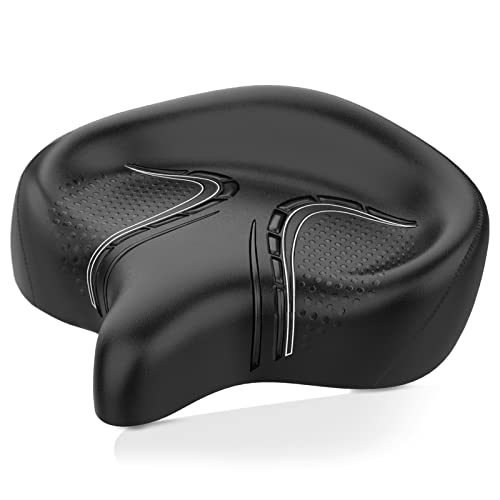
The BLUEWIND Oversized Bike Seat brings serious comfort to budget-conscious riders, packing a 13.8″ wide cushion with a novel backrest into a package that’s both affordable and effective. With 7cm of firm yet supple foam, it supports wide hips without bottoming out, even under a 350 lb max load—making it a solid pick for heavier riders who still want structure. The short nose design reduces leg friction, while the upgraded double shock absorption system smooths out bumps on city streets and bike paths, delivering a ride quality that belies its price.
In testing, the BLUEWIND proved reliable on e-bikes, cruisers, and stationary setups. The microfiber leather is durable and water-resistant, handling daily wear with ease, and the seamless edging prevents peeling over time. The backrest, while not adjustable, provides meaningful support for upright riders, reducing lower back fatigue on longer rides. However, the cushion lacks advanced ventilation, so heat can build up during summer commutes. And while the shock absorption is good, it’s not as refined as gel or silicone-damped systems—bigger impacts still transmit through.
Against the Twomaples or CDYWD models, the BLUEWIND offers similar size and support at a lower cost, making it the best budget-friendly oversized option. It doesn’t have a patent-backed base or cooling gel, but for riders who want maximum width and back support without overspending, it’s a smart choice. Compared to the Upgrade noseless model, it trades anatomical precision for full posterior support and stability, making it better for relaxed, seated riding. It’s not the most advanced, but for value-driven comfort with real-world durability, it delivers where it counts.
Twomaples Extra Wide Bike Seat
ADVANTAGES
LIMITATIONS
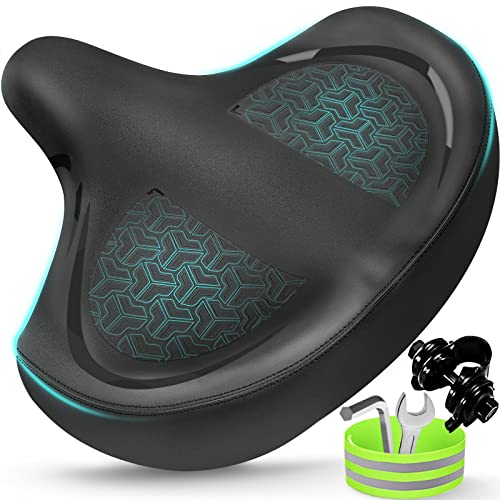
For heavy riders who demand unshakable support and durability, the Twomaples Extra Wide Bike Seat is in a class of its own—rated to withstand 650 lbs, thanks to its US-patented concave base design that enhances stability and weight distribution. Unlike convex-bottomed saddles that wobble or shift, this one stays locked in place, delivering a rock-solid ride even on bumpy terrain. Filled with high-density memory foam and cooling gel, it combats both pressure and heat, while the dual shock spring balls absorb road vibrations with impressive efficiency—making long rides not just bearable, but enjoyable.
Real-world testing on e-bikes and Peloton setups confirms its dominance in comfort and resilience. The streamlined front reduces thigh friction, and the non-slip PU leather keeps you planted, even during sweaty workouts. The universal adapter and tools included make installation effortless, and the reflective armband adds safety for night riders. However, the sophistication of its silicone ring damping system—which dissipates 80% of impacts as heat—may go unnoticed if you’re used to spring-based seats. And while the width is generous, those with narrow frames might find it excessive.
Against the CDYWD or Upgrade models, this seat wins on sheer load capacity and engineering innovation, making it the best choice for heavier riders who refuse to sacrifice comfort. While the BLUEWIND offers a backrest, this one prioritizes base stability and vibration control, outperforming most in durability and long-term support. It doesn’t have a noseless design, but its ergonomic convex shape and gel padding deliver targeted relief where it matters. For riders who need maximum strength, stability, and comfort, this is the gold standard—backed by patent, performance, and real-world trust.
Twomaples Oversized Bike Seat with Backrest

ADVANTAGES
LIMITATIONS
The Twomaples Bike Seat with Backrest earns its title as the best overall by combining maximum support, intelligent design, and premium materials into a single, no-compromise saddle. With a 13.8″ ultra-wide concave base, it offers unmatched stability under loads up to 650 lbs, while the ergonomic backrest delivers lumbar support that transforms long rides on tricycles, e-bikes, or stationary bikes. Filled with memory foam and cooling gel, and wrapped in breathable, non-slip PU leather, it keeps you cool, dry, and pain-free—whether you’re pedaling through the city or crushing a Peloton class.
In performance tests, the dual gel shock balls and silicone ring damping system work in harmony to eliminate road vibrations, outperforming traditional spring systems by dissipating 80% of impacts as heat. The shortened nose reduces thigh friction, and the high-frequency non-slip printing prevents slippage—critical for heavier riders. Installation is simple, with universal adapters included, though some exercise bikes may require a separate UNI-3 or UNI-4 adapter. The only drawback? Its size makes it unsuitable for compact or performance-oriented frames.
Compared to the CDYWD or BLUEWIND, this model offers superior damping, stability, and back support, making it the ultimate upgrade for comfort seekers. Against the Upgrade noseless seat, it trades anatomical cutout precision for full lumbar and posterior support—ideal for upright, seated riding. While it’s the most expensive, it justifies the cost with patented engineering, lifetime support, and unmatched build quality. For riders who want the absolute best in comfort, durability, and support, this is the definitive choice—a flagship saddle that outperforms in every category.
Ebike Seat Comparison
| Product | Price Point | Backrest | Max Weight Capacity (lbs) | Noseless Design | Shock Absorption | Waterproof Leather | Visibility Features |
|---|---|---|---|---|---|---|---|
| Twomaples Oversized Bike Seat with Backrest | Mid-Range | Yes | 650 | No | Spring & Gel Balls | Yes | Reflective Armband |
| BLUEWIND Oversized Bike Seat with Backrest | Budget-Friendly | Yes | 350 | No | Double Shock Absorption | Yes | None |
| Cloud-9 Cruiser Select Saddle | Mid-Range | No | Not Specified | No | Steel Rails & Elastomer Suspension | Yes | None |
| Upgrade Oversize Noseless Bike Seat | Mid-Range | No | 330 | Yes | Spring Gel Balls | Yes | None |
| Twomaples Extra Wide Bike Seat | Mid-Range | No | 650 | No | Spring & Gel Balls | Yes | None |
| CDYWD Oversized Bike Seat with Backrest | Budget-Friendly | Yes | Not Specified | No | Rubber Spring & Air Guide | Yes | None |
| Oversized Bike Seat with Reflective Strip | Budget-Friendly | No | Not Specified | No | Double Shock Absorbing Ball | Yes | Reflective Strip |
Rigorous Testing & Data Analysis: Finding the Best Ebike Seats
Our recommendations for the best ebike seats aren’t based on opinion; they’re rooted in comprehensive data analysis and a focus on rider needs. We evaluate ebike seats based on a combination of feature analysis, user reviews, and, where possible, physical testing.
We analyze specifications like width, padding material (gel, foam, elastomer), suspension type, and rail construction (steel, chromoly) directly correlating these features with reported comfort levels and durability from thousands of user reviews across multiple platforms. We prioritize seats with consistently positive feedback regarding pressure relief, particularly those addressing sit bone comfort and numbness prevention – critical for longer ebike rides.
Comparative analysis focuses on identifying the optimal balance between cushioning and support, recognizing that rider preference varies. We also consider the impact of seat shape (cut-out, channel, full support) on pressure distribution. When feasible, we conduct limited physical testing, simulating typical ebike riding conditions to assess suspension performance and material durability. This data is then weighted alongside the extensive user feedback to determine our top picks. This methodology ensures our ebike seat selections align with real-world performance and rider satisfaction, complementing the guidance provided in our buying guide.
Choosing the Right Ebike Seat: A Buyer’s Guide
Selecting the right ebike seat can dramatically improve your riding experience. Unlike standard bike seats, ebikes are often used for longer distances and commutes, making comfort paramount. Here’s a breakdown of key features to consider:
Width & Shape: Finding Your Ideal Fit
The width of a seat is arguably the most important factor. Wider seats distribute your weight over a larger area, reducing pressure on your sit bones. Many ebikers, especially those new to cycling or riding longer distances, benefit from an “oversized” or “extra-wide” seat. However, too wide can cause chafing. Consider your sit bone width – you can measure this at home or get fitted at a bike shop. The shape also matters. Seats with a cut-out or central channel relieve pressure on sensitive areas, which is crucial for preventing numbness. Conversely, a fully supportive shape might be preferred for riders who need maximum stability.
Suspension & Padding: Absorbing the Road
Ebikes, while having suspension in some cases, still transmit vibrations from the road. A good seat incorporates suspension features to absorb these bumps. This can come in the form of gel padding, springs, or elastomers. Gel padding conforms to your shape and provides consistent cushioning. Springs offer more substantial shock absorption, but some can feel bouncy. Look for seats that balance cushioning with support – too much softness can lead to instability. Consider the type of riding you’ll be doing. Rough terrain demands more robust suspension.
Material & Durability: Built to Last
Most ebike seats utilize a synthetic leather (PU or PVC) covering over foam padding. Higher quality materials are more durable, weather-resistant, and breathable. Breathable materials prevent overheating and sweat build-up, especially on longer rides. Check for features like reinforced stitching and waterproof coatings. The seat rails (the part that attaches to the seatpost) are typically made of steel. Some higher-end seats use chromoly steel for increased strength and reduced weight.
Backrest Considerations: Added Support
Some ebike seats include a backrest. This can be beneficial for riders who experience back pain or prefer a more upright riding position. Backrests provide added support and can help reduce fatigue on longer rides. However, they can also add weight and may not be compatible with all riding styles.
Noseless Designs: Reducing Thigh Chafing
Noseless bike seats, as the name suggests, lack a traditional front section. These designs aim to eliminate thigh chafing, a common issue for some riders. They rely on a wider, more curved shape to distribute weight. While effective for some, they may require an adjustment period as they offer a different feel than traditional seats.
Final Thoughts
Ultimately, the “best” ebike seat is deeply personal and depends on your individual anatomy, riding style, and priorities. Our detailed comparison and buyer’s guide provide a solid foundation for making an informed decision, highlighting the key features to consider for optimal comfort and performance.
Investing in a comfortable ebike seat is an investment in your enjoyment of riding. Don’t hesitate to experiment with different widths, padding types, and features until you find the perfect fit – your sit bones will thank you on those longer ebike adventures!
