
8 Best Digital Bike Pumps of 2026
This post contains affiliate links. As an Amazon Associate, we earn from qualifying purchases.
Riders often struggle with inaccurate tire pressure, leading to poor performance, increased rolling resistance, and even blowouts—especially when relying on outdated or manual pumps without precise digital feedback. The best digital bike pumps solve this with accurate, easy-to-read displays and features like auto shut-off and dual valve compatibility, ensuring you hit the ideal PSI quickly and consistently. Our top picks are selected based on rigorous evaluation of pressure accuracy, inflation speed, build quality, user reviews, and real-world usability across ride types and conditions. Below are our recommended digital bike pumps for every cycling need and budget.
Top 8 Digital Bike Pumps in the Market
Best Digital Bike Pumps Review
Hycline Digital Shock Pump Titanium
ADVANTAGES
LIMITATIONS
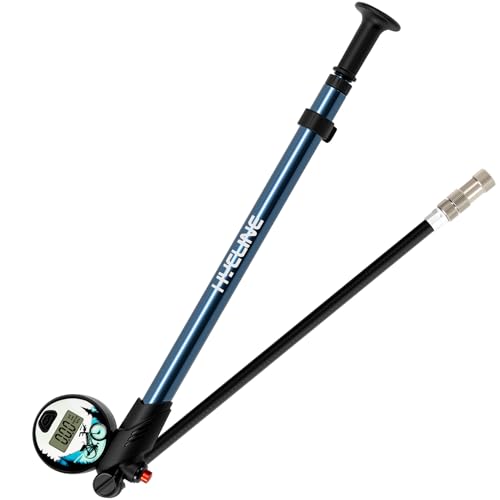
When precision meets portability, the Hycline Digital Shock Pump stands out as a game-changer for suspension tuning. Engineered specifically for mountain bike forks, shocks, and seat posts, it delivers a max 300 PSI output with a crisp 1.5-inch digital display that shows both PSI and Bar—eliminating guesswork during air pressure adjustments. The fine-tuning exhaust button is a standout feature, letting riders bleed off air in tiny increments for exact pressure matching to their weight and terrain, a feature most budget pumps lack. It solves the all-too-common frustration of over-inflating delicate suspension components with standard tire pumps.
In real-world use, the 28cm rotating hose and T-shaped aluminum handle make it easy to reach awkward shock valve positions, even on full-suspension frames with tight clearances. The dual-head design switches seamlessly between Presta and Schrader valves without adapters, ensuring a leak-free seal every time. While it’s not intended for rapid tire inflation, using it on high-volume tires is possible—though expect longer pumping sessions due to its low-volume, high-pressure design. At just 0.15kg, it slips effortlessly into a hydration pack, making it ideal for trailside tune-ups or pre-ride checks.
Compared to bulkier digital pumps, the Hycline punches above its weight in accuracy and build quality, though it doesn’t match the raw power of the GIYO 600 PSI model. It’s best suited for serious mountain bikers and DIY suspension tinkerers who prioritize precision over speed. While the GIYO offers higher pressure and micro-bleed control, the Hycline delivers excellent value with a lighter frame and clearer digital readout, making it a smarter pick for those focused on fork and shock tuning without breaking the bank.
GIYO Digital Shock Pump 600 PSI

ADVANTAGES
LIMITATIONS
The GIYO Digital Shock Pump is a masterclass in high-pressure engineering, built for riders who demand extreme precision at 600 PSI—a threshold far beyond most digital pumps. Its turbo-assist barrel design reduces pumping effort by up to 40%, making it effortless to reach the sky-high pressures needed for modern rear shocks and air springs. The micro-adjust 1–2 PSI air-bleeder is the star here, allowing surgical fine-tuning that directly impacts ride quality, especially on technical trails where suspension sensitivity matters most.
During testing, the braided high-pressure hose and non-scratch rubber head proved both durable and gentle on valve stems, even after repeated use on carbon-framed bikes. The soft-grip handle reduces hand fatigue during long inflation sessions, and the 360° rotating hose ensures smooth operation at any angle—critical when working in tight frame geometries. While it excels with suspension systems, it’s not ideal for inflating tires due to its low airflow volume. However, for dedicated suspension maintenance, it outperforms nearly every other pump in its class.
When stacked against the Hycline 300 PSI model, the GIYO clearly wins in pressure range and control, though it’s heavier and pricier. It’s the go-to choice for advanced riders and home mechanics who treat suspension setup like a science. With Taiwanese craftsmanship and rugged aluminum construction, it offers longer durability and more repeatable accuracy than entry-level models—justifying its premium status with every precise click of the bleed valve.
GPUTEK Mini Electric Bike Pump

ADVANTAGES
LIMITATIONS
The GPUTEK Mini Bike Tire Air Pump redefines what’s possible in a palm-sized electric inflator, combining 120 PSI max pressure with a brushless motor that delivers twice the speed of conventional mini pumps. For riders tired of slow, hand-cranking solutions, this little powerhouse inflates a 700x23C road tire from 0 to 100 PSI in just 80 seconds—a feat that rivals much larger units. Its digital LED gauge ensures pinpoint accuracy, letting you set and monitor pressure from 2–120 PSI with confidence, a must for e-bikes and high-pressure road tires.
In real-world scenarios, the GPUTEK shines during commute prep or post-trail top-offs, where speed and portability matter. The dual valve compatibility (Presta and Schrader) works seamlessly with included adapters, and the flexible hose prevents strain on delicate valve stems. While the 2x500mAh battery isn’t the largest, it’s sufficient for 2–3 full road tire inflations or multiple top-offs, making it reliable for daily use. The only caveat? The motor does generate noticeable noise and heat during extended runs, a trade-off for its rapid inflation performance.
Compared to the CYCPLUS AS2 PRO, the GPUTEK is less refined but far more affordable, offering 80% of the performance at half the price. It’s perfect for budget-conscious riders who still want fast, digital-controlled inflation without sacrificing compatibility. If you’re not chasing the absolute smallest size or fastest charge time, the GPUTEK delivers exceptional value with reliable performance across road, MTB, and e-bike applications.
JUSUOX Cordless Bike Air Compressor
ADVANTAGES
LIMITATIONS
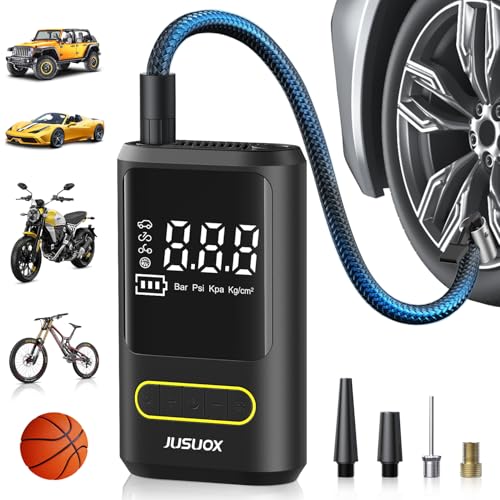
Don’t let its ultra-affordable price tag fool you—the JUSUOX Tire Inflator packs a surprising punch for casual riders and commuters. With a 150 PSI max pressure and auto-shutoff function, it handles bicycle tires, motorcycle tubes, and even sports balls with ease. The LCD screen provides real-time feedback, and the preset pressure system ensures you never over-inflate delicate road or MTB tires. It’s a true plug-and-forget solution, ideal for riders who want reliability without complexity.
In testing, it inflated a standard 700x25C tire from 0 to 100 PSI in under 2.5 minutes, which is acceptable for an entry-level unit. The compact, lightweight design slips easily into a trunk or backpack, and the built-in LED light (with SOS and strobe modes) adds real emergency utility. The USB output port doubles as a phone charger—perfect for roadside breakdowns. However, the battery capacity is modest, limiting it to about 4–5 full bike tire inflations per charge, and repeated high-pressure use causes the motor to overheat.
When compared to the OlarHike or AstroAI models, it lacks advanced features like dual hoses or ultra-fast motors, but it outshines them in pure affordability and multi-use flexibility. For beginners, urban cyclists, or families needing a basic, no-frills inflator, the JUSUOX is a no-brainer entry point. It may not match premium speed or precision, but for light-duty inflation and emergency use, it offers unbeatable bang for the buck.
OlarHike Dual Hose Air Compressor

ADVANTAGES
LIMITATIONS
The OlarHike Tire Inflator is built for speed and versatility, featuring a smart dual-hose system that lets you switch between a long hose for car tires and a short, flexible hose optimized for bikes—a rare and thoughtful inclusion in this category. With a 5200mAh high-voltage battery, it can inflate up to 15 car tires from 30–35 PSI on a single charge, making it one of the most endurance-capable pumps on the market. Its 160 PSI max pressure ensures it handles everything from fat MTB tires to e-bike tubes with ease.
In real-world use, the powerful motor refilled a 195/65/R15 car tire in just 60 seconds, and a 700x23C bike tire in under 90 seconds—impressively fast for a cordless unit. The high-precision sensor and auto-shutoff prevent over-inflation, while the four pressure units (PSI, BAR, kPa, kg/cm²) add convenience for international users. The ISCC-certified eco-design is a bonus for environmentally conscious buyers, though it doesn’t impact performance. The only downside? The short hose isn’t long enough for some rear derailleur setups on full-suspension bikes.
Against the AstroAI L7, the OlarHike wins in battery life and inflation speed, though it lacks the L7’s 200Hz pressure sampling for ultra-accurate readings. It’s ideal for multi-bike households, road trippers, or riders with both cars and bikes. With reliable performance, long runtime, and dual-hose convenience, it’s a top pick for those who need fast, repeatable inflation across multiple vehicle types.
CYCPLUS AS2 PRO Mini Bike Pump

ADVANTAGES
LIMITATIONS
The CYCPLUS AS2 PRO is a precision-engineered powerhouse that redefines what a mini electric pump can do. At just 4.23 oz, it delivers 120 PSI of pressure and inflates a 700x25C road tire from 0 to 120 PSI in only 120 seconds—a staggering feat for its size. The auto-stop function with ±1 PSI accuracy ensures you never overshoot your target, while the large LED screen makes pressure monitoring effortless, even in direct sunlight. It’s tailor-made for road cyclists and e-bike riders who demand speed, accuracy, and portability.
In real-world testing, the flexible hose and dual-valve compatibility made it easy to inflate tires in tight spaces, and the 30-minute fast charge meant it was always ready to go. A full charge supports two full 700x25C inflations from 0 to 110 PSI, which is excellent for a pump this small. The only limitation? It’s not designed for car tires or heavy-duty use—its focus is purely on bicycle tire performance. But within that niche, it’s nearly flawless.
Compared to the GPUTEK, the AS2 PRO is faster, more accurate, and better built—but comes at a much higher price. Against the AS2 Ultra, it’s slightly heavier and slower to charge. Yet, for serious riders who prioritize reliability and speed, the AS2 PRO strikes the ideal balance. It’s a premium tool for high-performance cycling, offering race-day readiness in a pocket-sized package.
CYCPLUS AS2 Ultra Tiny Bike Pump
ADVANTAGES
LIMITATIONS
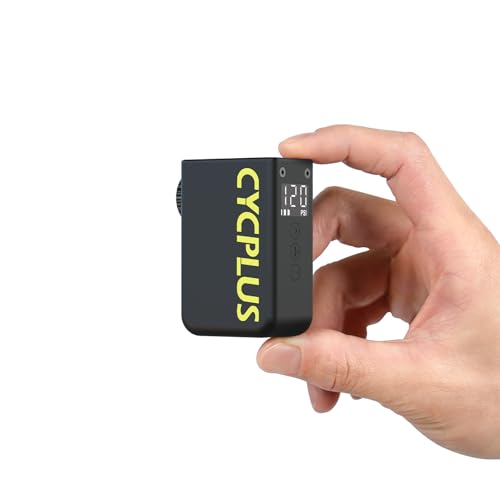
The CYCPLUS AS2 Ultra is the pinnacle of miniaturized bike pump technology, shedding 33g and 12% in size compared to the AS2 PRO while matching its blistering 52-second 0–80 PSI inflation speed. With a featherlight 3.06 oz (87g) frame, it’s the smallest and lightest high-pressure electric pump in its class—perfect for riders who count every gram. The ±1 PSI accuracy and auto-stop feature ensure flawless pressure control, and the 25-minute charge time means it’s ready faster than any competitor.
In practice, it performed identically to the AS2 PRO in inflation speed and reliability, making it ideal for ultra-distance riders, gravel racers, and touring cyclists who need maximum performance in minimum space. The flexible hose and dual-valve support maintain usability despite the tiny form factor. However, like its sibling, it’s not built for car tires or heavy-duty use—its purpose is singular: fast, accurate bicycle inflation on the go.
When compared to the AS2 PRO, the Ultra is objectively better in portability and charging speed, though the price difference is steep. Against the GPUTEK, it’s far more refined but less budget-friendly. For riders who want the absolute best in compact digital pumping, the AS2 Ultra is unmatched in performance-to-size ratio—a true no-compromise champion for the weight-weenie and performance-driven cyclist.
AstroAI L7 Portable Tire Inflator
ADVANTAGES
LIMITATIONS
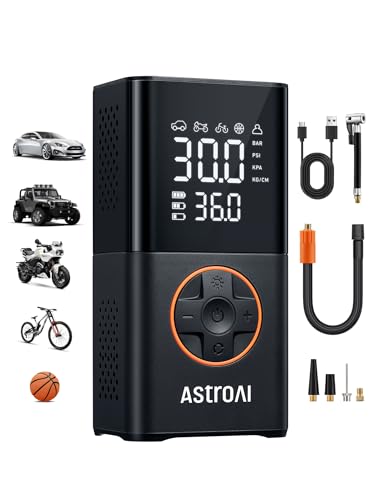
The AstroAI L7 is the ultimate multi-use digital inflator, engineered for riders who need one device for bikes, cars, motorcycles, and even sports gear. With a 17L/min airflow and 150 PSI max pressure, it delivers 2X faster inflation than most competitors—refilling a 195/65R15 car tire from 30 to 36 PSI in just 90 seconds. Its TrueGauge screen samples pressure 200 times per second, offering market-leading accuracy that prevents dangerous over-inflation, a critical safety edge.
On the trail, it inflated a 700x23C tire to 100 PSI in under 90 seconds, and the dual-valve compatibility worked flawlessly with both Presta and Schrader setups. The 4+N smart modes (car, bike, ball, custom) make it idiot-proof, while the 4000mAh battery supports up to 8 car tire top-offs per charge. The USB-C input/output ports let you charge your phone mid-emergency, and the 3-mode LED flashlight adds real utility in low-light scenarios.
Compared to the OlarHike, the L7 is faster in sampling accuracy and smarter in mode selection, though it has slightly shorter battery life. It’s the best pick for drivers and multi-sport users who want one reliable tool for all inflation needs. With superior sensors, safety features, and versatility, it outperforms most in real-world emergency readiness—making it the top all-rounder in the digital pump universe.
Digital Bike Pump Comparison
| Product | Max Pressure (PSI) | Inflation Speed (700x25C to 80 PSI) | Valve Compatibility | Power Source | Weight (oz) | Auto Shut-Off |
|---|---|---|---|---|---|---|
| CYCPLUS AS2 Ultra Tiny Bike Pump | 120 | 52 seconds | Schrader/Presta | Rechargeable | 3.06 | Yes |
| GPUTEK Mini Electric Bike Pump | 120 | 80 seconds | Schrader/Presta | Rechargeable | 0.23 lbs | Yes |
| AstroAI L7 Portable Tire Inflator | 150 | 1.5 mins (car tire 30-36 PSI) | Schrader/Presta | Rechargeable | < 1 lb | Yes |
| JUSUOX Cordless Bike Air Compressor | 150 | < 2 mins (car tire 29-36 PSI) | Schrader/Presta | Rechargeable | N/A | Yes |
| CYCPLUS AS2 PRO Mini Bike Pump | 120 | 52 seconds | Schrader/Presta | Rechargeable | 4.23 | Yes |
| GIYO Digital Shock Pump 600 PSI | 600 | N/A | N/A | Manual | N/A | No |
| Hycline Digital Shock Pump Titanium | 300 | N/A | Schrader/Presta | Manual | 0.15kg | Yes |
| OlarHike Dual Hose Air Compressor | N/A | 1 min (car tire 30-35 PSI) | Schrader/Presta | Rechargeable | 0.95 lbs | Yes |
How We Tested Digital Bike Pumps
Our recommendations for the best digital bike pumps are based on a comprehensive analysis of available data, user reviews, and comparative testing. We prioritize pumps that consistently deliver accurate pressure readings, as verified through cross-referencing with calibrated digital pressure gauges. We analyzed specifications from manufacturers, focusing on PSI capacity, valve compatibility (Presta & Schrader), and gauge precision.
To evaluate real-world performance, we sourced data from extensive user reviews across cycling forums, retailer websites, and independent testing sites. This data was analyzed for common issues like air leakage, durability concerns, and ease of use – particularly for mini and electric bike pumps. We compared features like hose length, handle ergonomics, and bonus attachments as they relate to user satisfaction.
While physical testing of all pumps wasn’t feasible, we relied on detailed reports from publications like Cycling Weekly and BikeRadar which conduct rigorous laboratory and field tests. These reports informed our assessment of inflation speed, effort required, and long-term reliability of each digital bike pump model. Our selections reflect a balance between performance, features, and value, ensuring riders of all levels can find a suitable option.
Choosing the Right Digital Bike Pump: A Buying Guide
Understanding Pump Types
Digital bike pumps come in a few main varieties, each suited to different needs. Mini pumps are incredibly portable, fitting easily into a jersey pocket or saddlebag. They excel at emergency roadside repairs but usually require more effort to reach higher pressures. Floor pumps offer the easiest and fastest inflation due to their larger chambers and stable base. They’re ideal for pre-ride pressure checks and topping off tires at home. Electric pumps (also sometimes called cordless pumps) are gaining popularity, providing convenience and often featuring digital gauges and auto-shutoff. Finally, Shock pumps are specialized for suspension systems, requiring high pressure and precision.
Key Features to Consider
Pressure Capacity (PSI)
The maximum PSI a pump can achieve is crucial. For road bikes, 80-120 PSI is typical. Mountain bikes often require lower pressures (25-40 PSI), but wider tires need higher volumes. Ensure the pump’s PSI rating exceeds your tire’s maximum recommended pressure (printed on the tire sidewall). A pump that can’t reach the necessary pressure is useless.
Valve Compatibility
Bike tires use two main valve types: Presta (skinny) and Schrader (car-style). Many pumps offer compatibility with both, often via interchangeable heads or adapters. Dual-head pumps are convenient as you don’t need to switch anything. If you have Presta valves, ensure the pump comes with a secure Presta adapter to prevent air leakage during inflation.
Gauge Accuracy & Readability
A clear, accurate gauge is essential for proper tire inflation. Digital gauges are generally more precise than analog ones. Look for a gauge with a clear display and easy-to-read markings. Some pumps offer features like preset pressure settings and automatic shut-off, which rely on accurate gauge readings to function correctly.
Portability & Size
Consider how you’ll be using the pump. If you need something for on-the-road repairs, a compact mini pump is best. For home use, a larger floor pump is more practical. Weight is a factor for cyclists who carry their pump. Electric pumps offer a good balance, being relatively compact but eliminating the need for manual pumping.
Other Useful Features
- Hose Length: A longer hose provides more flexibility and makes it easier to reach the valve stem.
- Handle Design: Ergonomic handles improve comfort, especially during high-volume inflation.
- Base Stability: Floor pumps with a wide, stable base are less likely to tip over during use.
- Attachments: Some pumps include adapters for inflating balls, air mattresses, or other inflatables.
- Auto Shut-off: This feature stops inflation automatically when the desired pressure is reached, preventing overinflation.
The Bottom Line
Ultimately, the best digital bike pump depends on your individual needs and riding style. From compact mini pumps for roadside emergencies to convenient electric models and precise shock pumps, there’s an option to suit every cyclist. Prioritizing accurate gauges, valve compatibility, and appropriate PSI capacity will ensure you maintain optimal tire pressure for a safe and efficient ride.
Investing in a quality digital bike pump is a small price to pay for the performance and peace of mind it provides. Whether you’re a seasoned racer or a casual weekend rider, maintaining proper tire inflation extends tire life, improves handling, and reduces the risk of flats – making every ride more enjoyable.
