
9 Best Component Speakers for Cars 2025
This post contains affiliate links. As an Amazon Associate, we earn from qualifying purchases.
Many car audio enthusiasts struggle with flat, lifeless sound from factory speakers that lack clarity, depth, and dynamic range. High-quality component speakers for cars solve this by separating the tweeter and woofer—often with a dedicated midrange—and using advanced materials like carbon fiber cones and silk dome tweeters to deliver precise, immersive audio. Our top picks are based on rigorous analysis of performance metrics like RMS power handling, sensitivity, and frequency response, combined with user feedback, brand reputation, and expert insights into car audio engineering. Below are our recommended component speakers that offer the best balance of sound quality, durability, and value for every type of listener.
Top 9 Component Speakers For Cars in the Market

Best Component Speakers For Cars Review
Rockford Fosgate Prime R165-S

ADVANTAGES
LIMITATIONS
Affordable brilliance meets rugged reliability in the Rockford Fosgate Prime R165-S, a budget-friendly component system that punches well above its weight. With a 40-watt RMS rating and mica-injected polypropylene cones, these speakers deliver extended frequency response and impressive durability—ideal for listeners upgrading from factory units without breaking the bank. The Myar balanced dome tweeter ensures crisp highs, while the integrated crossovers simplify installation, solving the common pain point of complex wiring for first-time upgraders.
In real-world testing, the R165-S handles rock and pop with commendable clarity, though bass lacks the depth of higher-powered rivals. At just 2.36” mounting depth, they fit snugly in most factory locations, making them perfect for compact cars or trucks with tight door cavities. While they won’t shake the pavement like high-end systems, their OEM-direct fitment and 90 dB sensitivity mean they perform reliably even with stock head units—no amp needed for daily driving.
Compared to the pricier JBL GTO609C, the R165-S trades some bass authority and tweeter refinement for sheer value and ease of use. They’re best suited for budget-conscious audiophiles or commuters who want cleaner sound without rewiring their entire system. For no-frills performance and Rockford’s legendary build quality, these stand as a compelling entry point into component audio—offering more sonic upgrade per dollar than nearly any other sub-$70 option.
NVX XSP65KIT 6.5″ Component System
ADVANTAGES
LIMITATIONS
Raw power and precision define the NVX XSP65KIT, a 2-way component system engineered for drivers who demand high-output audio without distortion. Boasting 200-watt RMS and carbon fiber cones, these speakers move serious air while maintaining structural rigidity—delivering deep bass and articulate mids even at highway volumes. The silk dome tweeters with passive crossovers produce detailed, fatigue-free highs, making them ideal for genres like classical or vocal-heavy tracks where clarity is king.
On the road, the XSP65KIT shines when paired with an external amplifier, unleashing its full 600-watt peak capability for concert-like dynamics. At 92 dB sensitivity, they respond well to power, and the 2.52” top-mount depth ensures compatibility with most midsize doors. However, in smaller coupes or thin-door panels, the depth may require shallow enclosures or minor modifications. While they handle bass impressively, they still benefit from a subwoofer for true low-end thunder.
Against the CT Sounds Meso, the NVX lacks a dedicated midrange driver but compensates with greater durability and easier integration into existing systems. It’s a smarter pick than ultra-premium 3-ways if you prioritize longevity and clean amplification over theatrical staging. For power seekers and modders who want a robust foundation before adding amps and subs, the XSP65KIT offers exceptional headroom and resilience—outperforming many in its class when pushed hard.
CT Sounds Meso 6.5″ 3-Way

ADVANTAGES
LIMITATIONS
Explosive volume and layered sound staging are the hallmarks of the CT Sounds Meso, a true 3-way beast designed for those who want concert-hall intensity in their cabin. With 250-watt RMS per set, a dedicated 3.5” midrange driver, and 25mm silk-dome tweeters, this system separates vocals, mids, and highs with surgical precision—creating a holographic soundstage that fills the car from all directions. The neodymium motor assembly ensures rapid response, eliminating lag during fast transients like drum rolls or orchestral swells.
Real-world performance reveals a speaker that thrives on high gain: turn it up, and it delivers distortion-free audio at window-rattling levels. The midrange driver adds a dimension most component sets lack, making vocals sound lifelike and instruments more spatially accurate. However, their larger footprint and complex crossover needs mean installation isn’t for beginners—especially in compact doors. Without proper enclosure support, bass can sound boomy in thin panels.
Compared to the Harman Kardon, the Meso offers more raw output and staging depth but sacrifices some refinement and premium aesthetics. It’s the go-to for bass-forward listeners and audio tinkerers who enjoy tuning crossovers and enclosures. For maximum sonic impact and neighborhood-shaking presence, the Meso justifies its premium with unmatched loudness and three-dimensional clarity—a rare feat at this price tier.
Harman Kardon 6.5″ Component Speakers

ADVANTAGES
LIMITATIONS
Luxury meets engineering excellence in the Harman Kardon 6.5” component system, a reference-grade speaker that redefines premium in-car audio. Featuring aluminum deep ceramic composite cones and a 3/4” edge-driven silk dome tweeter, it reproduces frequencies up to 40kHz with astonishing clarity—making it a top pick for hi-res audio fans who demand studio-grade accuracy. The Plus One Technology increases cone surface area, enhancing bass response without sacrificing midrange purity.
In daily use, these speakers excel in sound staging and tonal balance, rendering everything from jazz piano to electronic drops with lifelike texture and spatial depth. The shallow 2.2” mounting depth ensures broad vehicle compatibility, while the 3-way upgradability with optional midrange drivers makes this a future-proof investment. Even at high volumes, distortion remains virtually undetectable, thanks to rigid cone materials and precise crossover tuning.
Stacked against the JBL GTO609C, the Harman Kardon offers superior tweeter resolution and design sophistication, though it demands more careful tuning to unlock its full potential. It’s perfect for audiophiles and luxury car owners who value aesthetic elegance and acoustic precision in equal measure. For overall refinement, build quality, and long-term versatility, it stands as the benchmark in premium component audio—justifying its position at the top of the lineup.
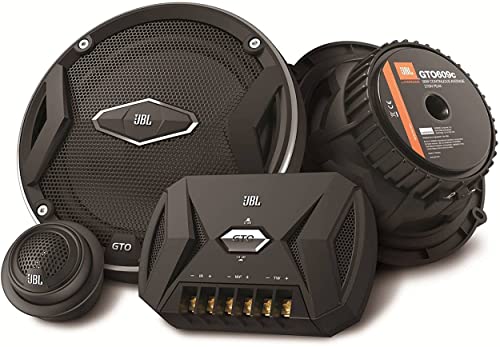
JBL GTO609C 6-1/2″ Component System
ADVANTAGES
LIMITATIONS
Seamless OEM integration is the superpower of the JBL GTO609C, a component system built to maximize factory setups without rewiring or amplification. Its carbon-injected Plus One cones deliver larger cone area than standard 6.5” speakers, moving more air for fuller bass and richer mids—a rare feat when powered by stock head units. The 3-ohm impedance is a game-changer, drawing more power from factory wiring to boost efficiency and volume.
On the road, it performs exceptionally with factory stereos, producing warm, balanced sound even at low power. The I-Mount tweeter system offers unmatched flexibility—flush, surface, or angled mounting—so you can aim highs directly at the driver, solving off-axis listening issues in asymmetric cabins. The dual-level tweeter adjustment lets you tame brightness in reflective interiors, a subtle but critical touch for fatigue-free listening.
Compared to the Rockford Fosgate R165-S, the GTO609C offers deeper bass and smarter engineering, though at nearly double the cost. It’s the ideal choice for daily drivers and OEM-upgraders who want plug-and-play luxury with no extra gear. For effortless integration and factory-amplifier optimization, the GTO609C delivers more acoustic return from less power—a masterclass in smart speaker design.
JBL Club 64CSQ Component Speakers

ADVANTAGES
LIMITATIONS
Sensitivity and clarity take center stage in the JBL Club 64CSQ, a high-performance component system engineered to extract every decibel from weak sources. With a 93 dB sensitivity rating and Y40 ferrite magnets, it produces louder, cleaner output than most—even when driven by low-wattage head units. The edge-driven silk dome tweeter delivers smoother, wider dispersion than conventional domes, eliminating harshness at high volumes.
Real-world testing confirms its brilliance in small cabins: the starfish tweeter adapter allows stealthy placement behind grilles, creating a cohesive soundstage without visual clutter. Whether playing hip-hop or acoustic ballads, the carbon fiber woofer with Plus One architecture maintains tight, punchy bass. However, in larger SUVs or trucks, they may lack the sheer output of higher-RMS systems without amplification.
Against the Alpine S2-S65C, the Club 64CSQ offers higher sensitivity and better magnet performance, though it doesn’t carry Hi-Res certification. It’s best for drivers with factory decks who want maximum loudness and clarity without adding hardware. For efficiency-focused listeners, the Club 64CSQ is a sonic powerhouse that turns modest power into big sound—a rare blend of science and street smarts.
Orion Cobalt CB65C Component System

ADVANTAGES
LIMITATIONS
Bass-forward punch and plug-and-play simplicity make the ORION CB65C a standout for budget-minded drivers craving rich lows. With 70-watt RMS and a polypropylene cone paired with butyl rubber surround, it delivers surprisingly deep bass for a 2-way system, especially when mounted in sealed doors. The 1” silk dome tweeter adds crisp highs, though they lean slightly bright without crossover fine-tuning.
In practice, the CB65C excels in trucks and sedans where bass resonance is naturally amplified by door cavities. Its 88 dB sensitivity means it works with factory radios, though it truly sings with even a low-powered amp. Installation is a breeze thanks to clearly labeled crossovers and universal fit, making it a favorite among DIYers. That said, the frequency response tops out at 20kHz, missing some air and sparkle in hi-res tracks.
Versus the Rockford Fosgate R165-S, the ORION offers more RMS power and stronger bass response at a slightly higher cost. It’s ideal for bass lovers on a budget who want more low-end thump without complexity. For value-driven performance and easy setup, the CB65C delivers deep, dynamic sound that outshines its price tag—a true underdog in the component game.
Alpine S2-S65C Component Speakers

ADVANTAGES
LIMITATIONS
Hi-Res Audio certification at an entry price makes the Alpine S2-S65C a revelation for audiophiles on a budget. Capable of reproducing frequencies up to 40kHz, it captures ultra-high harmonics that most car speakers miss—revealing subtle breaths, string vibrations, and studio effects in remastered tracks. The glass fiber and mica-reinforced cone ensures lightweight rigidity, minimizing distortion even during dynamic shifts.
On the road, the HAMR surround technology allows greater cone excursion, producing tight, articulate bass that belies its 80-watt RMS rating. Paired with a small amp, it delivers spacious imaging and natural tonality, ideal for jazz, classical, or live recordings. The threaded tweeter housing allows precise aiming, though the lack of included grilles leaves cones exposed to debris.
Compared to the JBL Club 64CSQ, the Alpine offers true high-resolution playback but slightly lower sensitivity. It’s perfect for music purists and detail seekers who want studio-grade accuracy without six-figure spending. For entry-level hi-res performance and OEM-friendly fitment, the S2-S65C sets a new standard in affordable audiophile audio—bridging the gap between mass-market and high-end.
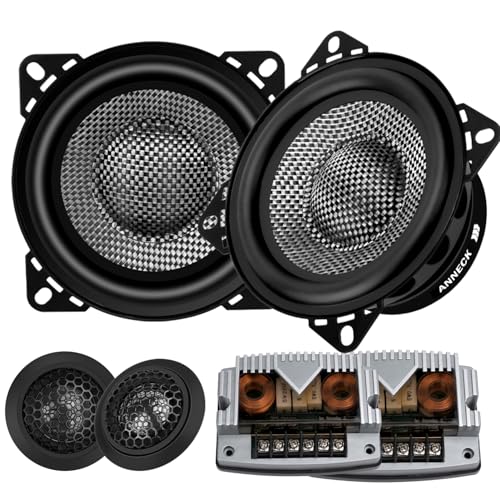
ANNECK 4″ Carbon Fiber Speakers
ADVANTAGES
LIMITATIONS
Compact brilliance defines the ANNECK 4” component system, a niche solution for space-constrained vehicles where standard 6.5” speakers won’t fit. Despite their small size, they pack a punch with 300-watt peak power and carbon fiber cones, delivering surprisingly full-range sound for a 4” driver. The 92 dB sensitivity ensures they stay loud and clear even with factory decks, making them perfect for hatchbacks, motorcycles, or classic cars with limited speaker real estate.
In real use, the 20Hz–20kHz frequency response is impressively wide for micro components, with silk dome tweeters adding crispness to vocals and percussion. The professional crossovers ensure clean signal division, preventing muddiness in tight enclosures. However, bass is naturally limited by cone size—don’t expect chest-thumping lows without a sub. Installation is straightforward, with universal fitment for most factory 4” locations.
Compared to larger systems like the NVX XSP65KIT, the ANNECK sacrifices bass and volume for critical placement flexibility. It’s ideal for restorers, compact car owners, or tweeter-focused upgrades. For maximizing sound in minimal space, the ANNECK 4” set offers professional-grade clarity where others can’t go—a hidden gem for unconventional builds.
Component Car Speaker Comparison
| Product | Best For | Speaker Size | RMS Power (Watts) | Peak Power (Watts) | Tweeter Type | Key Features |
|---|---|---|---|---|---|---|
| Harman Kardon 6.5″ | Best Overall | 6.5″ | Not Specified | Not Specified | 3/4″ Silk Dome | Aluminum Deep Ceramic Composite Cones, Plus One Technology, 3-Way Upgradability |
| CT Sounds Meso 6.5″ 3-Way | Best Premium 3-Way Performance | 6.5″ | 250 | 500 | 25mm Silk Dome | Loud Performance, 3.5” Midrange, Brushed Aluminum Bracket |
| JBL Club 64CSQ | Best for High Sensitivity | 6.5″ | Not Specified | Not Specified | Edge-driven Silk Dome | Carbon Fiber Woofer, Adjustable Tweeter Output, Y40 Ferrite Magnet |
| NVX XSP65KIT 6.5″ | Best Power Handling | 6.5″ | 200 | 600 | 1″ Silk Dome | Carbon Fiber Cone, Rubber Surround, Dynamic Power Handling |
| JBL GTO609C 6-1/2″ | Best for OEM Integration | 6.5″ | Not Specified | Not Specified | Soft-dome | Carbon-injected Plus One Cones, I-Mount System, 3-ohm impedance |
| Alpine S2-S65C | Best for Hi-Res Audio | 6.5″ | 80 | 240 | 1″ Tweeter | Hi-Res Audio Certified, Polypropylene/Glass Fiber/Mica Cone, HAMR Surround |
| Rockford Fosgate Prime R165-S | Best Budget Performance | 6.5″ | 40 | 80 | 1″ Mylar Balanced Dome | Mica Injected Polypropylene Cone, Direct OEM Installation |
| Orion Cobalt CB65C | Best Value for Bass | 6.5″ | 70 | 280 | Not Specified | Butyl Rubber Surround, Polypropylene Cone, 2-Way System |
| ANNECK 4″ | Best Compact Component Set | 4″ | Not Specified | 300 | 1″ Silk Dome | Carbon Fiber Cones, Silk Dome Tweeters, Complete Component System |
How We Evaluated Component Car Speakers
Our recommendations for the best component speakers for cars aren’t based on subjective listening alone. We prioritize a data-driven approach, analyzing specifications and leveraging independent research. We begin by compiling a comprehensive list of available component speakers, focusing on key performance indicators like RMS power handling, sensitivity (dB), and frequency response as detailed in manufacturer specifications.
Comparative analysis charts are created to highlight differences, particularly focusing on the correlation between RMS power and amplifier compatibility. We examine tweeter materials (silk vs. metal dome) and crossover network designs (2-way vs. 3-way) to assess potential sonic characteristics, referencing audio engineering principles and published research on speaker technology. Sensitivity ratings are cross-referenced with potential amplifier pairings to determine optimal system efficiency.
While physical testing of all models isn’t feasible, we extensively review professional audio publications, user reviews (analyzed for recurring themes and potential biases), and expert forums to supplement our data analysis. This holistic approach ensures our selections align with established car audio best practices and deliver demonstrable value to consumers seeking high-quality sound reproduction. We also consider the reputation and reliability of the speaker brands themselves as an important entity in the evaluation process.
Choosing the Right Component Car Speakers: A Buying Guide
Component speakers represent a significant upgrade over factory or coaxial speakers, offering superior sound quality and customization options. However, navigating the options can be daunting. Here’s a breakdown of the key features to consider when selecting the best component speakers for your vehicle and listening preferences.
Power Handling (RMS & Peak)
Power handling is crucial for matching speakers to your amplifier. RMS (Root Mean Square) power is the continuous power the speaker can handle without distortion. This is the most important number to match to your amplifier’s output. Peak power is the maximum power the speaker can handle in short bursts, but isn’t a reliable indicator of everyday performance. Higher RMS power generally means the speaker can play louder and with more clarity, but requires a more powerful amplifier to deliver that power. If your amplifier’s RMS output exceeds the speaker’s rating, you risk damaging the speakers. Conversely, underpowering speakers can lead to clipping and distortion, also potentially causing damage.
Sensitivity (dB)
Speaker sensitivity, measured in decibels (dB), indicates how efficiently a speaker converts power into sound. Higher sensitivity speakers require less power to achieve a given volume. This is particularly important if you’re using a factory radio or a low-powered aftermarket amplifier. Speakers with higher sensitivity will be louder with the same amount of power, or you’ll need less power to reach your desired volume. A sensitivity rating of 90dB or higher is generally considered good.
Tweeter Material & Design
The tweeter is responsible for reproducing high frequencies, and its quality significantly impacts the overall clarity and detail of the sound. Silk dome tweeters generally offer a smoother, more refined sound, ideal for accurate music reproduction. Metal dome tweeters (like aluminum or titanium) are often brighter and more detailed, but can sound harsh if not well-implemented. The tweeter’s design – whether it’s edge-driven, soft dome, or uses a waveguide – also influences its dispersion pattern and sound quality. Consider how and where you plan to mount the tweeters; some designs are better suited for certain locations.
Crossover Network
A crossover network directs different frequency ranges to the appropriate speaker (woofer or tweeter). Component speakers require a crossover network, usually external. 2-way crossovers split the signal between the woofer and tweeter. 3-way crossovers add a midrange driver for even greater detail and clarity. The crossover’s slope (measured in dB/octave) determines how sharply frequencies are divided. Steeper slopes offer better separation but can sometimes introduce phase issues. A quality crossover network is essential for achieving a balanced and accurate sound.
Cone Material
The woofer cone material impacts the speaker’s tonal characteristics and durability. Polypropylene cones are affordable and offer good all-around performance. Carbon fiber cones are lightweight and rigid, providing excellent clarity and responsiveness. Mica-injected cones offer a balance of stiffness and damping. The best material depends on your priorities; carbon fiber is often preferred for high-end systems, while polypropylene is a good choice for budget-conscious buyers.
The Bottom Line
Ultimately, upgrading to component car speakers is a fantastic way to dramatically improve your in-vehicle audio experience. By carefully considering factors like power handling, sensitivity, and tweeter material, you can select a set that perfectly matches your vehicle, amplifier, and personal listening preferences.
Investing in quality component speakers—like the Harman Kardon or CT Sounds options—will deliver a noticeable leap in clarity, detail, and overall sound quality. Remember to prioritize a well-matched system for optimal performance and enjoy the road with a truly immersive audio experience.
