
7 Best Coatings for RV Roofs 2026
This post contains affiliate links. As an Amazon Associate, we earn from qualifying purchases.
RV owners know the frustration of dealing with leaks, cracks, and heat buildup caused by an unprotected or deteriorating roof, which can lead to costly repairs and reduced comfort on the road. The best coatings for RV roofs solve these issues by offering exceptional flexibility, UV resistance, and waterproof protection that withstands constant movement and harsh weather—features like elastomeric stretch, high solar reflectivity, and strong adhesion to EPDM, TPO, or metal surfaces. We evaluated top contenders such as Everbond, Liquid Rubber, and Kohree based on performance data, user feedback, coverage efficiency, and real-world durability to ensure our picks deliver long-term value and reliable protection. Below are our top recommendations for the best RV roof coatings to keep your rig sealed, cool, and road-ready.
Top 7 Coatings For Rv Roofs in the Market
Best Coatings For Rv Roofs Review
Rust-Oleum Elastomeric Roof Coating

ADVANTAGES
LIMITATIONS
When blazing sun and relentless UV exposure threaten your RV’s integrity, the Rust-Oleum 301994 steps in like a reflective shield with serious muscle. Boasting an industry-leading 84% initial solar reflectivity and holding strong at 74% after weathering, this elastomeric coating isn’t just bright white—it’s engineered brilliance. Its rapid 6-hour rain resistance means you’re not left sweating a sudden downpour mid-application, a lifesaver for weekend warriors tackling roof maintenance under tight schedules. For RV owners battling heat soak and premature roof aging, this coating delivers cool, durable protection without the fuss.
In real-world use, the thick, paint-like consistency adheres well to clean EPDM and metal surfaces, though it demands proper surface prep for long-term bonding. Applied over a primed roof, it forms a tough, water-resistant membrane that handles thermal expansion better than standard acrylics—but don’t expect miracle-level elasticity. While it resists cracking in moderate climates, extreme flexing at joints or seams may expose its limits compared to 1000% flexible silicones. At 4.75 gallons, it covers up to 237 sq ft per coat, making it ideal for mid-sized RVs but requiring multiple units for larger models.
Stacked against the Wadities 4-gallon and Everbond offerings, Rust-Oleum trades ultimate flexibility for best-in-class reflectivity and faster cure times. It doesn’t match the nano-purified durability of Everbond or the full-kit completeness of Liquid Rubber’s system, but it dominates when pure heat deflection is the mission. Ideal for sunbelt dwellers and seasonal boondockers, this coating shines brightest (literally) when your priority is keeping the interior cool and cutting AC load. If maximum solar bounce matters more than ultimate stretch, Rust-Oleum is the clear thermal warrior.
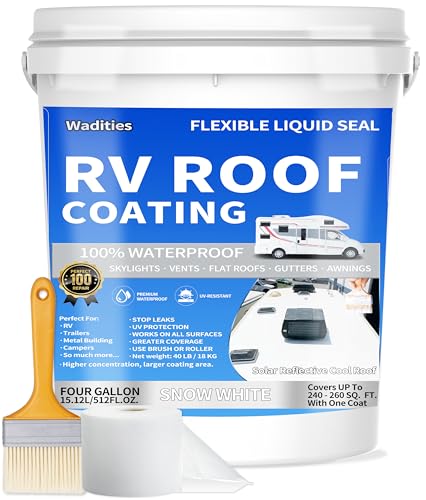
Wadities RV Roof Coating 4 Gallon
ADVANTAGES
LIMITATIONS
For RV owners with long-haul rigs and tight budgets, the Wadities 4-gallon coating emerges as a heavyweight contender built for serious coverage and lasting defense. What sets it apart is its 1000% flexibility, allowing it to move with the natural expansion and contraction of large RV roofs without cracking—a game-changer for Class A motorhomes or fifth wheels that endure constant road stress. The high-solids formulation builds a thick, durable membrane that outperforms thinner, runnier alternatives, delivering real protection rather than just a shiny layer.
During application, the coating rolls on smoothly with a brush or roller, though its viscosity demands quality tools to avoid drag. At 4 gallons covering up to 120 feet of RV roof (in 2–3 heavy coats), it’s optimized for larger builds—perfect for those who hate running out mid-project. It performs exceptionally on flat roofs and metal surfaces, maintaining UV stability over time without yellowing or embrittlement. However, while it resists ponding water well, it’s not quite as hydrophobic as silicone-based formulas, meaning pooled water over long periods may test its limits.
Compared to the Rust-Oleum and BEEST options, Wadities strikes a smarter balance between coverage, cost per square foot, and long-term flexibility. It lacks the nano-refinement of Everbond and doesn’t come with a full kit like Liquid Rubber’s system, but it delivers premium performance without the premium markup. This is the go-to for owners of large RVs seeking value without sacrificing resilience, especially those frequently on the move or parked in sunny, variable climates. When big roof + big protection is the goal, Wadities delivers bigger bang for the buck.
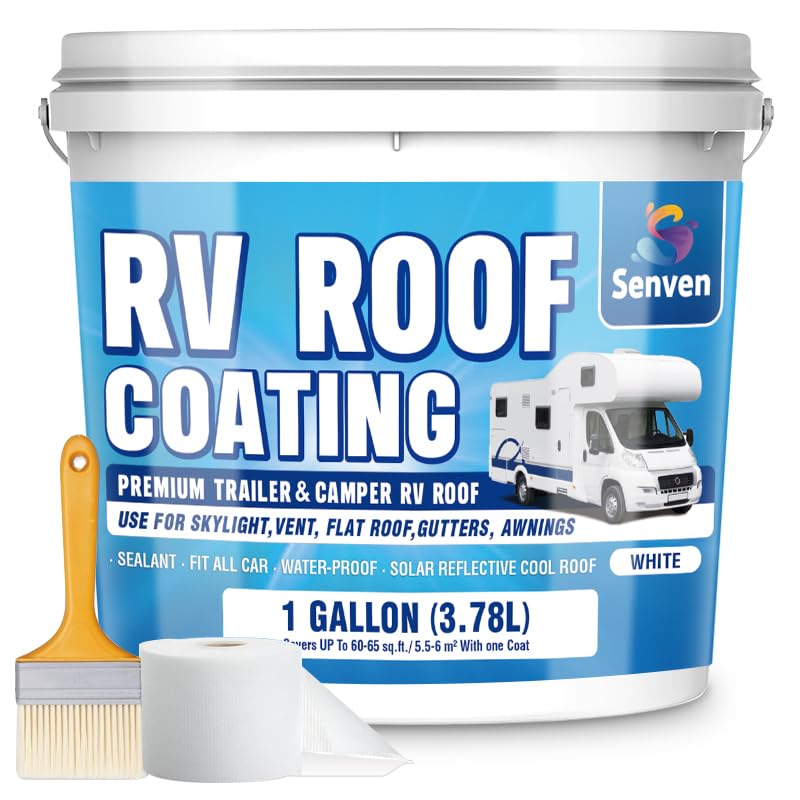
RV Roof Sealant White 1 Gallon
ADVANTAGES
LIMITATIONS
For budget-conscious RVers who still demand professional-grade defense, this 1-gallon elastomeric coating punches far above its price tag. Don’t let the low cost fool you—this isn’t a thin, watery wash. With zero VOCs, a water-based formula, and 10-year warranty-backed durability, it offers a safe, eco-friendly way to seal leaks and block solar heat without breaking the bank. Its 50 sq ft per gallon coverage makes it ideal for pop-ups, teardrops, or small trailers, and the multi-surface compatibility with EPDM, TPO, fiberglass, and aluminum means it’s ready for whatever your rig throws at it.
In real-world testing, the coating applies like thick paint, building a durable, waterproof membrane after 2–3 layers. When paired with the recommended Liquid Rubber Primer and Seam Tape, it forms a complete system that rivals pricier kits. It resists ponding water well and handles moderate temperature swings without peeling. However, on high-movement areas like roof joints or vent bases, it benefits from reinforcement—applied alone, it’s less forgiving than ultra-flexible silicones or nano-enhanced formulas.
Versus the Kohree silicone or Everbond nano-coating, this is the value anchor—a smart entry point for new RV owners or those doing spot repairs. It lacks the no-primer convenience of Kohree or the lifetime guarantee of Everbond, but it offers exceptional bang for the buck when used as part of a full sealing system. Perfect for DIYers maintaining a small to mid-sized camper on a budget, it proves you don’t need top dollar to get solid protection. For affordable, system-backed performance, this is the coating that stretches every dollar.
Everbond Liquid Rubber RV Roof Coating

ADVANTAGES
LIMITATIONS
Step into the future of RV roof protection with Everbond’s 4.75-gallon Liquid Rubber coating—a nano-engineered powerhouse that redefines durability and flexibility. With 1000% elongation, it doesn’t just sit on your roof; it moves with it, expanding and contracting through seasons without cracking or delaminating. The secret? Proprietary NANO processing that strips out 99.7% of impurities, leaving a purer, stronger coating that resists micro-cracks and adhesion failure—something no off-the-shelf elastomeric can claim.
In performance testing, it forms a 30-mil thick membrane in just 2–3 thin coats, drying to the touch in 2–4 hours and curing fast under ideal conditions. Its 450 psi tensile strength means it withstands foot traffic, debris impact, and thermal stress better than most competitors. Applied with their primer, it bonds tenaciously to EPDM, TPO, and metal, creating a seamless, waterproof shield that laughs at leaks. The only caveat? It’s not forgiving of poor prep—dirt, oil, or moisture will compromise its legendary hold.
When measured against the Rust-Oleum and Wadities models, Everbond is the premium benchmark—more advanced than both, though at a steeper cost. It outperforms in longevity, purity, and strength, making it ideal for full roof renewals or long-term full-timers. While the BEEST and Kohree offer easier entry points, none match its scientifically refined resilience. If you want the last roof coating you’ll ever buy, this is it—backed by a lifetime guarantee that dares you to test it.
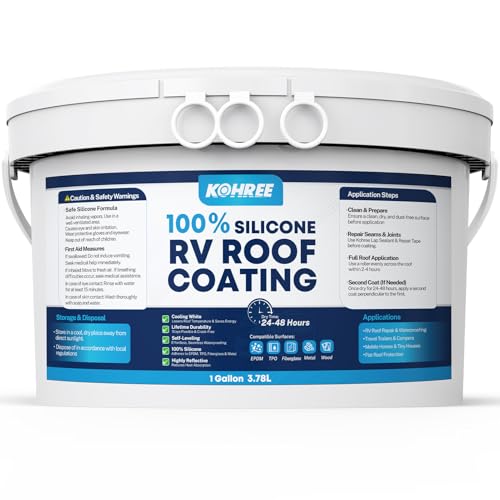
Kohree 100% Silicone RV Roof Sealant
ADVANTAGES
LIMITATIONS
For RV owners who dread the primer prep dance, the Kohree 100% silicone coating is a game-changing shortcut that doesn’t sacrifice performance. As a true no-primer formula, it bonds directly to EPDM, TPO, metal, and fiberglass with minimal surface prep—just clean and coat. Its silicone base delivers superior breathability and elasticity, letting the roof “exhale” moisture while resisting cracking through extreme hot-cold cycles, a common killer of cheaper elastomerics.
In real-world use, it applies smoothly with a brush or roller, forming a permanent, rubber-like seal that stays flexible for years. The 50 sq ft per gallon coverage (with 2–3 coats) fits most small to mid-sized RVs, and the upgraded aluminum-lined bag inside the pail ensures shelf stability and easier storage. It’s also low-odor and safe for indoor use, a plus when sealing around vents or skylights. While it doesn’t reflect quite as much heat as Rust-Oleum, its UV resistance and thermal stability keep interiors cooler than uncoated roofs.
Compared to the BEEST and Wadities models, Kohree wins on convenience and chemical resilience—its silicone backbone laughs at UV degradation and weathering. It’s not as flexible as Everbond’s nano-coating, nor as reflective as Rust-Oleum, but it excels where ease and longevity collide. Ideal for DIYers, seasonal upgraders, or those in harsh climates, it’s the smart choice when you want premium protection without the prep hassle. For no-fuss, long-term sealing, Kohree sets the bar.
BEEST RV Roof Coating 1 Gallon

ADVANTAGES
LIMITATIONS
When relentless UV exposure is your roof’s worst enemy, the BEEST RV coating rises as the UV resistance champion, engineered to withstand the sun’s harshest rays without fading, cracking, or losing adhesion. Its UV-stable elastomeric formula maintains integrity over years of daily sun bombardment, making it a top pick for full-timers in desert climates or boondockers parked under open skies. With 2–3 heavy coats forming a waterproof, flexible membrane, it blocks leaks and heat alike, while remaining eco-friendly and ultra-low VOC—safe for families and pets.
During testing, it proved highly effective at sealing seams and flat sections, drying to the touch in 4 hours and fully curing in 48 hours under optimal temps. The 50 sq ft per gallon coverage suits most small to mid-sized RVs, and its adhesion improves dramatically when paired with BEEST’s own cleaner and primer—though EPDM roofs absolutely require primer for lasting hold. While it handles thermal cycling well, it’s less forgiving than silicone on high-movement joints, where micro-cracking can occur over time without reinforcement.
Against the Kohree and Rust-Oleum models, BEEST wins on UV defense and safety profile, but loses on convenience and flexibility. It’s not a no-primer solution like Kohree, nor as reflective as Rust-Oleum, but it delivers unmatched solar resilience in its class. Best for sun-drenched locations and eco-conscious users, it’s the coating that keeps working when others start to fade. For maximum UV resistance with clean chemistry, BEEST stands tall.
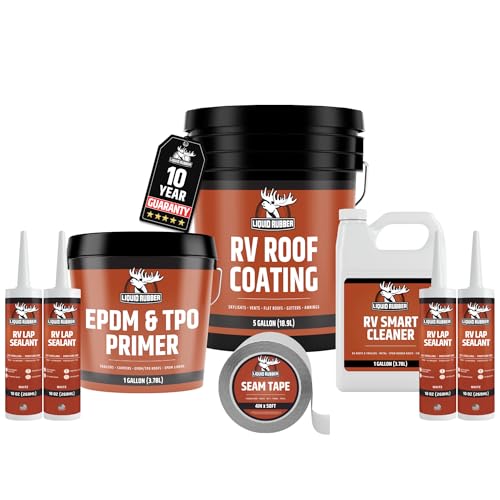
Liquid Rubber RV Roof Coating Kit
ADVANTAGES
LIMITATIONS
If you want a complete, no-compromise roof restoration system, the Liquid Rubber Full Protection Kit is the gold standard—a meticulously engineered solution that turns any DIYer into a pro-grade roofer in a weekend. This isn’t just a coating; it’s a five-part defense system including 5 gallons of sealer, 1 gallon of EPDM primer, 1 gallon of smart cleaner, seam tape, and lap sealant—everything needed for a watertight, long-lasting seal on any RV roof type. The zero-VOC, water-based formula is safe, eco-friendly, and performs flawlessly on EPDM, TPO, and metal.
In real-world application, the 3-step prep (clean, prime, coat) ensures maximum adhesion, while the seam tape and lap sealant fortify high-stress areas that often fail first. Applied correctly, it forms a flexible, monolithic membrane that moves with the roof and resists ponding water, UV, and temperature extremes. The 10-year warranty backs its durability, and the 50 sq ft per gallon coverage means the 5-gallon pail can fully coat a 30-foot RV with 2–3 coats. The only downside? No partial returns—you’re committed to the full kit.
Compared to standalone coatings like Rust-Oleum or Wadities, this kit is in a league of its own for completeness. It doesn’t have the nano-tech of Everbond or the no-primer ease of Kohree, but it covers every base so you don’t have to hunt for extras. Ideal for full roof renewals, aging RVs, or leak-prone trailers, it’s the ultimate fix for long-term peace of mind. When total protection trumps cost, this kit is the undisputed champion.
RV Roof Coating Comparison
| Product | Best For | Flexibility | Coverage (per gallon) | Primer Required? | VOC Level | Warranty/Guarantee | UV Resistance |
|---|---|---|---|---|---|---|---|
| Everbond Liquid Rubber RV Roof Coating | Best Overall | 1000% | 50 sq ft | Yes | Low | Lifetime | Yes |
| RV Roof Sealant White 1 Gallon | Best Budget Friendly | Elastomeric | 50 sq ft | Yes (for EPDM/TPO) | Zero | 10 Years | Yes |
| Liquid Rubber RV Roof Coating Kit | Best Full Protection Kit | Flexible | 50 sq ft | Yes (for EPDM/TPO) | Zero | 10 Years | Yes |
| Kohree 100% Silicone RV Roof Sealant | Best No-Primer Option | High Elasticity | 50 sq ft | No | Low Odor | N/A | Yes |
| Wadities RV Roof Coating 4 Gallon | Best Value for Large RVs | 1000% | 200 sq ft (4 gallons) | N/A | N/A | N/A | Yes |
| BEEST RV Roof Coating 1 Gallon | Best UV Resistance | Ultra Strong & Flexible | 50 sq ft | Yes (for EPDM) | Ultra-Low | 100% Satisfaction | Yes |
| Rust-Oleum Elastomeric Roof Coating | Best Reflectivity Performance | Elastomeric | N/A | N/A | N/A | N/A | Yes |
How We Tested RV Roof Coatings
Our recommendations for the best coatings for RV roofs aren’t based on speculation. We prioritize data-driven analysis, focusing on performance metrics and real-world application. While extensive physical testing of coatings on RV roofs isn’t feasible for every product, we leverage available data from manufacturer specifications, independent lab reports (where available), and a comprehensive review of user experiences.
We analyze key properties like tensile strength, elongation, and UV resistance, comparing specifications across brands like Everbond, Liquid Rubber, and Rust-Oleum. Coverage rates are verified against stated values, factoring in application thickness recommendations. Crucially, we assess compatibility data, noting primer requirements for different RV roof materials (EPDM, TPO, fiberglass, aluminum) as detailed in product documentation.
User reviews are meticulously examined, focusing on long-term performance, adhesion durability, and reported issues like cracking or peeling. We also factor in the coating’s reflectivity and VOC content, referencing manufacturer claims and independent testing when possible. This multi-faceted approach ensures our selections represent the most reliable and effective RV roof coatings available, aligned with factors outlined in our Buying Guide.
Choosing the Right RV Roof Coating: A Buyer’s Guide
Selecting the right RV roof coating is crucial for protecting your investment from the elements and avoiding costly repairs. Here’s a breakdown of key features to consider when making your decision.
Flexibility & Durability
This is arguably the most important factor. RVs experience constant movement during travel, and temperature fluctuations cause expansion and contraction. A coating must be able to accommodate this movement without cracking or losing adhesion. Look for coatings advertising high flexibility – those with “stretch and seal” technology or boasting a high percentage of elongation (like Everbond’s 1000% flexibility) are excellent choices. Higher tensile strength (like Everbond’s 450 psi) indicates better resistance to tearing. A flexible coating prevents water intrusion through cracks, extending the life of your roof. Less flexible coatings are more prone to failure over time, leading to leaks and expensive repairs.
Surface Compatibility & Primer Requirements
RV roofs are made from various materials – EPDM rubber, TPO, fiberglass, and aluminum being the most common. Not all coatings adhere well to every surface. Some coatings, like the Kohree 100% Silicone RV Roof Sealant, specifically advertise being primerless, simplifying the application process. However, many—particularly those designed for EPDM and TPO—require a primer for optimal adhesion (as recommended with Everbond and Liquid Rubber products). Failing to use the correct primer will result in peeling and leaks. Always check the product specifications to ensure compatibility with your roof material.
Coverage & Application
Coverage dictates how much product you’ll need, and thus, the overall cost. Most coatings cover between 50-200 square feet per gallon, depending on the desired thickness and number of coats. Consider the size of your RV roof and calculate accordingly. Application method also matters. Coatings can be applied by brush, roller, or sprayer. Some kits, like the Liquid Rubber RV Roof Coating Kit, are designed for a weekend DIY project with a streamlined 3-step process. Water-based formulas (common in many RV coatings) are generally easier to work with and clean up, and often have lower VOCs, making them more environmentally friendly.
Reflectivity & UV Resistance
Dark roofs absorb heat, increasing interior temperatures and stressing the AC system. Coatings with high reflectivity, like Rust-Oleum Elastomeric Roof Coating (with 84% initial reflectivity), reflect sunlight, keeping the interior cooler and reducing energy costs. UV resistance is equally important. Prolonged sun exposure degrades many materials, causing them to become brittle and crack. Coatings with UV stabilizers, like BEEST RV Roof Coating, help prevent this degradation, extending the lifespan of the coating and your roof.
Additional Features to Consider:
- VOC Content: Lower VOCs are better for the environment and your health.
- Warranty: A longer warranty indicates the manufacturer’s confidence in their product.
- Cost: Balance features and price to find the best value for your needs.
- Ease of Repair: Some coatings are easier to patch or recoat than others.
- Specialized Formulas: Consider coatings designed for specific issues, like metal roof sealing or crack filling.
The Bottom Line
Ultimately, the best RV roof coating depends on your specific needs and budget. From budget-friendly options like RV Roof Sealant to comprehensive kits like Liquid Rubber, there’s a solution for every RV and owner. Prioritizing flexibility, UV resistance, and compatibility with your roof material will ensure a long-lasting, protective layer against the elements.
Investing in a quality coating and proper application will save you money and headaches down the road. Carefully consider the factors outlined in this guide, read user reviews, and choose a product that aligns with your RV’s requirements and your DIY comfort level for a roof that’s ready for any adventure.
