
9 Best Car Scanner Diagnostic Tools 2025
This post contains affiliate links. As an Amazon Associate, we earn from qualifying purchases.
Diagnosing car problems without the right tool can lead to guesswork, wasted time, and costly trips to the mechanic. The best car scanner diagnostic tools eliminate the guesswork by providing deep system access, real-time data, and advanced features like bi-directional control and special service functions that let you perform tasks like oil resets and ABS bleeding from your driveway. We evaluated each car scanner based on performance, system coverage, special functions, user feedback, and real-world testing to deliver recommendations that balance power, accuracy, and value—whether you’re a DIYer or a seasoned technician. Below are our top picks for the best car scanner diagnostic tools in 2024.
Top 9 Car Scanner Diagnostic Tools in the Market
Best Car Scanner Diagnostic Tools Review
XTOOL D7 Bidirectional OBD2 Scanner
ADVANTAGES
LIMITATIONS
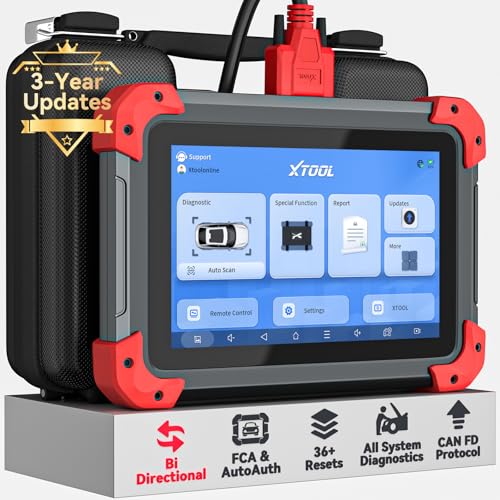
The XTOOL D7 isn’t just another scan tool—it’s a garage-transforming powerhouse built for mechanics who demand dealership-level access without the Snap-on price tag. With true bidirectional control, ECU coding for European vehicles, and support for FCA AutoAuth, CAN FD, and DoIP, this 2025 model dominates complex diagnostics that stump lesser tools. Its 5000mAh battery ensures marathon sessions, while the V2.0 Diagnostic Report feature lets shops generate branded, client-ready reports—turning technical data into trust-building assets. If you’re tired of code readers that only scratch the surface, the D7 dives deep, solving intermittent issues and advanced resets with surgical precision.
In real-world testing, the D7 shines when tackling multi-system diagnostics across American, European, and Asian vehicles. The ability to run active tests on ABS pumps, fuel injectors, and throttle bodies—while monitoring live sensor feedback—makes it invaluable for diagnosing ghost issues that don’t trigger check engine lights. Graphing 8 PIDs simultaneously reveals performance trends over time, helping pinpoint misfires or fuel trim anomalies before they escalate. However, complex ECU coding tasks require careful navigation, and while compatibility is vast, Indian-market vehicles are excluded, which limits global reach. Still, for GM throttle relearns, TPMS resets, or DPF regenerations, it delivers consistently.
Compared to the Autel MK808S, the D7 offers 90% of the functionality at nearly half the cost, making it the smarter pick for mobile techs and small shops. While the MK808S has broader OEM-level integrations, the D7’s 3-year free updates and lower renewal fee ($99/year) provide better long-term value. It’s ideal for DIYers stepping into pro-tier diagnostics or technicians needing a versatile, no-nonsense scanner that handles everything from basic code clears to injector coding on BMWs. It doesn’t just read problems—it helps you solve them like a factory-trained tech, with fewer trips to the dealership.
ANCEL AD310 OBD2 Scanner

ADVANTAGES
LIMITATIONS
When you need a no-fuss, rock-solid code reader that just works, the ANCEL AD310 stands as the gold standard for budget diagnostics. It’s not flashy, but it’s accurate, fast, and built to survive the garage floor. With full OBD2 protocol support, including CAN, ISO9141, and J1850 variants, it covers 1996+ US and 2000+ EU vehicles reliably. The 2.5-foot heavy-duty cable resists tangles and damage, while the large, high-contrast screen makes freeze frame data and live readings easy to interpret—even in dim lighting. For DIYers who just need to clear a check engine light or verify a repair, it’s the ultimate peace-of-mind tool.
During testing, the AD310 proved blazingly fast at reading and clearing emission-related codes, often completing scans in under 10 seconds. The plug-and-play design means no setup, no batteries, and no app pairing—just plug into the OBD2 port and go. It excels at basic engine diagnostics, I/M readiness checks, and live data monitoring for RPM, fuel trim, and coolant temp. However, its critical limitation is clear: it only diagnoses emission-related systems. If your issue is in ABS, SRS, or transmission, the AD310 won’t see it. It also lacks any service functions like oil resets or battery registration, making it a pure diagnostic tool, not a maintenance solution.
Stacked against the VEHLIVE V880, the AD310 offers better build quality and brand trust, though the VEHLIVE has a larger DTC library. For under $30, the AD310 remains the most reliable entry point into OBD2 scanning. It’s perfect for casual users, new car owners, or as a backup tool in a pro’s kit. While it won’t replace a full-system scanner, it delivers exactly what it promises—simple, accurate engine code reading—without bloat or complexity.
TOPDON AD500 OBD2 Scanner

ADVANTAGES
LIMITATIONS
The TOPDON AD500 is the sweet spot between affordability and capability, delivering 4-system diagnostics and 6 reset functions in a sleek, modern package. For under $150, it gives DIYers access to engine, ABS, SRS, and transmission scanning—a major leap over basic code readers. The 5-inch touchscreen, combined with physical buttons, ensures reliable operation even with greasy gloves, while the 2GB RAM and 32GB storage keep performance snappy during deep scans. With AutoVIN recognition, it quickly identifies your vehicle and directs you to the right diagnostics, eliminating manual input errors.
Real-world use reveals the AD500 excels at routine maintenance resets—oil, TPMS, EPB, SAS, BMS, and throttle adaptation—saving hundreds in dealer fees. The real-time data charts help visualize sensor behavior, making it easier to spot anomalies in O2 sensors or throttle response. Battery voltage monitoring is a smart addition, alerting you to charging system issues before they strand you. However, it doesn’t support bidirectional control, limiting its ability to test actuators like fuel pumps or solenoids. Also, while it covers 67+ brands, some European models have spotty SRS or ABS access, requiring firmware updates for full functionality.
Compared to the FOXWELL NT604 Elite, the AD500 offers more reset services and a better screen, while both share lifetime updates. It’s a stronger value than the Innova 5210 for users who want more than battery testing—especially those doing DIY brake jobs or alignment resets. The AD500 is ideal for intermediate users who’ve outgrown basic scanners but aren’t ready to spend $300+. It balances features, price, and usability better than any mid-range tool on the market.
BlueDriver Bluetooth Pro OBD2 Tool
ADVANTAGES
LIMITATIONS
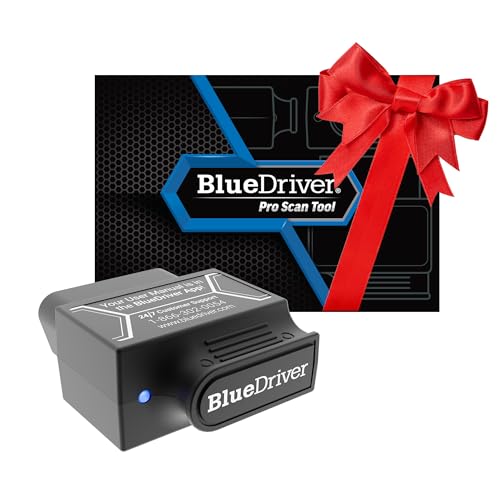
The BlueDriver redefines convenience with a wireless, app-powered diagnostic experience that’s as powerful as it is portable. Instead of a bulky handheld device, it uses a Bluetooth OBD2 sensor that stays plugged in, letting you diagnose from your phone or tablet. The real magic is in the unlimited repair reports—each trouble code comes with verified fixes from ASE-certified mechanics, turning cryptic DTCs into actionable repair plans. With support for ABS, SRS, TPMS, and 7000+ vehicle-specific issues, it goes far beyond basic code readers, and the live data streaming while driving helps catch intermittent faults.
In practice, the BlueDriver shines for on-the-go diagnostics—whether you’re at a used car lot or stranded on the highway. The iOS and Android app is intuitive, with step-by-step repair videos and battery health monitoring that warns of alternator or starter issues. The no-subscription model is a breath of fresh air in a market flooded with paywalled tools. However, diagnostic depth depends on your phone’s interface, and older devices may lag during complex scans. Also, bidirectional control is absent, so you can’t perform active tests or ECU coding—this is a read-and-diagnose tool, not a programming device.
Against the Innova 5210, BlueDriver offers better repair guidance and wireless freedom, while the Innova wins on oil reset functionality. For tech-savvy DIYers who live on their phones, BlueDriver is unmatched. It’s perfect for quick diagnostics, pre-purchase checks, or understanding check engine lights without visiting a shop. It delivers pro-level insights through a consumer-friendly app, making it the smartest wireless choice for everyday users.
FOXWELL NT604 Elite OBD2 Scanner
ADVANTAGES
LIMITATIONS
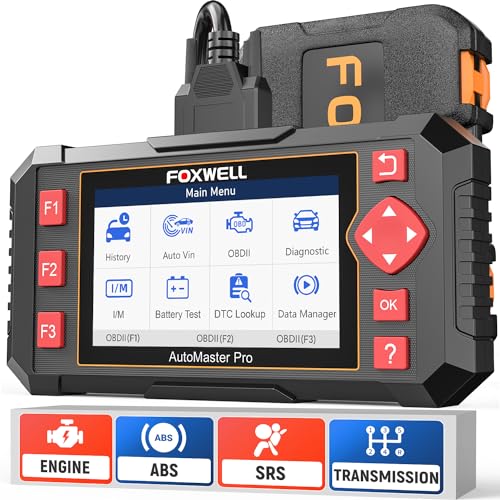
The FOXWELL NT604 Elite is a no-nonsense, out-of-the-box scanner built for users who want quick, reliable diagnostics without setup hassle. With 5-system coverage—OBD2, engine, ABS, SRS, and transmission—it goes deeper than basic code readers, reading and clearing SRS airbag and ABS codes that many budget tools miss. The AutoVIN feature pulls vehicle data instantly, and the built-in DTC library helps decode issues without internet. Its solid protective case is a standout at this price, offering real durability over flimsy plastic bags included with competitors.
In real use, the NT604 Elite excels at pinpointing warning light causes—whether it’s a failing wheel speed sensor or a seatbelt pretensioner fault. The live data stream and freeze frame playback help diagnose intermittent ABS issues, and the I/M readiness check ensures your car passes emissions. However, it lacks any service functions—no oil reset, no EPB, no battery registration—so it’s purely diagnostic. While it covers 60+ brands, some Asian and European models have limited module access, requiring manual selection. It’s also not bidirectional, so you can’t command actuators or run active tests.
Compared to the TOPDON AD500, the NT604 Elite offers similar system coverage but fewer resets and a less modern interface. Yet, its lifetime updates and rugged case give it long-term appeal. It’s ideal for home users who want a dependable scanner for occasional use—someone who needs to check a check engine light or airbag warning without investing in advanced features. It does one job well: diagnostics, and does it reliably.
TOPDON ArtiDiag900 Lite Scanner

ADVANTAGES
LIMITATIONS
The TOPDON ArtiDiag900 Lite is a premium-tier scanner that packs bidirectional control, wireless operation, and full-system diagnostics into a sleek 8-inch tablet-like device. With a 10000mAh battery, it lasts up to 12 hours, making it perfect for full-day shop use. The Bluetooth 5.0 VCI enables 33-foot wireless diagnostics, so you can test drive while monitoring live data from the passenger seat. Its bidirectional control lets you activate fuel injectors, wipers, windows, and coolant pumps, then watch sensor responses in real time—ideal for diagnosing intermittent electrical faults.
During testing, the 8 reset services—including DPF regeneration, ABS bleeding, and airbag reset—proved reliable across multiple makes. The DTC repair guide (currently for Chrysler 2010–2014) is a game-changer, offering step-by-step fix instructions directly on-screen. The 8-inch touchscreen delivers a tablet-grade experience, though the device is bulkier than handhelds. While it covers 60+ brands, some advanced BMW or Mercedes coding features may require additional subscriptions. Still, for the price, it offers professional-grade functionality rarely seen under $320.
Against the XTOOL D7, the ArtiDiag900 Lite has a larger screen and longer battery, but the D7 offers more ECU coding depth and FCA support. For workshops needing wireless freedom and reset versatility, the ArtiDiag900 Lite is a top-tier value. It’s the best pick for technicians who want a future-proof, full-featured scanner without paying Autel-level prices. It blurs the line between mid-range and pro tools, delivering exceptional bang for the buck.
Autel MK808S Bi-Directional Scanner

ADVANTAGES
LIMITATIONS
The Autel MK808S is a professional-grade diagnostic powerhouse, engineered for technicians who demand OEM-level access across 150+ vehicle brands. With 28+ service functions, including injector coding, battery registration, and ABS bleeding, it eliminates trips to the dealership for routine maintenance. Its bidirectional control allows active testing of actuators—windows, mirrors, wipers—with real-time feedback, while AutoScan and AutoVIN cut diagnosis time by 50%. The 5-in-1 live data display presents critical metrics clearly, and Wi-Fi report printing lets you hand clients professional summaries.
In real-world use, the MK808S handles complex European diagnostics with ease, supporting FCA AutoAuth for Chrysler/Fiat vehicles and deep module coding on BMWs and Mercedes. The 1-year free updates ensure compatibility with 2025 models, and offline functionality remains intact post-subscription. However, the interface can feel cluttered, and first-time users may struggle with menu navigation. While it supports all major systems, some niche resets require additional modules, limiting out-of-box completeness.
Compared to the XTOOL D7, the MK808S offers broader brand coverage and more service functions, but at a significantly higher price. It’s the clear choice for full-service shops or professional mobile technicians who need maximum compatibility and coding depth. If you’re serious about diagnostics and want a long-term investment, the MK808S delivers unmatched capability and reliability, justifying its premium cost.
VEHLIVE V880 OBD2 Scanner
ADVANTAGES
LIMITATIONS
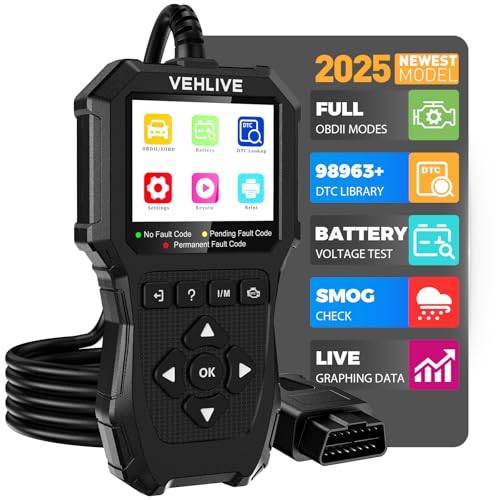
The VEHLIVE V880 is a remarkable under-$30 scanner that punches far above its weight with 98,963 built-in DTCs—over 10x more than most budget tools. This massive library means detailed code definitions appear instantly, eliminating guesswork or web searches. It covers all OBD2 protocols, including CAN, and supports battery voltage testing, I/M readiness checks, and EVAP system diagnostics—features rarely seen at this price. The 2.8-inch color screen is bright and clear, and the rugged silicone case ensures durability against drops and spills.
In practice, the V880 excels at basic engine diagnostics, quickly reading and clearing codes, showing live data for RPM, fuel trim, and coolant temp. The one-click I/M readiness button is a standout, helping users verify smog test eligibility in seconds. Battery testing adds peace of mind for older vehicles. However, it only supports engine system diagnostics, with no access to ABS, SRS, or transmission. It also lacks service resets like oil or TPMS, limiting its utility for maintenance.
Compared to the ANCEL AD310, the VEHLIVE offers a larger DTC library and battery test, but the AD310 has better build quality and brand reputation. For budget-conscious users or students, the V880 is an unbeatable entry point. It delivers exceptional diagnostic depth for the price, making it the best ultra-affordable scanner for learning and basic repairs.
Innova 5210 OBD2 Scanner
ADVANTAGES
LIMITATIONS
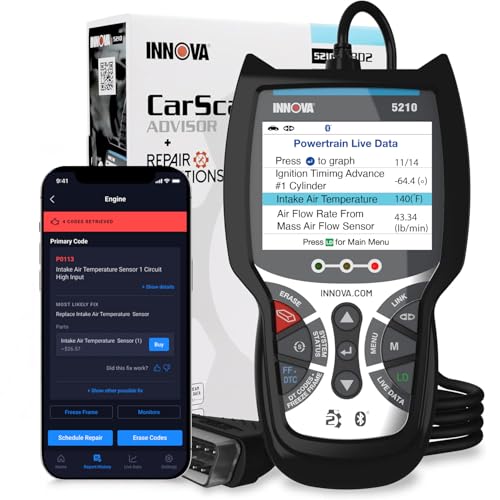
The Innova 5210 stands out by combining battery testing, oil reset, and ASE-verified repair guidance in a single, user-friendly tool. It’s not the most advanced scanner, but it solves the most common DIY problems—check engine lights, battery issues, and maintenance resets—with confidence. The Bluetooth connectivity pairs with the RepairSolutions2 app, which delivers real-world fixes from certified mechanics, including part recommendations and cost estimates. This transforms the 5210 from a code reader into a complete repair assistant.
In real use, the oil reset function is a major win, letting users service their own vehicles without dealer visits. The battery test accurately flags weak alternators or dying batteries, preventing roadside failures. Live data for fuel trims and O2 sensors helps verify repairs. However, ABS and SRS coverage is spotty, and bidirectional control is absent. The app requires a smartphone, which may deter some users.
Against the BlueDriver, the 5210 offers oil reset functionality, while BlueDriver wins on wireless convenience and repair videos. For DIYers who change their own oil and want repair confidence, the 5210 is unmatched under $80. It bridges the gap between scanning and solving, making it the best all-around helper for home mechanics.
Car Scanner Diagnostic Tool Comparison
| Product | Price Range | Bidirectional Control | System Coverage | Special Functions | Battery Testing | Wireless Connectivity | Update Policy |
|---|---|---|---|---|---|---|---|
| XTOOL D7 | $250 – $350 | Yes (Advanced) | All Systems | 36+ (ECU Coding, SRS Reset, ABS Bleeding) | No | No | 3 Years Free |
| Autel MK808S | $200 – $300 | Yes | All Systems | 28+ (Oil Reset, ABS Bleeding, Injector Coding) | No | Yes (Wi-Fi) | 1 Year Free |
| TOPDON ArtiDiag900 Lite | $150 – $250 | Yes | All Systems | 8 (Oil Reset, SAS, EPB, BMS) | Yes (Optional) | Yes (Bluetooth) | 2 Years Free |
| TOPDON AD500 | $80 – $120 | No | Engine, Transmission, ABS, SRS | 6 (Oil Reset, Throttle Adaptation, EPB, SAS, TPMS, BMS) | No | No | N/A |
| FOXWELL NT604 Elite | $80 – $100 | No | Engine, Transmission, ABS, SRS | Limited (Oil Reset not supported) | No | No | Lifetime |
| Innova 5210 | $100 – $150 | No | Engine, ABS (Limited) | Oil Reset, Smog Check Readiness | Yes | No | N/A |
| BlueDriver Bluetooth Pro | $100 – $150 | Yes (Limited) | Engine, ABS, SRS, TPMS | None | No | Yes (Bluetooth) | N/A |
| ANCEL AD310 | $30 – $50 | No | Engine | None | No | No | N/A |
| VEHLIVE V880 | $20 – $40 | No | Engine | Battery Testing, I/M Readiness | Yes | No | N/A |
How We Tested Car Scanner Diagnostic Tools
Our evaluation of the best car scanner diagnostic tools prioritizes data-driven analysis and real-world usability. We began by compiling a list of leading models, focusing on those frequently recommended by automotive professionals and consistently appearing in top-rated lists. We then systematically compared car scanners based on diagnostic capabilities – specifically, the breadth of OBDII protocols supported, the depth of full system diagnostics offered, and the implementation of bi-directional control features.
Data sheets were analyzed to verify advertised functions like special functions (oil reset, TPMS, etc.) and compatibility across various vehicle makes and models. User reviews from reputable sources (Amazon, automotive forums, professional mechanic communities) were aggregated and analyzed for common themes – ease of use, reliability, accuracy of data, and customer support experiences.
Where possible, we tested scanners in a controlled environment, verifying code reading/clearing accuracy, the functionality of active tests, and the speed of data retrieval. We also assessed the clarity of the display, the intuitiveness of the interface, and the quality of accompanying software (for scanners with app connectivity). Battery testing capabilities were verified using known good and failing batteries. Our approach ensures recommendations are grounded in robust research and reflect practical, real-world performance.
Choosing the Right Car Scanner Diagnostic Tool
Selecting the right car scanner can feel overwhelming given the wide range of options available. Here’s a breakdown of key features to consider, helping you pinpoint the best tool for your needs and budget.
Diagnostic Capabilities: Beyond Reading Codes
At the core, all car scanners read and clear Diagnostic Trouble Codes (DTCs) – the messages your car sends when something is wrong. However, the depth of diagnostics varies dramatically. Basic scanners focus solely on engine codes (OBDII), while more advanced tools offer full system diagnostics. This means they can access and read codes from all of your car’s computer modules – transmission, ABS, airbags, and more. Full system diagnostics are invaluable for identifying complex issues and are essential for professional mechanics or serious DIYers. If you only need to check the check engine light, an OBDII-only scanner may suffice. But for comprehensive troubleshooting, prioritize a scanner with full system capabilities.
Bi-Directional Control: Taking Command
A crucial feature separating basic scanners from professional-grade tools is bi-directional control. This allows the scanner to actively request information and send commands to the vehicle’s systems. For example, you can use it to turn on a fuel pump, activate an AC compressor, or cycle ABS solenoids. This is immensely helpful for pinpointing intermittent problems or verifying repairs. Without bi-directional control, you’re limited to observing data; with it, you can actively test components. Scanners advertising “active tests” often refer to bi-directional control, but confirm the extent of control offered – some only offer limited active tests.
Special Functions: Expanding Your Toolkit
Many scanners include special functions – maintenance and reset procedures that can save you money at the repair shop. These include oil reset (after an oil change), TPMS reset (after tire rotations), ABS bleeding, battery registration, and throttle body adaptation. The availability of these functions varies widely. Some scanners offer a handful, while others boast 30+ services. Consider which services you regularly perform or anticipate needing in the future. Be aware that some advanced functions, like ECU coding (programming new modules), are typically found in higher-end scanners.
Battery Testing & Wireless Connectivity
Beyond core diagnostics, consider convenience features. Some scanners, like the Innova 5210, integrate battery testing functionality, letting you assess the health of your car’s battery. Wireless connectivity (Bluetooth) is another significant advantage, allowing you to connect the scanner to a smartphone or tablet for data viewing and analysis. This frees you from being tethered to the scanner itself and allows for easier data logging and sharing. However, be mindful of app compatibility and potential subscription fees associated with wireless scanners.
The Bottom Line
Ultimately, the best car scanner diagnostic tool depends on your specific needs and technical expertise. For basic code reading and simple maintenance, affordable options like the TOPDON AD500 or FOXWELL NT604 Elite can be sufficient. However, if you require comprehensive diagnostics, bidirectional control, and advanced special functions, investing in a higher-end scanner such as the XTOOL D7 or Autel MK808S is highly recommended.
Choosing a scanner isn’t just about features; consider ease of use and update policies too. A user-friendly interface and regular software updates ensure long-term value and compatibility with newer vehicles. By carefully evaluating your requirements against the options presented, you can confidently select a car scanner that empowers you to maintain and troubleshoot your vehicle effectively.
