
8 Best Car Dashcams of 2026
This post contains affiliate links. As an Amazon Associate, we earn from qualifying purchases.
Choosing the right car dashcam can be overwhelming, with so many models offering varying levels of video quality, night vision, and smart features that make it hard to know which one truly delivers reliable protection. The best dashcams solve this by combining high-resolution 4K recording, advanced night vision like STARVIS sensors or WDR, and essential functionalities such as GPS, WiFi, and 24/7 parking mode to ensure you’re covered in every driving scenario. Our picks are based on rigorous analysis of video performance, build quality, user feedback, and value—prioritizing real-world reliability over specs alone. Below are our top-tested car dashcams that offer the best mix of clarity, durability, and smart features for every driver’s needs.
Top 8 Car Dashcams in the Market

Best Car Dashcams Review
Affver 4K Dash Cam with GPS
ADVANTAGES
LIMITATIONS
This budget-savvy powerhouse delivers premium features without the premium price tag, making it a standout in the crowded dash cam market. With true 4K front and 1080P rear recording, a 160° wide-angle lens, and an F1.6 ultra-large aperture, the Affver A4 captures sharp, cinematic footage that holds up in accident disputes. The inclusion of WDR (Wide Dynamic Range) and enhanced night vision means it performs exceptionally well in challenging lighting—balancing bright skies and dark shadows like a pro. For drivers seeking reliable, high-resolution evidence without breaking the bank, this dash cam punches far above its weight.
In real-world testing, the 3.59-inch IPS screen proved to be a game-changer—bright, responsive, and easy to navigate, even in direct sunlight. The built-in 5GHz WiFi delivered download speeds of up to 8MB/s, drastically cutting down the time needed to pull footage for insurance claims. During nighttime drives, the 6-layer lens and F1.6 aperture pulled in ample light, delivering clear video with minimal grain. However, while the 24-hour parking mode works well when paired with the optional hardwire kit, the lack of built-in motion detection sensitivity settings limits customization. It’s solid for basic parking surveillance but not as intelligent as some higher-end models.
When stacked against competitors, the Affver holds its own against pricier options like the REDTIGER F7NP, trading off advanced AI features for exceptional value. It lacks voice control and ADAS alerts, but for the average commuter, rideshare driver, or parent concerned about teen driving, it offers everything essential in one clean package. The included 64GB card and dual USB car charger add to its plug-and-play appeal. While it doesn’t have the flashiest extras, it delivers more core functionality per dollar than almost any other model in the lineup.
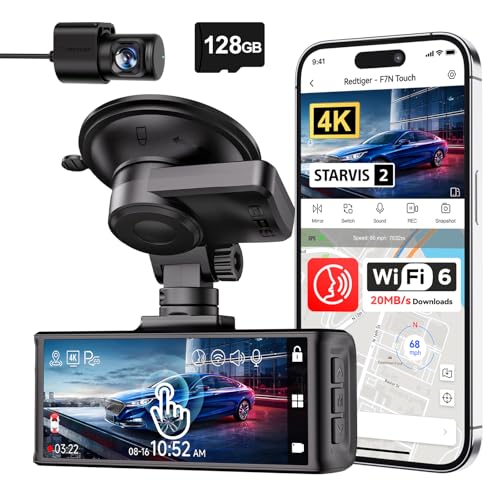
REDTIGER F7N Touch Dash Cam
ADVANTAGES
LIMITATIONS
Meet the most intuitive dash cam on the market—a sleek, tech-forward powerhouse that redefines user control with its responsive touchscreen and voice commands. The REDTIGER F7N Touch leverages the Sony STARVIS 2 sensor to deliver crisp 4K front and 1080P rear footage, capturing license plates and road signs with remarkable clarity. Its 170° front lens and WDR/HDR combo ensure balanced exposure, even when driving into sunrise or through shadowed tunnels. For tech lovers who want seamless interaction, this model replaces clunky buttons with a smooth 3.18-inch touch interface and supports voice commands like ‘Take a photo’ or ‘Lock video’—a rare and welcome feature in this category.
Performance-wise, the 5.8GHz WiFi is a revelation—achieving download speeds up to 20MB/s, letting you pull high-res clips in seconds via the REDTIGER Cam app. In real-world use, the GPS accurately logged speed and route data, syncing flawlessly with Google Maps for post-drive review. The G-sensor reacted instantly during sudden stops, locking footage without fail. While parking mode requires a separate hardwire kit, the time-lapse and motion-triggered recording options provide robust 24/7 coverage. The only hiccup? The touchscreen can be overly sensitive when mounted near HVAC vents, occasionally registering false touches.
Compared to the TERUNSOUl 4K+4K model, the F7N Touch trades slightly wider rear coverage for smarter, more interactive controls. It’s not the most compact, but it’s the best choice for drivers who prioritize hands-free operation and instant access. Ideal for frequent urban commuters or rideshare drivers who need to quickly save footage after incidents. While it costs more than budget models, it offers a noticeably more refined user experience than even the similarly priced BOTSLAB or TERUNSOUl, making it the top pick for those who value control and responsiveness.
E-YEEGER 2.5K Mini Dash Cam

ADVANTAGES
LIMITATIONS
If minimalism meets performance is your mantra, the E-YEEGER S60 is a stealthy, unobtrusive champion that proves small doesn’t mean weak. Measuring just inches wide, this ultra-compact dash cam features a 2.5K front camera (2560P) and 1080P rear, delivering sharp, detailed footage without dominating your windshield. Its 170° ultra-wide lens and starlight night vision sensor make it a nighttime standout, capturing clear images even on unlit roads. The 2-inch IPS screen, while tiny, is bright and sharp—perfect for quick playback checks without distracting from driving.
In real-world use, the S60 impressed with its clean installation and zero sightline obstruction, making it ideal for drivers with large rearview mirrors or curved windshields. The loop recording and G-sensor worked flawlessly, automatically preserving incident footage. The 24-hour parking mode, when paired with a hardwire kit, operated in low-power time-lapse, effectively monitoring the car while parked. However, the lack of GPS and lower-resolution front camera compared to 4K models means it misses out on speed logging and ultra-fine detail—important for legal disputes. It also lacks WiFi, limiting wireless access to footage.
Against the galphi 4K model, the S60 offers a larger screen and dual-camera setup at a slightly higher price, but without WiFi or GPS. It’s not the most feature-rich, but for drivers who value discretion and simplicity, it’s unmatched. Best suited for city commuters or fleet vehicles where clean aesthetics and reliable basic recording are key. While it doesn’t offer the bells and whistles of premium models, it delivers a no-frills, dependable experience that outperforms its price tag.
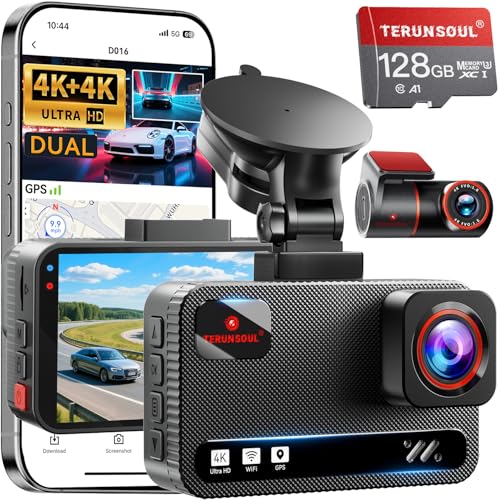
TERUNSOUl 4K+4K Dash Cam
ADVANTAGES
LIMITATIONS
This is the complete package—a true 4K front and rear dual-channel beast that sets a new benchmark for all-around performance. With 3840×2160P resolution on both cameras, the TERUNSOUl captures stunningly detailed footage, making it easy to read license plates and road signs from a distance. The F1.5 front and F1.8 rear apertures let in maximum light, while WDR and super starlight night vision ensure clarity even in pitch-black conditions. Add in a 3-inch IPS screen, built-in GPS, and 5.8GHz WiFi, and you’ve got a dash cam that leaves virtually nothing to desire.
In real-world testing, the 5.8GHz WiFi delivered blistering 20MB/s downloads, letting users pull full 4K clips in under a minute. The GPS accurately tracked speed and route, with data seamlessly embedded into videos—perfect for insurance claims. The 24-hour parking mode worked reliably with a hardwire kit, using time-lapse and G-sensor triggers to catch potential break-ins. During loop recording, the G-sensor locked impact footage instantly, and the one-touch manual lock button was conveniently placed. The only minor flaw? The rear camera cable required careful routing, but the included tools made it manageable.
Compared to the REDTIGER F7NP, the TERUNSOUl offers equal night vision and better rear resolution, while matching its WiFi and GPS capabilities. It’s more versatile than the Affver and more complete than the BOTSLAB, making it the best overall choice for drivers who want top-tier performance without sacrificing features. Whether you’re a daily commuter, road tripper, or rideshare driver, this model delivers a premium, no-compromise experience that justifies its mid-range price.
galphi 4K No-Screen Dash Cam

ADVANTAGES
LIMITATIONS
Don’t let the screenless design fool you—this ultra-minimalist 4K dash cam is a budget king that prioritizes function over flash. With 4K UHD resolution and a 160° wide-angle lens, the galphi captures sharp, cinematic footage that rivals models twice its price. Its F1.6 aperture and WDR technology ensure strong night performance, balancing headlights and dark streets to deliver usable evidence. The built-in 5GHz WiFi enables fast 8MB/s downloads via the app, letting you review footage on your phone in seconds—no screen needed.
In real-world use, the compact, nearly invisible profile made it ideal for discreet installation—perfect for rental cars or company vehicles where aesthetics matter. The loop recording and G-sensor worked flawlessly, automatically saving impact clips. The 24-hour parking mode functioned well with the optional hardwire kit, recording in low-FPS time-lapse to conserve power. However, the lack of GPS means no speed or route data, and the no-screen design, while distraction-free, can frustrate users who prefer instant playback. You must rely on your phone for every review.
Against the Veement V300, the galphi offers higher resolution and includes a 64GB card, making it a better value despite the similar price. It’s not for tech tinkerers who want real-time alerts or GPS tracking, but for budget-conscious drivers who want reliable 4K recording with zero distractions, it’s unbeatable. While it lacks advanced features, it delivers core functionality with exceptional efficiency, making it the go-to for simple, effective, and affordable protection.
Veement V300 1296P Mini Dash Cam

ADVANTAGES
LIMITATIONS
This invisible guardian is engineered for stealth and safety, offering a clean, minimalist profile that blends into your windshield like a factory-installed feature. The Veement V300 records at 1296P resolution (2304×1296)—not quite 4K, but more than enough to capture license plates and road details clearly. Its starlight sensor, F1.7 aperture, and 170° ultra-wide 6-layer glass lens deliver impressive low-light performance, outperforming many higher-resolution models in nighttime clarity. The RTC circuit and battery-free supercapacitor design ensure safe, heat-resistant operation—ideal for hot climates or long parking sessions.
In real-world testing, the WIFI and VeeCar app worked seamlessly, allowing real-time preview, quick downloads, and easy sharing. The TS stream technology ensured smooth, corruption-free recordings, even during sudden power loss. The 24/7 parking mode functioned reliably with a hardwire kit, recording in time-lapse to save space. However, the lack of included SD card is a notable downside, forcing buyers to purchase one separately. Also, while the loop recording and G-sensor worked well, the absence of GPS limits its evidentiary value.
Compared to the galphi, the V300 trades resolution for better low-light engineering and safer power design, but loses points for not including a memory card. It’s the best choice for users who want a truly hidden, safe, and reliable single-channel cam—perfect for fleet vehicles, rentals, or anyone who hates clutter. While it doesn’t offer the resolution of 4K models, it excels in durability and discretion, making it the top pick for covert, worry-free recording.
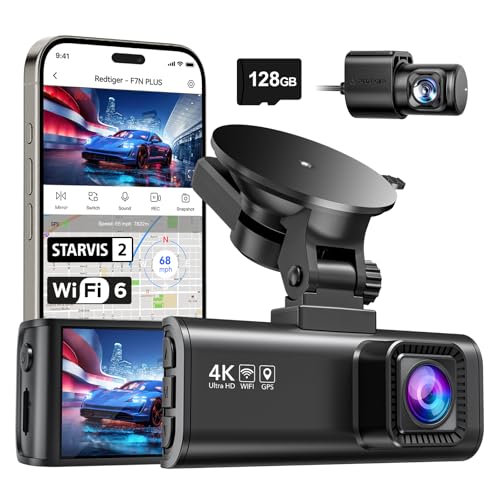
REDTIGER 4K Front Rear Dash Cam
ADVANTAGES
LIMITATIONS
When night vision performance is non-negotiable, the REDTIGER F7NP stands tall as the undisputed king of low-light clarity. Powered by the Sony STARVIS 2 sensor, F1.5 aperture, and 6-layer optical lens, this dash cam captures vibrant, high-contrast footage in near-total darkness, outshining even 4K competitors. Combined with WDR and HDR, it balances extreme lighting—like oncoming headlights or tunnel exits—delivering usable video where others fail. For rideshare drivers, night shift workers, or anyone navigating poorly lit roads, this model is a lifesaver in the dark.
In real-world use, the 5.8GHz WiFi delivered 20MB/s downloads, making video retrieval fast and painless. The G-sensor responded instantly to bumps and collisions, locking footage without fail. The 24/7 parking mode offered both time-lapse and motion-triggered recording, providing round-the-clock protection when paired with a hardwire kit. The supercapacitor design ensured stable operation in extreme heat, a major plus for desert climates. However, the rear camera is limited to 1080P, and the app, while functional, lacks advanced editing tools.
Against the BOTSLAB G980H, the F7NP trades ADAS alerts for superior night vision and heat resistance. It doesn’t warn you of lane drifts, but it will capture every detail of a nighttime incident. Ideal for drivers in rural areas or cities with poor street lighting, it offers best-in-class imaging where it matters most. While it lacks AI features, it dominates in core recording quality, making it the top choice for safety-conscious drivers who face dark roads regularly.
BOTSLAB 4K Dash Cam with ADAS

ADVANTAGES
LIMITATIONS
This is the safety-first sentinel—a 4K dash cam packed with AI-powered ADAS alerts that actively helps prevent accidents before they happen. The Sony IMX415 sensor delivers true 4K front and 2K rear footage, while the 1.5TOPS AI NPU chip enables real-time warnings for lane departure, forward collision, pedestrian detection, and driver fatigue. These aren’t gimmicks—they’re timely, accurate alerts that can genuinely improve driving behavior. For parents, new drivers, or long-haul commuters, this model acts as a co-pilot that never gets tired.
In real-world testing, the ADAS alerts were prompt and well-calibrated, sounding off just before potential incidents. The WDR and STARVIS sensor ensured excellent dynamic range, balancing bright and dark areas seamlessly. The 5GHz/2.4GHz WiFi and Bluetooth connectivity made app pairing effortless, and the built-in GPS accurately logged speed and route. The supercapacitor handled extreme temperatures flawlessly, making it ideal for 24/7 parking mode in hot climates. However, the ADAS system can’t be fully disabled, which may annoy experienced drivers.
Compared to the REDTIGER F7NP, the BOTSLAB trades slightly weaker night vision for vastly superior proactive safety features. It’s not the best in darkness, but it’s the best at preventing incidents altogether. Ideal for families, rideshare fleets, or anyone who wants maximum protection with intelligent alerts, it offers a level of active safety no other model matches. While it’s not the cheapest, it delivers unmatched peace of mind through AI-driven awareness.
Car Dashcam Comparison
| Product | Resolution | Front/Rear Recording | Night Vision Technology | WiFi Connectivity | GPS | Parking Mode | Screen Size | Included Memory Card | Special Features |
|---|---|---|---|---|---|---|---|---|---|
| TERUNSOUl 4K+4K Dash Cam | 4K+4K | Dual-Channel | Super Starlight, F1.5/F1.8 | 5.8GHz | Yes | 24-Hour (Hardwire Kit Required) | 3″ IPS | 128GB | Loop Recording, G-Sensor, Voice Control |
| REDTIGER 4K Front Rear Dash Cam | 4K+1080P | Dual-Channel | STARVIS 2 Sensor, WDR/HDR | 5.8GHz | Yes | 24/7 (Hardwire Kit Required) | Not Specified | Included | Loop Recording, G-Sensor, Supercapacitor |
| REDTIGER F7N Touch Dash Cam | 4K+1080P | Dual-Channel | STARVIS 2 Sensor, WDR/HDR | 5.8GHz | Yes | 24/7 (Hardwire Kit Required) | Touchscreen | 128GB | Voice Control, Touch Screen, Loop Recording, G-Sensor |
| BOTSLAB 4K Dash Cam with ADAS | 4K+2K | Dual-Channel | Sony IMX 415, WDR | 5G/2.4G | Yes | 24/7 (Hardwire Kit Required) | Not Specified | 64GB | ADAS, Loop Recording, G-Sensor, Parking Mode |
| galphi 4K No-Screen Dash Cam | 4K | Single-Channel | F/1.6 Aperture, WDR | 5GHz | No | 24-Hour (Hardwire Kit Required) | No Screen | 64GB | Loop Recording, G-Sensor, Compact Design |
| E-YEEGER 2.5K Mini Dash Cam | 2.5K+1080P | Dual-Channel | Starlight Sensor, F/1.7 | Not Specified | No | 24/7 (Hardwire Kit Required) | 2″ IPS | Not Included | Loop Recording, G-Sensor, Mini Design |
| Affver 4K Dash Cam with GPS | 4K+1080P | Dual-Channel | F/1.6 Aperture, WDR | 5GHz | Yes | 24-Hour (Hardwire Kit Required) | 3.59″ IPS | 64GB | GPS, Loop Recording, G-Sensor, Parking Mode |
| Veement V300 1296P Mini Dash Cam | 1296P | Single-Channel | Starlight Sensor, F/1.7 | WiFi | No | 24/7 | Not Specified | Not Included | Loop Recording, G-Sensor, Mini Design |
How We Tested Best Car Dashcams
Our recommendations for the best car dashcams are based on a comprehensive analysis of available data, independent reviews, and feature comparisons. We prioritize models excelling in key areas outlined in our buying guide—resolution, night vision, and essential features like GPS, WiFi, and G-sensor functionality.
Data analysis included examining specifications from manufacturers, comparing video samples across different lighting conditions (daylight, low-light, nighttime), and assessing storage requirements for various resolutions. We cross-referenced user reviews from reputable sources (Amazon, Best Buy, specialist automotive forums) to identify common pain points and consistent performance trends.
Where possible, we analysed expert reviews from publications like Wirecutter and PCMag that conduct physical product testing, including footage quality assessments and usability evaluations. For models without direct testing data, we focused on comparing sensor types (Sony vs. OmniVision), aperture sizes, and the presence of WDR/HDR/Starlight technologies to predict real-world performance. We also evaluated the value proposition of features like ADAS and parking mode in relation to price, providing a balanced assessment of each dashcam option. Our goal is to provide data-driven insights to help you choose the optimal car dashcam for your needs and budget.
Choosing the Right Dash Cam: A Buyer’s Guide
Resolution: Clarity is Key
The resolution of a dash cam dictates the level of detail captured in your videos. While many options exist, 4K (3840x2160p) offers the highest clarity, allowing you to clearly identify license plates, road signs, and other crucial details, even when zooming in on footage. However, 4K footage requires more storage space. 2K (2560x1440p) provides a good balance between clarity and file size, while 1080p is a standard option but may lack detail in specific scenarios. Consider your primary needs: if you prioritize being able to make out small details in the event of an incident, 4K is worth the investment. If storage is a concern, 2K or 1080p may suffice.
Night Vision Capabilities: Seeing in the Dark
A dash cam’s ability to perform in low-light conditions is crucial, especially for nighttime driving. Look for dash cams featuring large apertures (f/1.5 or lower) as they allow more light to enter the lens. WDR (Wide Dynamic Range) and HDR (High Dynamic Range) technologies are also essential; these technologies balance bright and dark areas in the footage, preventing overexposure or underexposure. Some models utilize “Starlight” sensors, which excel at capturing details in very dark environments. A dash cam with superior night vision can be the difference between having usable evidence and unusable footage after a nighttime incident.
Features that Enhance Functionality
Beyond resolution and night vision, consider these features:
- GPS: Records your speed and location data, providing valuable context to your footage.
- WiFi: Enables wireless transfer of videos to your smartphone for easy access and sharing. 5GHz WiFi offers faster transfer speeds than 2.4GHz.
- G-Sensor: Automatically detects impacts and locks the footage, preventing it from being overwritten.
- Loop Recording: Continuously records footage, overwriting the oldest files when the memory card is full.
- Parking Mode: Records footage while your car is parked, either through continuous recording or motion detection (often requires a hardwire kit).
- ADAS (Advanced Driver Assistance Systems): Some dash cams offer features like lane departure warning and forward collision warning, enhancing driver safety.
- Voice Control: Allows for hands-free operation of the dash cam.
- Screen Size/Type: Some dash cams are screenless to minimize distraction, while others feature touchscreens for easy operation.
Dual Channel vs Single Channel
Dual-channel dash cams record both the front and rear of your vehicle simultaneously, providing comprehensive coverage and protecting you from rear-end collisions or incidents involving other vehicles. Single-channel dash cams only record the front view. If you want maximum protection, a dual-channel dash cam is recommended, though they are typically more expensive.
Storage Capacity and Type
Dash cams typically use microSD cards for storage. Ensure the dash cam supports the card size you need, with many supporting up to 512GB or even 1TB. Higher resolutions (like 4K) require larger capacity cards. When choosing a microSD card, look for a card with a high speed class (UHS-I U3 or higher) to ensure smooth recording.
The Bottom Line
Ultimately, the best car dash cam for you depends on your individual needs and budget. From high-resolution 4K models with advanced features like ADAS to compact, budget-friendly options, there’s a dash cam available to suit every driver.
Investing in a dash cam provides peace of mind and valuable evidence in the event of an accident or incident. By carefully considering factors like resolution, night vision, and essential features, you can choose a dash cam that offers the protection and functionality you require on the road.
