
7 Best Car Audio DSPs for 2026
This post contains affiliate links. As an Amazon Associate, we earn from qualifying purchases.
Many car audio enthusiasts struggle with muddy, unbalanced sound due to their vehicle’s poor acoustics and factory audio limitations. The best car audio digital sound processors solve this by offering precise control over tone, timing, and frequency distribution, with key features like parametric equalization, time alignment, and Bluetooth app tuning for real-time adjustments. We evaluated each DSP based on performance metrics like signal-to-noise ratio, voltage output, user reviews, and hands-on analysis of tuning software to ensure reliable, high-fidelity results across different budgets and system complexities. Below are our top picks for the best car audio digital sound processors.
Top 7 Car Audio Digital Sound Processors in the Market
Best Car Audio Digital Sound Processors Review
Dayton Audio DSP-408
ADVANTAGES
LIMITATIONS
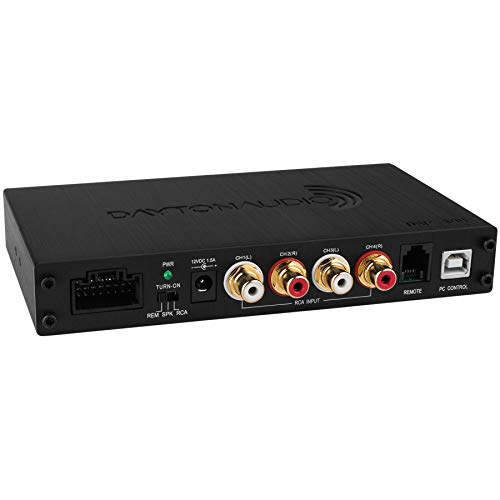
This game-changing DSP brings studio-grade precision to car and home audio setups with its 4-in/8-out architecture, 10-band parametric EQ per output channel, and real-time time alignment—making it a rare hybrid that excels in both environments. What truly sets the Dayton Audio DSP-408 apart is its flexible input/output mixing, allowing users to blend signals from multiple sources and route them intelligently across speakers and subwoofers. For audiophiles wrestling with mismatched components or phase issues, this processor delivers laser-focused sound staging and acoustic coherence that transforms chaotic interiors into concert-hall-like listening spaces.
In real-world tuning, the DSP-408 shines when calibrating multi-way speaker systems, especially when aligning door mids with dash tweeters and rear fills. Its GUI software (Windows/Mac) is refreshingly intuitive, letting you visualize crossovers, EQ curves, and delay settings with surgical accuracy. With 96 kHz processing, low-latency response, and support for high-level inputs via optional adapters, it handles everything from factory head units to aftermarket preamps. However, the lack of built-in Bluetooth means you’ll need a USB connection or optional dongle for wireless control—a minor inconvenience for purists who prefer wired reliability during tuning sessions.
Compared to budget DSPs like the PRV AUDIO 2.4X, the DSP-408 offers far deeper customization and professional features typically found in much pricier units. While not as app-centric as the Stetsom STX 2436, it’s ideal for technical tuners and DIY integrators who want granular control without sacrificing usability. It doesn’t match the ultra-high voltage output of the B2 Audio 4v model, but its balanced versatility between car and home use makes it a standout—delivering more processing power and flexibility than similarly priced competitors.
NVX XDSP28 8-Channel DSP

ADVANTAGES
LIMITATIONS
The NVX XDSP28 is a tuning powerhouse wrapped in a sleek, user-friendly package, boasting 15-band parametric EQ on all eight outputs, 0.02 ms time alignment precision, and a rotary knob interface that makes on-the-fly adjustments feel natural and responsive. With 2V output levels, 94+ dB SNR, and ultra-low THD of 0.01%, it delivers clean, distortion-free signals even under high-gain conditions—perfect for high-sensitivity setups where noise can ruin clarity. This unit stands out for its onboard tone generator with pink noise and frequency sweep, giving installers the tools to dial in speakers without external gear—a rare feature at this price point.
During real-world use, the XDSP28 proves its worth in complex systems with multiple amplifiers and subs. The rotating encoder simplifies navigation through crossover slopes, phase settings, and filter types (Butterworth, Linkwitz-Riley, etc.), while the LCD screen provides clear feedback without needing a smartphone. It handles front, rear, and sub channels with ease, and the 12 built-in EQ presets (Rock, Hip Hop, Vocal, etc.) offer solid starting points for casual listeners. That said, its Bluetooth is for app control only, not audio streaming, and the app, while functional, lacks the polish of more premium options like B2 Audio’s.
When stacked against the Stetsom STX 2436, the XDSP28 trades some app elegance for superior onboard control and higher EQ resolution. It’s not as compact as the PRV AUDIO model, but it offers twice the outputs and far more tuning depth. For users who value hands-on physical control and high-end tuning accuracy, the NVX hits a sweet spot—packing more professional features than the budget tier while undercutting high-end models in cost.
DS18 DSP2.8DBT 8-Channel
ADVANTAGES
LIMITATIONS
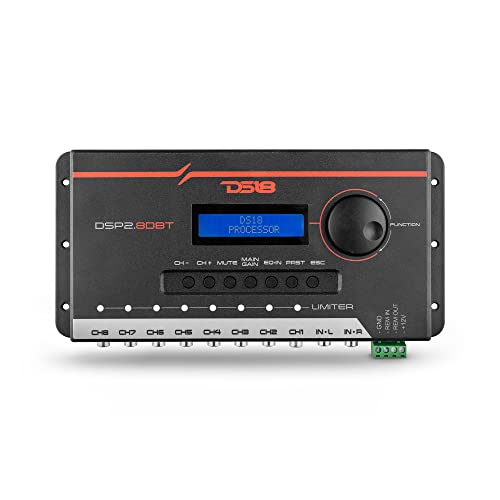
The DS18 DSP2.8DBT is a tech-forward processor built for advanced users who demand total command over their audio environment, featuring 8-output channels, 3-band parametric EQ per channel, and a Bluetooth-enabled app with real-time control that turns your smartphone into a wireless tuning cockpit. Its standout trait is the didactic interface design—the app walks users through setup with guided workflows, making complex tasks like time alignment and crossover design feel approachable even for intermediate enthusiasts. The inclusion of Linkwitz-Riley, Butterworth, and Bessel filters gives tuners the flexibility to match speaker characteristics precisely, a must for high-fidelity builds.
In practice, the DSP2.8DBT excels when fine-tuning multi-amp systems with component speakers and subwoofers. The LCD screen provides basic feedback, but the real magic happens in the app, where you can save genre-specific presets, adjust phase down to 0/180°, and tweak crossovers with visual feedback. It handles signal delays well, though the 2V output may fall short driving very high-input amplifiers without gain boosting. While the app is powerful, it occasionally lags during rapid adjustments, and the lack of 4 input channels limits flexibility compared to full-featured models like the Dayton DSP-408.
Against the B2 Audio 4v 10-channel DSP, the DS18 unit offers similar app-driven control but fewer outputs and lower voltage. However, it beats the PRV AUDIO 2.4X in processing depth and user guidance, making it ideal for tech-savvy tuners who want structured learning and smartphone integration. It doesn’t have the raw power of top-tier models, but its educational approach and real-time app tuning deliver more intuitive mastery than most in its class.
Stetsom STX 2436 Bluetooth DSP

ADVANTAGES
LIMITATIONS
The Stetsom STX 2436 is the undisputed king of app-centric control, offering a 12-band graphic EQ, real-time voltmeter, limiter functions, and a highly responsive Bluetooth app that lets you tune your entire system from the driver’s seat—no laptop or cables needed. With support for factory head units via high-level inputs, it’s tailor-made for users upgrading stock audio without replacing the radio. The 49-foot Bluetooth range ensures reliable connection even when tuning from outside the vehicle, and the password-protected setup prevents unwanted tampering—a smart touch for shared or demo vehicles.
In real-world use, the STX 2436 thrives in daily-driven cars where convenience and simplicity matter. The app’s layout is clean, with sliders for EQ, crossovers, and delay, plus a built-in sound pressure meter to help balance levels. It handles basic time alignment and high/low-pass filtering competently, though it lacks the parametric precision of higher-end models. The RCA and high-level inputs make integration seamless, but the 2V output and limited time alignment resolution mean it’s best paired with mid-tier amplifiers, not ultra-high-end builds.
Compared to the NVX XDSP28, the Stetsom trades physical knobs and deeper EQ bands for superior wireless usability and broader compatibility. It doesn’t offer the raw power of the B2 Audio 4v model, but its ease of use and factory integration make it a top pick for beginners and upgraders. For those who want hassle-free tuning with smartphone dominance, the STX 2436 delivers smarter app control and broader accessibility than most rivals.
AudioControl EPICENTER Bass Processor
ADVANTAGES
LIMITATIONS
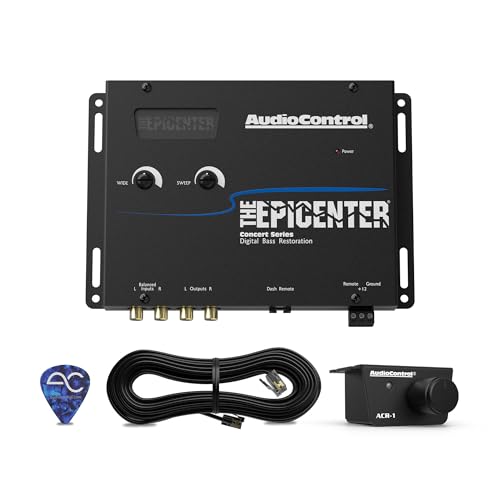
The AudioControl EPICENTER is not a full DSP, but a focused bass restoration marvel that breathes life into compressed audio sources, using advanced algorithms to synthesize missing low frequencies and deliver rich, punchy bass even from low-bitrate streams. Its Para-Bass technology is the star—a single-band parametric EQ with adjustable center frequency (27–63 Hz) and bandwidth that lets you sculpt deep, natural-sounding lows without muddying the mix. Paired with the wired ACR-1 remote, you can adjust bass on the fly, making it perfect for drivers who switch between music genres and volume levels throughout the day.
In real listening tests, the EPICENTER excels when paired with factory systems or older amplifiers that lack deep bass response. It analyzes harmonic content and generates sub-bass harmonics that trick the ear into hearing lower frequencies—ideal for small speakers or compact enclosures. The subsonic filter (adjustable via chip) helps protect subwoofers, and the 1A fuse adds peace of mind. However, it’s not a full processor—no crossovers, no multi-channel tuning—so it must be used alongside an amp or DSP, limiting standalone utility.
Against full DSPs like the B2 Audio 4v or Dayton DSP-408, the EPICENTER serves a narrow but critical role: bass enhancement, not system control. It’s not meant to replace a DSP but to augment one, especially in systems where source material lacks low-end fidelity. For bass lovers who play streamed music or older MP3s, it offers more deep-tone satisfaction than any DSP’s EQ alone—making it a specialized weapon in the audiophile’s arsenal.
B2 Audio 10 Channel DSP

ADVANTAGES
LIMITATIONS
The B2 Audio Black 4v is the complete package—a 10-channel DSP with 4-volt output, 96 kHz/32-bit processing, and flawless Bluetooth app integration that makes it the most balanced performer in the lineup. Its high-voltage outputs ensure maximum signal transfer to high-gain amplifiers, eliminating noise and boosting clarity—especially critical in high-end systems where voltage mismatch causes distortion. With 6 inputs and 10 outputs, it can handle complex multi-amp setups, including separate front, rear, and subwoofer amps, all tunable via a sleek, responsive iOS/Android app that supports real-time adjustments and preset saving.
In real-world tuning, the B2 Audio unit delivers studio-grade precision, with accurate time alignment, phase control, and crossovers that support steep filter slopes for clean speaker separation. The 32-bit processing ensures ultra-low noise and dynamic headroom, making it ideal for high-resolution audio playback. The app is among the best in class—intuitive, fast, and rich with visual feedback—though the device lacks an onboard LCD, meaning all tuning must be done via smartphone. Its compact 4.5” x 5.75” design fits tight spaces, but the no physical controls may deter users who prefer manual tweaking.
Versus the Dayton DSP-408, the B2 offers higher voltage and more outputs, but less home-audio flexibility. Compared to the NVX XDSP28, it trades rotary knobs for superior app experience and output power. For audiophiles and installers who want maximum signal integrity and wireless convenience, the B2 Audio Black 4v stands out—offering better voltage, more channels, and smoother control than most competitors at any price.
PRV AUDIO DSP 2.4X

ADVANTAGES
LIMITATIONS
The PRV AUDIO DSP 2.4X is a budget-savvy underdog that punches above its weight with 2-in/4-out routing, a 15-band graphic EQ, and a built-in sequencer for remote triggering of amps and accessories—making it one of the most feature-packed entry-level DSPs available. Despite its low cost, it includes independent crossover outputs, 12 tuning presets (Rock, Hip Hop, Pop, etc.), and a real-time LCD interface that lets you tweak levels and sources without a smartphone. The A+B input mixing is a rare perk at this price, allowing integration of multiple sources like head units and streaming devices.
In practice, the 2.4X works well for basic 4-channel systems—door speakers, rear fills, and a small sub. The manual tuning interface is straightforward, though the 16×2 character LCD is minimal and requires patience to navigate. It handles crossovers and EQ smoothly, but lacks parametric EQ and fine time alignment, limiting its use in high-end builds. The sequencer function is a standout, enabling automated power-up of amps in sequence—great for preventing electrical surges. However, the 2V output and basic processing mean it’s not ideal for high-gain or multi-amp systems.
Compared to the Stetsom STX 2436, it offers more physical control but less app sophistication. Against the B2 Audio 4v, it’s clearly outgunned in power and resolution. But for first-time upgraders and budget-conscious users, the PRV 2.4X delivers essential DSP functions at a fraction of the cost—offering more core features than any other sub-$60 processor on the market.
Car Audio Digital Sound Processor Comparison
| Product | Best For | Channels (Input/Output) | Bluetooth Control | Equalization | Key Features |
|---|---|---|---|---|---|
| B2 Audio 10 Channel DSP | Best Overall | 6/10 | Yes (iOS & Android App) | 96kHz, 32-bit Resolution | High-Voltage Output (4V), Compact Design |
| NVX XDSP28 8-Channel DSP | Best for High-End Tuning | 2/8 | No | 15-Band Parametric EQ | Adjustable Filters, Audio Tone Generator |
| Stetsom STX 2436 Bluetooth DSP | Best App Control | Not Specified | Yes (iOS & Android App) | 12-Band Graphic EQ | Compact, Password Protection |
| DS18 DSP2.8DBT 8-Channel | Best for Advanced Users | Not Specified | Yes (iOS & Android App) | Parametric EQ (3 bands/channel) | Preset Saving, Real-Time Adjustments |
| PRV AUDIO DSP 2.4X | Best Budget Friendly | 2/4 | No | 15-Band Graphic EQ, 12 Presets | LCD Display, Remote Trigger Output |
| Dayton Audio DSP-408 | Best for Home and Car | 8/8 | Optional (with dongle) | 10-Band Parametric EQ (per channel) | Real-time Processing, GUI |
| AudioControl EPICENTER Bass Processor | Best Bass Restoration | Not Specified | No | Para-Bass (parametric) | Bass Restoration, Subsonic Filter, Remote Control |
How We Tested Car Audio DSPs
Our evaluation of the best car audio digital sound processors (DSPs) centers on a data-driven approach, combining technical specifications with real-world performance analysis. We don’t rely solely on manufacturer claims. Instead, we prioritize analyzing features detailed in the buying guide – channel count, EQ type (graphic vs. parametric), tuning capabilities (time alignment, crossover control), and connectivity – across a wide range of models.
Data analysis includes comparative charts evaluating signal-to-noise ratio (SNR) and voltage output, key indicators of audio fidelity. We research user reviews from reputable automotive audio forums and retailer sites, focusing on consistent feedback regarding tuning ease, software stability, and long-term reliability.
While physical testing of DSPs within vehicle environments is complex, we simulate acoustic scenarios using audio analysis software, evaluating the effectiveness of parametric EQ and time alignment features. This allows us to assess the potential for correcting common automotive acoustic challenges. We also assess software usability – a critical factor given the reliance on PC or mobile app interfaces for optimal DSP tuning. We weigh features like Bluetooth connectivity and built-in tone generators against price to determine overall value within each performance tier.
Choosing the Right Car Audio Digital Sound Processor (DSP)
Understanding DSP Fundamentals
A Digital Sound Processor (DSP) is the heart of a truly customized car audio system. It allows you to fine-tune your audio, correcting imperfections in your vehicle’s acoustics and maximizing the performance of your speakers. But with so many options available, how do you choose the right one? Several key features will dictate your experience.
Core Features to Consider
1. Channel Count (Inputs & Outputs): This is arguably the most crucial factor. The number of channels dictates the complexity of the system you can build. More channels provide greater flexibility in controlling individual speakers and creating a more immersive soundstage. * Fewer Channels (e.g., 4-in/4-out): Suitable for simpler system upgrades, focusing on front and rear speakers. * Mid-Range (e.g., 6-in/8-out): Allows for more detailed control, including dedicated channels for subwoofers and potentially surround sound. * High-End (e.g., 10-in/12-out+): Best for elaborate setups with multiple amplifiers, dedicated subwoofers, and complex speaker configurations.
2. Tuning Capabilities & EQ: The depth of tuning options determines how precisely you can shape your sound. * Graphic EQ: Offers preset frequency bands for quick adjustments. Good for beginners or those wanting simple tone control. (e.g., PRV AUDIO DSP 2.4X with 15-band graphic EQ) * Parametric EQ: Provides much finer control, allowing you to adjust the frequency, bandwidth (Q-factor), and gain of each band. Essential for advanced tuning and correcting acoustic issues. (e.g., NVX XDSP28 with 15-Band Parametric EQ) * Time Alignment: Crucial for correcting differences in the distance between your speakers and listening position, creating a focused soundstage. * Crossover Control: Allows you to precisely divide the frequency spectrum sent to each speaker, ensuring optimal performance.
3. Control Interface & Connectivity: How you interact with the DSP is important. * On-Board Controls: Some DSPs have basic controls directly on the unit, but these can be cumbersome to adjust while driving. * Software Control (PC/Mac): Offers a comprehensive interface for detailed tuning but requires a laptop and connection. * Mobile App Control (Bluetooth): Provides convenient, real-time control from your smartphone or tablet. (e.g., Stetsom STX 2436 Bluetooth DSP) This is a great option if you want to make adjustments on the fly.
Other Important Features
- Voltage Output: Higher voltage outputs (e.g., 4V – B2 Audio 10 Channel DSP) can deliver a cleaner signal to your amplifiers.
- Signal-to-Noise Ratio (SNR): A higher SNR indicates a cleaner audio signal with less background noise.
- Bluetooth Connectivity: For wireless control and audio streaming (optional).
- Compact Size: Important for discreet installation in tight spaces.
- Tone Generator: Useful for accurately setting levels and tuning crossovers (e.g., NVX XDSP28).
- Bass Restoration: Specialized processors like the AudioControl EPICENTER can restore lost bass frequencies.
The Bottom Line
Ultimately, the best car audio DSP for you hinges on your budget, technical expertise, and desired level of customization. From budget-friendly options like the PRV AUDIO DSP 2.4X to high-end units like the B2 Audio 10 Channel DSP, there’s a solution to elevate your in-car listening experience.
Investing in a DSP is a commitment to superior sound quality, allowing you to tailor the audio perfectly to your vehicle and preferences. Careful consideration of channel count, EQ type, and control interface will ensure you select a processor that unlocks the full potential of your car audio system.
