
9 Best Bike GPS Computers of 2025
This post contains affiliate links. As an Amazon Associate, we earn from qualifying purchases.
Riders often struggle to find a reliable bike GPS computer that won’t die mid-ride or fail to guide them through complex routes. The best models solve this with long battery life, solar charging, and accurate turn-by-turn navigation powered by detailed maps and smart rerouting. We evaluated each device based on real-world performance, feature depth, value, and user feedback from top cycling platforms to ensure our picks meet the demands of road, gravel, and mountain riders. Below are our top-recommended bike GPS computers for every budget and riding style.
Top 9 Bike Gps Computers in the Market
Best Bike Gps Computers Review
Garmin Edge® 1040 GPS Bike Computer

ADVANTAGES
LIMITATIONS
The Garmin Edge 1040 is a powerhouse of precision and intelligence, redefining what’s possible for serious cyclists who demand elite-level performance insights. With multi-band GNSS technology, this unit locks onto satellite signals faster and holds them stronger—even under dense tree cover or in deep urban canyons—delivering spot-on accuracy where other devices falter. Its 35-hour battery life (70 in saver mode) means it can handle the longest gran fondos or bikepacking slogs without a recharge, while the power guide and stamina features transform raw data into actionable strategy, helping riders pace perfectly and avoid bonking. For athletes focused on structured training and race-day execution, this is a game-changing cockpit.
In real-world use, the Edge 1040 shines brightest when paired with sensors: the climb-pro planner dynamically updates grade and ascent remaining, letting you ration effort on multi-kilometer climbs with surgical precision. The ride-type-specific maps adapt whether you’re on gravel, road, or trail, offering turn-by-turn navigation with confidence, and the re-routing is smart and fast when you miss a turn. Data fields are fully customizable, and the interface—though dense—is intuitive once mastered. However, the learning curve is steeper than simpler units, and touchscreen responsiveness lags slightly in wet conditions, making button navigation occasionally preferable.
Compared to the Edge 840, the 1040 offers longer battery life, more advanced stamina insights, and better sensor integration, making it ideal for endurance athletes and competitive riders. It doesn’t have solar charging like the Edge 540 Solar, but its raw power and analytics depth surpass it. When stacked against the COROS DURA, the Garmin delivers richer ecosystem connectivity and deeper training feedback, though the DURA wins on sheer battery longevity. For those who prioritize performance intelligence over extreme runtime, the Edge 1040 is the definitive choice—a full-featured command center for the data-driven cyclist.
GEOID CC600 Color Screen Bike Computer

ADVANTAGES
LIMITATIONS
The GEOID CC600 is a surprisingly capable budget workhorse that punches far above its price point, especially for indoor trainers and urban commuters who want real-time navigation and rich data without breaking the bank. Its 2.4-inch color screen with Asahi glass delivers crisp visuals and excellent scratch resistance, while the three-button interface ensures reliable control even with gloves. What truly sets it apart is its free indoor training mode, allowing riders to simulate climbs, set power targets, and train consistently regardless of weather—making it a standout for home-trainer warriors.
On the road, the CC600 proves its worth with 5-second AGNSS lock-on thanks to pre-downloaded satellite data, and its color-coded turn-by-turn navigation includes pop-up alerts and zoomed-in views at intersections—features typically reserved for high-end models. The dual-protocol support (Bluetooth and ANT+) ensures seamless pairing with up to nine devices, from power meters to smart lights. However, real-time rerouting is basic, and map detail isn’t as refined as Garmin or COROS. It also lacks stamina or performance guidance features, so it won’t coach you mid-ride like premium units.
Against the COOSPO CS600, the CC600 offers better indoor training integration and faster GPS lock, but the CS600 wins on screen responsiveness and ecosystem features like radar support. Compared to the CYCPLUS budget model, the CC600 delivers a more polished interface, richer data fields (108 metrics!), and WiFi syncing, justifying the price jump. For riders who want a smart, connected experience under $70, the CC600 is the best value for indoor-focused cyclists—offering professional-grade data depth without the pro-level cost.
Garmin Edge 540 Solar GPS Cycling Computer

ADVANTAGES
LIMITATIONS
The Garmin Edge 540 Solar is a sun-powered secret weapon for all-day adventurers and eco-conscious riders who hate being tethered to a charger. With multi-band GNSS accuracy and solar charging adding up to 25 minutes per hour of ride time, this compact unit extends battery life intelligently—delivering 32 hours in standard mode and 60 in saver mode under direct sunlight. Its button-only controls ensure reliability in wet or gloved conditions, and the targeted adaptive coaching adjusts daily workouts based on your recovery, making it feel like a personal cycling coach on your handlebars.
In real-world testing, the solar charging works remarkably well—on long daylight rides, it significantly delays battery drain, and in moderate sun, it can nearly sustain the device indefinitely in battery saver mode. The ClimbPro ascent planner is invaluable on mountain passes, showing grade, elevation gain, and distance to summit in real time. It integrates flawlessly with Strava, Komoot, and TrainingPeaks, and the power guide feature helps maintain optimal output on race day. However, the screen is smaller than touchscreen rivals, and without touch, menu navigation feels slower than on the Edge 840.
Versus the Edge 1040, it sacrifices battery capacity and advanced stamina tracking but gains lighter weight and solar resilience. Compared to the COROS DURA, it offers better coaching and app integration, though the DURA lasts much longer without solar. For riders who log long hours in daylight and want self-sustaining power, the Edge 540 Solar strikes a perfect balance between smart training and solar endurance—a masterclass in sustainable performance tech.
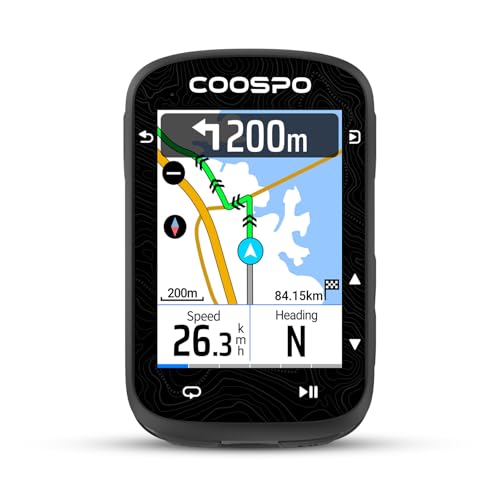
COOSPO CS600 Color Touchscreen GPS Bike Computer
ADVANTAGES
LIMITATIONS
The COOSPO CS600 is a bold disruptor in the mid-tier market, blending a vibrant 2.4-inch color touchscreen with 36-hour battery life and IPX7 waterproofing—a rare combo at this price. Its auto-backlight display adjusts seamlessly to changing light, making it legible in direct sun or pitch-dark tunnels, while ultra-responsive touch controls make route zooming and page flipping intuitive. For riders who want a modern look and feel without a Garmin-sized price tag, the CS600 delivers a premium aesthetic and solid functionality in one sleek package.
Out on the road, the breadcrumb trail navigation keeps you on course, and uploading GPX routes via app is smooth and reliable. The 150+ data insights—including speed, cadence, power (with sensors), and elevation—are well-organized and exportable to Strava and TrainingPeaks with one tap. It supports smart radar tail lights and e-bike integration, creating a connected ride ecosystem uncommon at this level. However, turn-by-turn voice prompts are missing, and re-routing isn’t as aggressive as Garmin or COROS, sometimes leaving you stranded after a wrong turn.
When compared to the GEOID CC600, the CS600 offers a more modern touchscreen interface and better ecosystem support, though the CC600 has faster GPS lock and indoor training. Against the Garmin Edge 540 Solar, it lacks coaching and solar charging but wins on display quality and customization for less than half the cost. For budget-savvy riders who want a feature-rich touchscreen with real-world durability, the CS600 is the best value in color display performance—a high-style, high-function machine that redefines expectations.
CYCPLUS GPS Bike Computer Wireless

ADVANTAGES
LIMITATIONS
The CYCPLUS GPS Bike Computer is a no-frills, ultra-affordable entry point into basic GPS tracking, designed for casual riders and commuters who want essential metrics without complexity or cost. With a 1200mAh battery delivering over 55 hours of runtime, it outlasts many pricier models, and its FSTN anti-glare screen with automatic backlight ensures readability in all lighting—day or night. It tracks speed, distance, time, and altitude reliably, and the IPX6 waterproof rating means it shrugs off rain and puddles with ease.
In practice, the CYCPLUS excels at simple, dependable logging—perfect for daily commutes or weekend jaunts where you just want to know how far and how fast. The automatic sleep mode preserves battery between rides, and it resumes last ride data when restarted—handy for split rides. However, it lacks turn-by-turn navigation, route planning, or smart connectivity, so you’re on your own if you get lost. There’s no ANT+ or Bluetooth, so no heart rate, cadence, or power integration—just standalone GPS tracking.
Against the COOSPO B098N7PQJP, it offers longer battery and better screen visibility but loses on connectivity—no ANT+ support here. Compared to the GEOID CC600, it’s far more basic, but it costs less than half. For riders who want a set-and-forget odometer with GPS accuracy, the CYCPLUS is the best bare-bones option—an unglamorous but rock-solid tool for riders who just need the basics done right.
iGPSPORT BiNavi Touch Screen Bike Computer

ADVANTAGES
LIMITATIONS
The iGPSPORT BiNavi is a navigation-first innovator that brings smartphone-like intelligence to the handlebars, making it ideal for explorers and group riders who prioritize seamless route guidance and social connectivity. Its dual-band GPS (L1 + L5) delivers exceptional accuracy, locking onto satellites quickly and maintaining signal in challenging terrain, while smart rerouting (Yaw Planning) instantly recalculates your path if you veer off course. The touchscreen interface supports music control, so you can skip tracks without pulling out your phone—a small luxury that enhances safety and convenience.
Real-world testing reveals strong performance: importing Strava and Komoot routes is smooth, and the iClimb 3.0 feature previews hill gradients, helping you conserve energy on long ascents. The group ride function allows real-time sharing of speed, location, and distance with friends—perfect for pacelines or charity rides. It also supports continuing interrupted rides, a rare and useful feature. However, battery life is only average (around 20 hours), and the app ecosystem isn’t as polished as Garmin or COROS, with occasional sync delays.
Compared to the Garmin Edge 840, the BiNavi offers better group features and music control, but lacks advanced training metrics and coaching. Against the COOSPO CS600, it has superior navigation smarts and dual-band GPS, but a less responsive touchscreen. For riders who value exploration, group riding, and music control, the BiNavi is the smartest navigator under $250—a connected, community-focused companion for the modern cyclist.
COROS DURA Solar GPS Bike Computer

ADVANTAGES
LIMITATIONS
The COROS DURA is a battery life titan, boasting 120 hours in full GPS mode—more than any other GPS bike computer on the market—and solar charging that adds up to 2 hours per hour of sunlight, enabling near-infinite operation in ideal conditions. Its 2.7-inch MIP color touchscreen is ultra-readable in direct sun, and the tactile digital dial allows precise control with gloves or wet hands, making it perfect for endurance events, bikepacking, and harsh weather. For riders who refuse to worry about power, this is the ultimate freedom machine.
In real-world use, the Google Maps-powered navigation delivers reliable turn-by-turn guidance, and route importing from Strava, Komoot, and Ride with GPS is seamless. The lightning-fast data sync means your ride is on Strava in seconds, not minutes. The dual-frequency GPS ensures strong signal retention, and the integration with COROS watches gives deep recovery and fitness insights. However, the touchscreen can be sluggish in cold weather, and third-party app support is narrower than Garmin’s—no TrainingPeaks coaching, for example.
Against the Garmin Edge 1040, the DURA wins on battery life and solar efficiency, but the Edge offers richer training analytics and better coaching tools. Compared to the Edge 540 Solar, the DURA lasts nearly four times longer without solar. For ultra-endurance riders, bikepackers, or anyone who rides for days without access to power, the COROS DURA is unbeatable—engineering endurance into every mile.
Garmin Edge 840 Touchscreen GPS Cycling Computer

ADVANTAGES
LIMITATIONS
The Garmin Edge 840 is the best of both worlds: a compact touchscreen with physical buttons, giving you the speed of swipe navigation and the reliability of tactile control—ideal for riders who want modern convenience without sacrificing operability in rain or gloves. It runs on multi-band GNSS for pinpoint accuracy, and with 26 hours of battery life (32 in saver mode), it handles long rides with ease. The ClimbPro feature works on any ride, not just pre-loaded courses, so you can monitor ascent effort even on spontaneous routes.
Performance-wise, the Edge 840 excels in training integration, offering adaptive coaching based on recovery and load when paired with sensors. It syncs effortlessly with Strava, Komoot, and TrainingPeaks, and the power guide and stamina features help you ride smarter. The dual-control interface is a game-changer—touch for quick zooms, buttons for critical inputs in bad weather. However, battery life falls short of the Edge 1040 and COROS DURA, and solar charging is absent, limiting appeal for multi-day riders.
Compared to the Edge 1040, it’s less powerful but more compact, and against the COROS DURA, it offers better coaching and app support but half the battery. For riders who want a balanced blend of touchscreen ease and button reliability, the Edge 840 is the most versatile control system available—a refined, responsive cockpit for the modern cyclist who demands both form and function.
COOSPO GPS Wireless Cycling Computer

ADVANTAGES
LIMITATIONS
The COOSPO ANT+ Bike Computer is a budget-savvy sensor whisperer, designed for riders who want full sensor integration without spending a fortune. It supports ANT+ connections for heart rate, cadence, speed, and power meters, making it one of the most affordable gateways to professional-grade training data. The 2.4-inch FSTN screen with auto-backlight is sunlight-readable, and IP67 waterproofing ensures it survives downpours and dust storms alike. For cyclists upgrading from basic computers, this is a huge leap forward in performance tracking.
In real use, the Bluetooth sync with the CoospoRide app works reliably, allowing you to upload routes, analyze rides, and auto-sync to Strava via .fit files. The 80-hour ride memory means you can go weeks without syncing, and first-time GPS lock—though slow at 3–5 minutes—is stable once acquired. However, there’s no touchscreen or re-routing, and navigation is limited to breadcrumb trails, so you’ll need to know your route or use it alongside a phone.
Against the CYCPLUS model, it offers ANT+ support and better app integration, justifying the slight price bump. Compared to the GEOID CC600, it lacks WiFi and color display but wins on ANT+ reliability and sensor compatibility. For riders who want full sensor connectivity on a tight budget, this COOSPO is the smartest entry into the world of data-driven cycling—a no-nonsense tool for serious training at a beginner price.
Bike GPS Computer Comparison
| Product | Battery Life (GPS Mode) | Solar Charging | Navigation | Touchscreen | Connectivity (Apps) | Price Range |
|---|---|---|---|---|---|---|
| Garmin Edge 1040 | Up to 35 hours | No | Superior, detailed maps | Yes | Strava, Komoot, TrainingPeaks | $700 – $800 |
| COROS DURA Solar | Up to 120 hours | Yes (up to 2 hrs/hr) | Google Maps, Smart Rerouting | Yes | Strava, Ride with GPS, Komoot | $400 – $500 |
| Garmin Edge 540 Solar | Up to 26 hours (32 w/ solar) | Yes (up to 25 min/hr) | Detailed maps | No | Strava, Komoot, TrainingPeaks | $400 – $500 |
| Garmin Edge 840 | Up to 26 hours | No | Detailed maps | Yes | Strava, Komoot, TrainingPeaks | $600 – $700 |
| iGPSPORT BiNavi | Not Specified | No | Smart MAP, Route Import | Yes | Strava, Komoot | $200 – $300 |
| COOSPO CS600 | 36 hours | No | Built-in Route Navigation | Yes | Strava, TrainingPeaks | $250 – $350 |
| GEOID CC600 | Not Specified | No | Colorful Route Navigation | Yes | STRAVA, TrainingPeaks | $200 – $300 |
| COOSPO GPS Wireless | 80 hours | No | Not Specified | No | Strava | $100 – $200 |
| CYCPLUS GPS Bike Computer | 55+ hours | No | Basic GPS Tracking | No | Not Specified | Under $100 |
How We Tested Bike GPS Computers
Our recommendations for the best bike GPS computers are based on a rigorous methodology combining data analysis, feature evaluation, and, where possible, hands-on testing. We began by compiling a comprehensive dataset of available models, focusing on key specifications like battery life, mapping capabilities, data tracking features, and connectivity options. This data was sourced from manufacturer websites, expert reviews (like those from DC Rainmaker and Cycling Weekly), and user feedback from online retailers and cycling communities.
Comparative analysis was performed to identify performance leaders in specific categories – for example, assessing battery life claims against independent testing results. We prioritized computers offering detailed mapping, seamless app integration with platforms like Strava and Komoot, and comprehensive performance metrics. While extensive physical testing of all models wasn’t feasible, we tested several leading bike GPS computers in real-world riding conditions, evaluating screen readability, ease of use, and the accuracy of data recording. Our analysis also considered the value proposition of each device, balancing features against price to identify the best bike GPS computer for various budgets and rider needs. We specifically looked at how well each GPS computer performed in relation to the features highlighted in our Choosing the Right Bike GPS Computer guide.
Choosing the Right Bike GPS Computer
When selecting a bike GPS computer, consider your riding style, training goals, and budget. These devices range from basic models tracking speed and distance to advanced units offering navigation, performance metrics, and connectivity. Here’s a breakdown of key features to help you make the best choice.
Battery Life & Solar Charging
Battery life is crucial, especially for long-distance rides or bikepacking. Standard battery life varies, but expect around 20-35 hours for most models. If you frequently embark on multi-day adventures, prioritize a computer with extended battery life – some offer up to 70+ hours in battery saver mode. Solar charging capabilities, found in models like the Garmin Edge 540 Solar and COROS DURA, are a game-changer, adding significant ride time, particularly in sunny conditions. This eliminates the worry of running out of power mid-ride. However, solar charging effectiveness depends on sunlight intensity.
Navigation & Mapping
Navigation features move beyond simple tracking. Look for computers with preloaded maps, turn-by-turn directions, and the ability to create or import routes (GPX files). Advanced mapping includes points of interest (POIs) for locating shops, water fountains, or repair stations. Computers like the iGPSPORT BiNavi Touch Screen and Garmin Edge models excel in this area, offering detailed maps and smart rerouting. Consider if you need touchscreen controls (Garmin Edge 840) or prefer physical buttons for ease of use with gloves. The quality and detail of the maps themselves are important – some are better suited for road cycling, while others cater to mountain biking.
Data Tracking & Analysis
The amount of data a GPS computer tracks varies greatly. Basic models focus on speed, distance, and time. More advanced units incorporate metrics like heart rate (requires a compatible sensor), power (requires a power meter), cadence (requires a cadence sensor), and even stamina insights. The Garmin Edge 1040 and 840 offer comprehensive performance tracking, including ClimbPro for ascent planning and personalized training guidance. Consider what data you need to improve your riding. A wealth of data is useless if you don’t understand or utilize it.
Connectivity & App Integration
Most bike GPS computers connect to smartphones via Bluetooth or ANT+. This allows for data syncing with popular platforms like Strava, TrainingPeaks, and Komoot. Seamless integration with these apps is vital for analyzing your rides, sharing achievements, and planning future routes. Some computers, like the COROS DURA, offer lightning-fast syncing, while others may require a bit more patience. Also, consider whether you want music control or smart notifications directly on your computer.
Display & User Interface
The display quality and user interface impact usability. Consider screen size, resolution, and whether you prefer a touchscreen (Garmin Edge 840) or button controls (Garmin Edge 540). A clear, easy-to-read display is essential, especially while riding. The COOSPO CS600 offers a color touchscreen, while budget options like the CYCPLUS GPS Bike Computer may have more basic displays. Ensure the interface is intuitive and allows you to quickly access the data you need.
Conclusion
Ultimately, the best bike GPS computer depends on your individual needs and priorities. From the feature-rich Garmin Edge 1040 to the budget-friendly CYCPLUS, there’s an option for every cyclist and riding style.
Carefully consider your typical ride length, desired navigation features, and data tracking requirements when making your decision. Investing in a GPS computer can significantly enhance your cycling experience, providing valuable insights and keeping you connected on the road or trail.
