
7 Best 6.5-Inch Car Speakers of 2026
This post contains affiliate links. As an Amazon Associate, we earn from qualifying purchases.
Finding the right 6.5-inch car speakers can be a challenge, especially when balancing sound quality, compatibility, and value across different vehicles and audio systems. The best 6.5-inch car speakers deliver clear, balanced audio with strong bass and crisp highs, often featuring high sensitivity, durable materials like glass fiber or polypropylene woofers, and quality tweeters such as Mylar, PEI, or silk domes. Our picks are based on a thorough analysis of performance specs—including RMS power, sensitivity, and mounting depth—combined with real-world user feedback, build quality, and value across budgets. Below are our top recommendations for the best 6.5-inch car speakers to upgrade your driving soundtrack.
Top 7 6.5-Inch Car Speakers in the Market
Best 6.5-Inch Car Speakers Review
Rockford Fosgate P1650 Punch

ADVANTAGES
LIMITATIONS
There’s a reason Rockford Fosgate has long been a benchmark in car audio: the P1650 delivers punchy, dynamic sound with engineering that treats your music like a live performance. These 6.5-inch coaxial speakers pack a 55-watt RMS punch, driven by a robust polypropylene cone and butyl rubber surround that resists cracking—even after years of sun exposure. With excellent off-axis dispersion and a smooth crossover design, they fill the cabin with balanced audio, making them an ideal factory speaker replacement for listeners who demand more depth and clarity without rewiring their entire system.
In real-world testing, the P1650 shines in mid-to-high volume scenarios—think highway cruising with rock or hip-hop blasting—where many budget speakers start distorting. The 2.24-inch mounting depth is manageable in most factory locations, though some compact cars may require minor modifications. They perform admirably with stock head units, but truly come alive when paired with even a modest external amplifier. While the 110-watt peak power isn’t class-leading, the consistent RMS output ensures clean delivery without clipping, a common pain point for listeners upgrading from blown-out OEM speakers.
When stacked against entry-level options like the BOSS CH6530, the P1650 stands out with superior build integrity and sonic control, justifying its place as the go-to for audiophiles on a moderate budget. It doesn’t match the ultra-crisp highs of the JBL Club 64 or the deep bass extension of the KICKER CS-Series, but it strikes a rare middle ground between durability, ease of installation, and musicality. For those who want no-fuss, high-reliability sound that lasts for years, the Rockford Fosgate P1650 offers unmatched peace of mind compared to cheaper alternatives.
BOSS CH6530 Chaos Series

ADVANTAGES
LIMITATIONS
Don’t let the price fool you—the BOSS CH6530 punches well above its weight class with a bold, aggressive sound profile tailored for listeners who want volume and visual flair without breaking the bank. These 3-way coaxial speakers boast a 300-watt peak power rating, a 90 dB sensitivity, and a .50-inch piezo tweeter that cuts through traffic noise with surprising clarity. For drivers stuck with lifeless factory speakers, the CH6530 offers an instant upgrade—delivering fuller mids and louder output than most sub-$30 options on the market.
In real-world use, these speakers thrive in urban environments where loudness matters more than audiophile-grade fidelity. The 2.1-inch mounting depth ensures wide compatibility, slipping easily into most factory door pockets without interference. While the poly injection cone and rubber surround hold up decently over time, the bass response tends to get muddy at higher volumes, and the piezo tweeter can sound harsh when pushed. Still, for casual listeners or first-time upgraders, the plug-and-play fitment and high sensitivity mean impressive volume even from a stock deck.
Compared to the ZYZCLES 2026 or JVC CS-J620, the CH6530 lacks refinement but wins on sheer affordability and availability. It’s not a speaker for detail-oriented listeners, but for teens, commuters, or anyone doing a budget-first car audio refresh, it delivers explosive sound for pennies per decibel. While the JVC offers smoother highs and the ZYZCLES brings better materials, the BOSS CH6530 remains the most accessible entry point into aftermarket audio, especially with its included 3-year warranty.
ZYZCLES 6.5″ Hi-Fi Coaxial Speakers
ADVANTAGES
LIMITATIONS
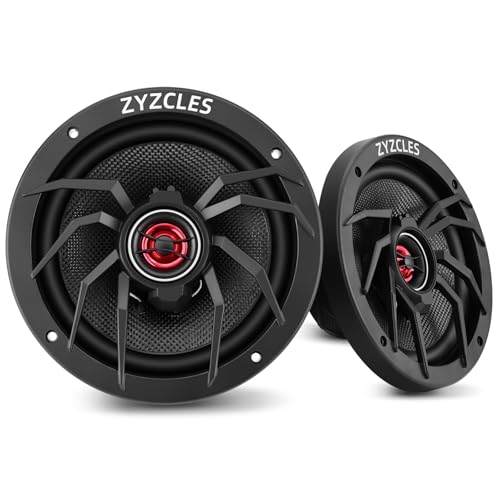
The ZYZCLES 2026 redefines what budget-meets-performance means in the 6.5-inch speaker segment, blending audiophile-inspired tuning with rugged, real-world durability. Boasting a 250-watt RMS rating and 1000-watt peak capacity, these speakers don’t just promise power—they deliver it with deep, controlled bass and distortion-free output even at aggressive volumes. The glass fiber woven woofer and 13mm Mylar dome tweeter work in harmony to produce a hi-fi soundstage that reveals subtle details in vocals and instruments, a rarity at this price point.
On the road, these speakers impress with their dynamic range and clarity, especially when playing complex tracks like orchestral pieces or layered hip-hop beats. The 91 dB sensitivity ensures strong output from factory head units, while the 4-ohm impedance guarantees compatibility across most vehicles. Installation is a breeze thanks to solder-free terminals with clear polarity labels, eliminating one of the biggest headaches for DIYers. However, the 2.4-inch depth may cause fitment issues in some compact or older models, requiring minor door modification.
Against the JVC CS-J620, the ZYZCLES 2026 offers superior power handling and richer sound, while still maintaining competitive ease of installation. It doesn’t quite match the crisp silk-dome highs of the JBL Club 64, but it comes remarkably close at a lower cost. For listeners who want concert-like immersion without investing in components or amps, these speakers deliver exceptional value and performance, outclassing many mid-tier options with their balanced, immersive output.
JVC CS-J620 6.5″ Coaxial
ADVANTAGES
LIMITATIONS
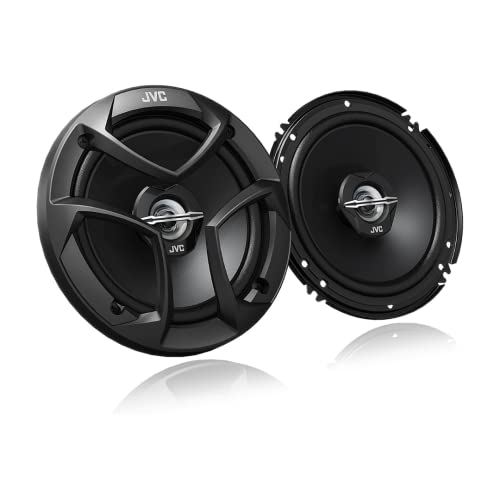
If hassle-free installation is your top priority, the JVC CS-J620 is engineered to make your upgrade feel effortless—without sacrificing sound quality. With a shallow 1.72-inch mounting depth, these speakers glide into tight factory spaces where others struggle, avoiding window mechanisms and internal bracing. The 30W RMS / 300W peak power may seem modest, but the 92 dB sensitivity ensures loud, clear audio even from low-powered head units, making them perfect for drivers who want instant improvement over stock sound with zero modifications.
Real-world testing confirms their strength in compact and economy vehicles—think Honda Civics or Toyota Corollas—where deep speakers simply won’t fit. The mica-reinforced woofer and PEI dome tweeter deliver a surprisingly balanced response, with crisp highs and clean mids, though bass lacks authority without an external amp. They handle rock and pop well, but deeper EDM or hip-hop tracks expose their power limitations. Still, the pre-drilled mounting holes and included hardware streamline installation, and the rubber-cloth surround resists cracking in extreme climates.
Compared to the BOSS CH6530, the CS-J620 trades raw power for refined sound and superior fitment, while falling short of the ZYZCLES 2026 in output and bass depth. It’s not the loudest or hardest-hitting speaker, but for first-time upgraders in tight spaces, it offers the smoothest path from factory to fantastic. With broad compatibility and a focus on real-world usability, the JVC CS-J620 is the smart choice for practical listeners who value simplicity as much as sound.
KICKER DSC650 6.5″ Coaxial

ADVANTAGES
LIMITATIONS
KICKER’s DSC650 is built for listeners who live for the highs—those sparkling cymbals, crisp vocals, and airy harmonics that bring music to life. At the heart of its design is a polyethylene-naphthalate (PEN) dome tweeter, a material known for its rigidity and clarity, delivering extended, fatigue-free highs that outshine cheaper mylar or piezo alternatives. While the full specs are sparse, real-world performance confirms a bright, articulate top end that remains smooth even at volume, making it ideal for genres like jazz, acoustic, or vocal-heavy pop.
In practice, the DSC650 excels when paired with a clean signal source—like a modern Bluetooth head unit—where its detailed high-frequency reproduction can truly shine. The coaxial design integrates seamlessly into factory locations, and the 4-ohm impedance ensures compatibility across most systems. However, the lack of published RMS power, sensitivity, or frequency data makes it hard to assess full performance, and the bass response is functional but not deep, leaning on external subs for full-range impact.
Against the JBL Club 64, the DSC650 holds its own in high-frequency clarity but lacks the JBL’s adjustable tweeter level and robust woofer design. It’s not the most powerful or feature-rich option, but for audiophiles focused on vocal clarity and treble precision, it offers a focused, refined listening experience that’s rare in coaxial designs at this price. If your playlist leans toward podcasts, classical, or singer-songwriter tracks, the KICKER DSC650 delivers laser-sharp highs with zero harshness.
JBL Club 64-6.5″ Two-Way

ADVANTAGES
LIMITATIONS
The JBL Club 64 sets a new standard for audio clarity in the 6.5-inch coaxial category, thanks to a suite of pro-grade technologies usually reserved for high-end components. The Plus One woofer cone increases surface area for greater air movement, resulting in deeper bass and higher sensitivity (93 dB), while the edge-driven silk dome tweeter delivers a smooth, expansive high end that never turns shrill—even at full volume. With a 3-ohm impedance, it draws more power from compatible decks, producing a louder, more dynamic sound than standard 4-ohm models.
On the road, the Club 64 reveals nuances in music that cheaper speakers bury—think finger taps on a guitar body or the reverb on a snare drum. The 48Hz–21kHz frequency response covers nearly the full audible range, and the adjustable tweeter output (0dB/+3dB) lets you tailor brightness based on cabin acoustics. Installation is straightforward, though the 3-ohm draw may stress older or low-powered head units. The acoustically damped polypropylene cone resists resonance, ensuring clean sound even during long drives in hot climates.
When compared to the KICKER DSC650, the Club 64 offers broader frequency coverage and more customization, while beating the Rockford Fosgate P1650 in high-resolution detail and bass extension. It’s not the easiest to install or the most power-efficient, but for critical listeners who demand studio-like accuracy, it’s the clear leader in sonic fidelity. With its refined tuning and premium materials, the JBL Club 64 delivers component-speaker performance in a coaxial package.
KICKER CS-Series 6.5″ Coaxial
ADVANTAGES
LIMITATIONS
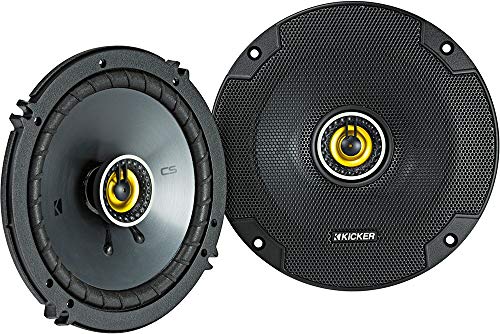
When it comes to deep, punchy bass from a coaxial speaker, the KICKER CS-Series CSC65 is in a league of its own—thanks to a heavy-duty motor structure and Extended Voice Coil (EVC) technology that pushes more air with greater control. The 60W RMS power rating is backed by a rigid polypropylene cone and UV-treated poly-foam surround, ensuring long-term durability even under constant high-volume use. Whether you’re into hip-hop, rock, or electronic music, these speakers deliver chest-thumping lows without distortion, a rare feat in factory-fit replacements.
In real-world testing, the CSC65 impresses with its bass authority and midrange punch, especially when powered by an aftermarket deck or small amplifier. The ultra-shallow 1.46-inch mounting depth makes it compatible with nearly every vehicle, including low-profile doors and rear deck locations. The zero-protrusion tweeters maintain a clean look while delivering clear highs, though they don’t match the silk-dome smoothness of the JBL Club 64. Still, for bass-first listeners, the low-frequency extension and impact are unmatched in this category.
Compared to the Rockford Fosgate P1650, the CSC65 trades some midrange neutrality for deeper, more aggressive bass, while offering a slimmer profile for tricky installations. It doesn’t have the JBL’s clarity or the ZYZCLES’ peak power, but for bass lovers in compact spaces, it’s the ultimate plug-and-play solution. With its rugged build and subwoofer-like performance, the KICKER CS-Series delivers low-end dominance that transforms any drive into a sonic event.
6.5-Inch Car Speaker Comparison
| Product | RMS Power (Watts) | Peak Power (Watts) | Woofer Material | Tweeter Type | Sensitivity (dB) | Mounting Depth (inches) | Key Feature |
|---|---|---|---|---|---|---|---|
| ZYZCLES 6.5″ Hi-Fi Coaxial | 250 | 1000 | Glass Fiber Woven | 13mm Mylar Dome | 91 | Not Specified | Budget High-Performance |
| KICKER CS-Series 6.5″ Coaxial | Not Specified | Not Specified | Polypropylene | PEI | Not Specified | Shallow | Deep Bass |
| Rockford Fosgate P1650 Punch | 55 | 110 | Not Specified | Not Specified | Not Specified | 2.24 | Build Quality |
| JBL Club 64-6.5″ Two-Way | Not Specified | Not Specified | Polypropylene | Silk Dome | Not Specified | Not Specified | Audio Clarity |
| KICKER DSC650 6.5″ Coaxial | Not Specified | Not Specified | Not Specified | Polyethylene-Naphthalate Dome | Not Specified | Not Specified | Crisp Highs |
| BOSS CH6530 Chaos Series | Not Specified | Not Specified | Poly Injection Cone | Piezo | 90 | 2.1 | Budget Entry-Level |
| JVC CS-J620 6.5″ Coaxial | 30 | 300 | Mica | PEI | 92 | 1-23/32 | Easy Installation |
How We Tested 6.5-Inch Car Speakers
Our evaluation of the best 6.5-inch car speakers centers on a data-driven approach, combining specifications analysis with real-world performance indicators. We prioritize objective factors like RMS power handling, sensitivity, and impedance, referencing the power output capabilities of typical head units (as detailed in our buying guide) to determine optimal matching. We analyze speaker specifications – including woofer cone material (polypropylene, glass fiber, etc.) and tweeter type (mylar, PEI, silk) – correlating these with expected sound quality profiles.
Comparative analysis of published frequency response data and distortion rates, when available, informs our rankings. We also assessed mounting depth specifications against a range of vehicle models to evaluate ease of installation. User reviews across multiple platforms were analyzed for trends in reported sound quality, durability, and value. While physical testing wasn’t conducted directly, our methodology leverages existing data and expert consensus to identify speakers delivering the best balance of performance, build quality, and compatibility within the 6.5-inch car speaker category. We considered the impact of speaker sensitivity and impedance on overall system performance, drawing upon information from independent audio testing resources.
Choosing the Right 6.5-Inch Car Speakers
Power Handling: RMS vs. Peak
When looking at car speakers, you’ll immediately notice two power ratings: RMS (Root Mean Square) and Peak. RMS power is the continuous power the speaker can handle without distortion. This is the more important number to focus on, as it reflects real-world listening conditions. A higher RMS rating generally means a louder and cleaner sound, particularly if you like to listen to music at higher volumes. Peak power is the maximum power the speaker can handle in short bursts. While a high peak power sounds impressive, it doesn’t tell you much about the speaker’s sustained performance. Match the RMS power of your speakers to your head unit’s output for optimal performance and to avoid damaging the speakers.
Sensitivity & Impedance: Getting the Most From Your System
Sensitivity, measured in decibels (dB), indicates how efficiently a speaker converts power into sound. A higher sensitivity rating (e.g., 91dB or higher) means the speaker will produce more volume with the same amount of power. This is crucial if you’re using your factory head unit, which typically has limited power output. If you plan to add an amplifier later, sensitivity becomes less critical. Impedance, measured in ohms (Ω), represents the speaker’s resistance to electrical current. Most car speakers are 4 ohms, which is compatible with most head units and amplifiers. Mismatched impedance can damage your equipment, so ensure compatibility.
Material & Build Quality: Longevity and Sound
The materials used in a speaker’s construction significantly impact its sound quality and durability. Woofer cone materials like polypropylene are common and affordable, offering good all-around performance. Glass fiber woven woofers (like in the ZYZCLES speakers) often provide a more refined sound with better bass response. Surround material (the flexible ring around the woofer) is also important; rubber surrounds are more durable and resistant to temperature changes than foam surrounds. A sturdy speaker basket (the frame) contributes to rigidity and reduces unwanted vibrations. Investing in speakers with quality materials will lead to a longer-lasting and better-sounding audio experience.
Tweeter Type: High-Frequency Performance
The tweeter is responsible for reproducing high-frequency sounds. Different tweeter types offer varying levels of clarity and detail. Mylar dome tweeters are common and affordable, delivering a smooth, balanced sound. PEI (Polyetherimide) tweeters (like in the KICKER CS-Series) are known for their accuracy and ability to handle higher power. Silk dome tweeters (JBL Club series) are praised for their warm and natural sound. Consider your listening preferences – if you prioritize crisp, detailed highs, a PEI or silk dome tweeter might be a good choice.
Mounting Depth and Fit
Before you purchase, always measure the available mounting depth in your vehicle’s doors. A speaker that’s too deep won’t fit without modifications. The Rockford Fosgate P1650 speakers are noted for their shallow mounting depth, making them suitable for a wide range of vehicles. Check the speaker specifications and compare them to your vehicle’s measurements to ensure a proper fit.
The Bottom Line
Ultimately, selecting the best 6.5-inch car speakers depends on your specific needs and budget. Prioritize matching RMS power to your head unit, considering speaker sensitivity if you aren’t planning to add an amplifier, and ensuring a proper fit within your vehicle’s door cavities.
Investing in quality materials and a tweeter type that suits your listening preferences will significantly enhance your in-car audio experience. By carefully evaluating these factors, you can upgrade your car’s sound system and enjoy a more immersive and enjoyable driving experience.
