
7 Best 360 Cameras for Motorcycle (2026 Guide)
This post contains affiliate links. As an Amazon Associate, we earn from qualifying purchases.
Riding at high speeds and rough terrain makes capturing smooth, immersive footage a major challenge for motorcyclists, especially when dealing with shaky video, poor lighting, or complicated editing. The best 360 cameras for motorcycle use solve this with advanced stabilization like FlowState and 360° Horizon Lock, plus AI-powered reframing that lets you effortlessly create cinematic shots from all-around video. We evaluated top models based on real-world performance, prioritizing resolution, stabilization, low-light quality, battery life, and user feedback from riders to ensure our picks deliver reliability and ease of use. Discover our top recommendations below.
Top 7 360 Camera For Motorcycle in the Market
Best 360 Camera For Motorcycle Review
Insta360 X4 Motorcycle Bundle

ADVANTAGES
LIMITATIONS
The Insta360 X4 Motorcycle Bundle explodes onto the scene with 8K 360° video that redefines what action cameras can do on two wheels. With dual 1/2″ sensors, Active HDR, and flowing FlowState Stabilization, this camera captures every twist, turn, and terrain change in cinematic clarity—no shot missed, no angle miscalculated. Riders who demand pro-level immersion without the production crew will love how the invisible selfie stick effect turns solo rides into third-person cinematic sequences, making your footage feel like it was shot by a drone trailing just behind. It’s not just about recording your journey—it’s about redefining how it’s seen.
In real-world riding conditions—from pothole-riddled backroads to high-speed highway stretches—the X4 delivers rock-solid stabilization and 360° Horizon Lock that keeps your horizon perfectly level, even during aggressive leans or sudden bumps. Its 135-minute battery life handles long rides with ease, while the waterproof design (10m natively, 50m with case) means rain or river crossings don’t spell disaster. The 2.5″ Gorilla Glass touchscreen is bright and responsive, even with gloves, making on-the-go adjustments intuitive. However, the lack of an included microSD card is a notable omission, and while 4K60fps wide-angle mode is solid, the real magic lies in post-shot reframing—something that demands reliable app use and editing patience.
When stacked against the Insta360 X3, the X4 is clearly its more powerful, longer-lasting evolution—offering 67% more battery life, higher resolution, and a brighter, more durable screen. It’s ideal for serious riders and content creators who want broadcast-quality footage without lugging around extra gear. Compared to the DJI Osmo 360, it trades a slightly smaller sensor for broader software maturity and a more rugged, field-ready build. For those stepping into high-end 360 motorcycling content, the X4 delivers unmatched value in image quality, stabilization, and creative flexibility.
Insta360 X3 Motorcycle Bundle
ADVANTAGES
LIMITATIONS
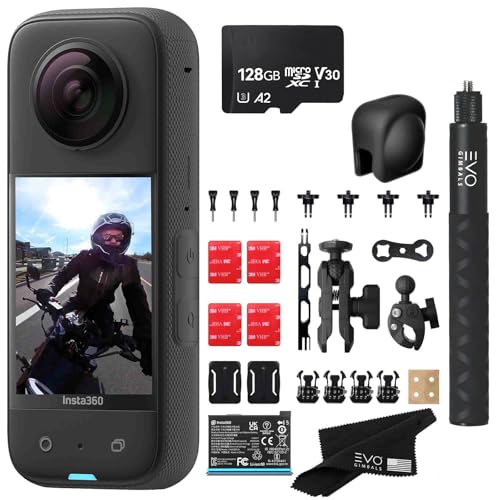
The Insta360 X3 remains a mid-range powerhouse that punches well above its weight, especially for motorcyclists who want pro-grade 360° storytelling without breaking the bank. Boasting 5.7K HDR video, dual 1/2″ 48MP sensors, and 72MP photos, it captures rich, vibrant footage even in mixed lighting—perfect for dawn rides or urban canyon carving. The invisible selfie stick effect turns every ride into a cinematic chase scene, while AI-powered reframing in the Insta360 app lets you shoot first, decide later, a game-changer for riders who can’t pause to compose.
In real-world use, the X3 handles vibration-heavy environments with impressive grace, thanks to FlowState Stabilization and 360° Horizon Lock that keep footage buttery smooth, even over gravel or rough pavement. The 2.29″ touchscreen is responsive, and the included 128GB card and full motorcycle mount kit make it a true plug-and-play setup. However, the battery life (around 80 minutes) can fall short on extended tours, and while it’s waterproof to 10m, it lacks the cold-weather endurance of newer models. The 4K single-lens mode is excellent for vlogging, but the real strength lies in 360 capture, which demands post-processing time.
Compared to the X4, the X3 feels like a slightly older sibling—less battery, lower resolution, and no 8K—but it’s still fully capable for most riders. Against the AKASO 360, it offers superior software, better HDR, and a more polished ecosystem. It’s the ideal pick for intermediate riders and content creators who want high-end features at a more accessible price, with proven reliability and a mature app experience. While it doesn’t have the latest bells and whistles, it delivers excellent performance, solid build, and creative freedom that few in its class can match.
DJI Osmo 360 Motorcycle Combo

ADVANTAGES
LIMITATIONS
The DJI Osmo 360 lands as the low-light king of motorcycle 360 cameras, thanks to its groundbreaking 1-inch 360° imaging sensor—a rarity in this category. This isn’t just a spec bump; it translates to sharper, cleaner footage in dim conditions, whether you’re riding at dusk, under forest canopies, or through cityscapes at night. With 8K 360° video, 120MP photos, and 4K/120fps slow-motion capability, it’s built for creators who want cinematic depth and dynamic range without post-processing guesswork. The magnetic quick-release system makes swapping mounts a snap, perfect for riders who want to go from helmet to handlebar in seconds.
On the road, the Osmo 360 shines in low-light scenarios where competitors struggle with noise and blur. Its 170° Boost video mode captures wide, immersive scenes with minimal distortion, and native 8K ensures you have plenty of resolution to reframe later. The heavy-duty clamp and multi-POV mount are rock-solid, even at high speeds, and the build feels premium. However, battery life is modest, and the stabilization, while good, doesn’t quite match the Insta360 X4’s Horizon Lock during extreme motion. The app ecosystem, though improving, still lags behind Insta360’s AI-powered editing tools, making post-production a bit more manual.
When compared to the Insta360 X5, the Osmo 360 trades AI smarts and replaceable lenses for superior sensor size and low-light performance. It’s the best choice for night riders, urban explorers, and filmmakers who prioritize image purity over automation. Against the X4, it doesn’t offer longer battery or invisible stick refinement, but it captures more light and detail in dark scenes. For those who ride when the sun goes down, the Osmo 360 delivers unmatched clarity where it matters most.
AKASO 360 Weatherproof 5.7K Camera

ADVANTAGES
LIMITATIONS
The AKASO 360 is the budget rebel of the 360 motorcycle world—offering 5.7K video, dual 1/2″ 48MP sensors, and AI subject tracking at a price that undercuts the competition by hundreds. It’s a no-frills, high-value entry for riders who want 360° freedom without the premium tag. The invisible selfie stick effect works surprisingly well, and 360° Horizon Lock keeps your footage level during aggressive maneuvers. While it lacks HDR, the DNG8 RAW photo mode helps salvage detail in darker scenes, giving editors more flexibility.
In real-world testing, the 360-SuperSmooth stabilization holds up decently on paved roads, but it starts to show minor jitters on rough terrain—nothing a little post-processing can’t fix. The 2.29″ touchscreen is functional, though not as bright or responsive as Insta360’s Gorilla Glass display. Battery life is solid at around 90 minutes, and the camera is weatherproof, though it requires a case for submersion. The biggest letdown? The invisible selfie stick is not included, forcing riders to buy it separately—despite the feature being advertised. Still, for casual riders and first-time 360 users, it delivers core functionality at a steal.
Against the Insta360 X3, it’s clearly a step down in software polish and HDR capability, but it matches on sensor size and photo resolution. Compared to the WRSFXV 4K, it offers true 360° capture instead of wide-angle POV. It’s best for budget-conscious riders who want real 360° creative control without investing in high-end gear. While it doesn’t have the AI editing or ruggedness of premium models, it proves that immersive footage doesn’t have to cost a fortune.
Insta360 X5 Essentials Bundle

ADVANTAGES
LIMITATIONS
The Insta360 X5 isn’t just an upgrade—it’s a quantum leap in 360 motorcycling tech, earning its title as the best overall choice for serious riders and creators. With dual 1/1.28″ sensors, 8K30fps video, and a triple AI chip design, it dominates in low-light clarity, delivering crisp, noise-free footage even on shadowy forest trails or night rides. The replaceable lenses are a game-changer—drop it, scratch it, no problem—just snap in a new one and keep rolling. And with a 208-minute battery, it outlasts nearly every rival, making it ideal for cross-country tours or multi-day adventures.
On the road, the FlowState Stabilization is uncannily smooth, handling potholes, jumps, and high-speed wobbles with ease. The built-in wind guard drastically reduces audio distortion—rare in 360 cams—so your vlogs and ride commentary stay clear, even at 70mph. The InstaFrame mode lets you capture flat, shareable clips instantly, while still preserving the full 360° for later editing. It’s waterproof to 15m, and the fast charging (80% in 20 minutes) means minimal downtime. However, the lack of included SD card and premium price may deter casual users.
Compared to the X4, the X5 offers better low-light performance, longer battery, and tougher build, but at a steeper cost. Against the DJI Osmo 360, it trades a slightly smaller sensor for superior AI editing, replaceable parts, and better audio. It’s the ultimate pick for professional riders, vloggers, and adventure filmmakers who need rugged reliability, top-tier image quality, and creative flexibility. If you want the most future-proof, feature-rich 360 camera for motorcycle use, the X5 is unmatched in performance and peace of mind.
AKASO 360 Weatherproof Creator Combo

ADVANTAGES
LIMITATIONS
The AKASO 360 Creator Combo is the smart budget buy for riders who want everything in one box without the premium price. It delivers 5.7K 360° video, 72MP photos, and AI subject tracking, just like its sibling model—but now includes the invisible selfie stick, extra mounts, and a carrying case, making it a true ready-to-ride package. The dual 1/2″ sensors ensure sharp, detailed footage, and the 360° Horizon Lock keeps your shots level, even during aggressive leans. For creators who want to start filming immediately, this bundle removes the guesswork.
In real-world use, the 360-SuperSmooth stabilization performs well on smooth roads, though it can’t match Insta360’s AI-driven refinement on rough terrain. The touchscreen is responsive, and the included accessories add real value—especially the selfie stick, which unlocks the third-person effect right out of the box. However, like the base model, it lacks HDR, so dynamic range is limited in high-contrast scenes. Low-light performance is acceptable but not stellar, and the app ecosystem isn’t as polished as Insta360’s. Still, for beginners, vloggers, or hobbyists, it’s a complete, affordable 360 solution.
Compared to the Insta360 X3, it’s less refined but far more affordable and includes more accessories. Against the base AKASO 360, it’s the better choice thanks to the included stick and mounts. It’s ideal for budget-focused riders who want full 360° capability and creative tools without overspending. While it doesn’t have pro-level stabilization or AI editing, it offers the most bang for the buck in the entry-tier 360 space.
WRSFXV 2026 Upgraded HD Camera

ADVANTAGES
LIMITATIONS
The WRSFXV 2026 is the ultra-compact wildcard—a thumb-sized 4K action cam that sacrifices true 360° for extreme portability and stealth. With a 170° wide-angle lens, it captures immersive POV footage perfect for helmet brims, jacket zippers, or handlebar nooks where bulkier cams won’t fit. Weighing just 1.25 oz, it’s invisible on gear, making it ideal for discreet recording or multi-angle setups. The 90-minute 4K battery life is solid, and it supports recording while charging, a rare win for long rides or time-lapses.
In practice, the wide-angle lens minimizes fisheye, delivering natural-looking footage, and the 30m waterproof case opens doors for rain rides or water adventures. The built-in Wi-Fi and Bluetooth make file transfers simple, and the mount-anywhere design encourages creative placement. However, this isn’t a true 360 camera—it’s a single-lens wide-angle cam, so you lose the reframing and third-person magic of real 360 models. Audio is passable, but wind noise can be an issue without a mic add-on.
Compared to the AKASO 360, it’s not a 360 cam at all, but it wins in size, weight, and price. Against the Insta360 X3, it’s no contest in features—but for covert clips, backup angles, or ultra-light travel, it’s unmatched. It’s perfect for minimalist riders, vloggers needing secondary angles, or adventurers who prioritize stealth over specs. If you need a tiny, tough, and affordable clip-on cam, the WRSFXV delivers where others can’t fit.
360 Camera Comparison for Motorcycle Use
| Product | Video Resolution (Max) | Stabilization | Waterproof (Depth) | Battery Life (Approx.) | Special Features | Price Range |
|---|---|---|---|---|---|---|
| Insta360 X5 Essentials Bundle | 8K30fps | FlowState Stabilization + 360° Horizon Lock | 49ft (15m) | 208 min | Invisible Selfie Stick, AI Editing, Replaceable Lenses | $400 – $500 |
| Insta360 X4 Motorcycle Bundle | 8K/5.7K60fps | FlowState Stabilization + 360° Horizon Lock | 33ft (10m) | 135 min | Invisible Selfie Stick, 2.5″ Touchscreen | $350 – $450 |
| Insta360 X3 Motorcycle Bundle | 5.7K | FlowState Stabilization & 360 Horizon Lock | 33ft (10m) | ~70 min | Invisible Selfie Stick, AI Reframing | $300 – $400 |
| AKASO 360 Weatherproof Creator Combo | 5.7K | 360° Supersmooth Video, 360° Horizon Steady | Waterproof (with case) | ~90 min | Invisible Selfie Stick (Included), AI Subject Tracking | $200 – $300 |
| AKASO 360 Weatherproof 5.7K Camera | 5.7K | 360° Supersmooth Video, 360° Horizon Steady | Waterproof (with case) | ~90 min | AI Subject Tracking | $150 – $250 |
| DJI Osmo 360 Motorcycle Combo | 8K | Not explicitly stated, advanced stabilization implied | Not explicitly stated | ~160 min | 1-inch Sensor, Low-Light Performance | $500 – $600 |
| WRSFXV 2026 Upgraded HD Camera | 4K | Not explicitly stated | 30m (with case) | 90 min | Ultra Compact, Wireless Connectivity | Under $100 |
How We Tested 360 Motorcycle Cameras
Our recommendations for the best 360 camera for motorcycle riding aren’t based on specs alone. We prioritize real-world performance through a data-driven approach. This involved analyzing user footage from popular motorcycle vlogs and online communities (Reddit’s r/motovlogging, YouTube reviews) to identify common pain points – stabilization, low-light quality, and ease of reframing.
We evaluated 360 camera options based on comparative analyses of resolution (4K, 5.7K, 8K), focusing on the trade-offs between detail and file size. Image stabilization performance was assessed by reviewing comparative tests specifically simulating motorcycle vibrations. We also scrutinized independent lab tests examining dynamic range and low-light ISO performance, using DXOMARK data where available.
Crucially, we looked at user reviews regarding mounting reliability and wind noise reduction – critical factors for motorcycle applications. Finally, we considered the effectiveness of each camera’s companion app for editing and reframing, including features like AI-powered selection and horizon leveling, to determine the most user-friendly experience for creating compelling motorcycle footage. We also examined the durability and weather resistance claims of each 360 camera against reported field experiences.
Choosing the Right 360 Camera for Motorcycle Riding
Selecting a 360 camera for motorcycle riding requires careful consideration of several features to ensure you capture stunning, immersive footage of your adventures. While many options exist, focusing on a few key areas will help you narrow down the best choice for your needs and budget.
Resolution & Image Quality
The resolution of a 360 camera directly impacts the detail and clarity of your videos and photos. Higher resolutions like 8K (found in the Insta360 X5 and X4) offer significantly more detail than 5.7K or 4K options (like the AKASO 360 models). This is especially important for motorcycle footage, where you’ll likely be capturing fast-moving scenes and want to be able to zoom in during editing without losing quality. However, higher resolutions also demand more storage space and processing power. Consider your editing workflow and storage capacity when making this decision. If you prioritize sharing quickly and don’t need extensive editing capabilities, a 5.7K camera might suffice.
Stabilization & Horizon Leveling
Motorcycle rides are inherently bumpy, making image stabilization crucial. Look for cameras with advanced stabilization features like FlowState Stabilization (Insta360) or “Supersmooth” (AKASO). These technologies use sophisticated algorithms to minimize shakes and jitters, resulting in smooth, professional-looking footage. Additionally, 360° Horizon Lock is a game-changer. This feature keeps the horizon level even when the camera is tilted or rotated, eliminating the need for extensive post-production adjustments. Without effective stabilization and horizon leveling, your footage will be unusable.
Low-Light Performance
Riding often involves varying light conditions, including dusk, dawn, and shaded areas. A camera’s ability to perform well in low light is essential for capturing usable footage. Cameras with larger sensors (like the 1-inch sensor in the DJI Osmo 360) generally excel in low light, producing brighter, clearer images with less noise. The Insta360 X5’s triple AI chip also contributes to improved low-light performance. If you frequently ride in challenging lighting conditions, prioritize a camera with strong low-light capabilities.
Ease of Use & Reframing
360 cameras capture everything around them, requiring you to reframe the footage to create traditional-looking videos. The ease with which you can reframe footage is a significant factor. Cameras like the Insta360 series offer AI-powered reframing tools within their mobile apps, automatically selecting the most interesting angles. The “invisible selfie stick” effect, available on many models, allows you to create unique third-person perspectives without the stick being visible in the final footage. Consider how comfortable you are with editing and reframing when choosing a camera.
Additional Features to Consider:
- Waterproofing: Essential for riding in all weather conditions.
- Battery Life: Longer battery life allows for extended rides without interruption.
- Mounting Options: Ensure the camera has compatible mounting options for your motorcycle.
- Audio Quality: A good quality microphone or wind guard (like on the Insta360 X5) is important for clear audio recording.
- Wireless Connectivity: For easy transfer of footage to your smartphone or computer.
The Bottom Line
Ultimately, the best 360 camera for motorcycle riding depends on your individual needs and budget. From the high-end Insta360 X5 with its impressive features to the more affordable AKASO options, there’s a camera to suit every rider. Prioritizing stabilization, resolution, and ease of use will ensure you capture incredible footage of your adventures.
Consider how you plan to use your footage – are you a serious vlogger needing top-tier quality, or a casual rider wanting to document your journeys? Regardless of your choice, a 360 camera unlocks a new perspective for motorcycle content creation, allowing you to share the thrill of the ride like never before.
