
6 Best Car Cell Phone Boosters of 2026
This post contains affiliate links. As an Amazon Associate, we earn from qualifying purchases.
Dropped calls, slow data, and spotty coverage plague drivers in rural areas, tunnels, and remote terrain—especially when relying on cell service for navigation or emergencies. The best car cell phone boosters solve this by amplifying weak signals with powerful gain, broad carrier compatibility, and reliable 5G support, ensuring stronger connections for all major U.S. networks. We evaluated top models based on real-world performance, FCC certification, gain (dB), user reviews, and expert testing using signal measurement tools across diverse driving conditions. Below are our top picks for the best car cell phone boosters that deliver consistent, powerful signal improvement where you need it most.
Top 6 Car Cell Phone Boosters in the Market
Best Car Cell Phone Boosters Review
HiBoost 2025 Magnetic Antenna

ADVANTAGES
LIMITATIONS
This precision-engineered powerhouse redefines in-vehicle connectivity with its 50 (Ω) RF connectors and honeycomb-brick thermal design, slashing signal loss while boosting heat dissipation by 30%. The result? A rock-solid 5G and 4G LTE signal even in rural corridors and underground tunnels, where most boosters falter. For drivers who rely on uninterrupted video calls or real-time navigation, this unit delivers unrivaled signal stability—a game-changer for telecommuters, road warriors, and emergency responders alike.
In real-world testing across mountain passes and urban canyons, the enhanced magnetic roof antenna locked onto weak towers with impressive tenacity, maintaining a usable connection at signal edges below -110dBm. With a max gain of 50dB, it consistently amplified coverage across multiple devices—two smartphones, a hotspot, and a tablet—without throttling. The Signal Supervisor app adds serious value, offering live diagnostics and guided installation, though initial setup demands careful cable routing. It struggles slightly in deep concrete parking garages, where even strong boosters hit physical limits.
Compared to the weBoost Drive Reach, this model offers longer-term reliability and superior heat management, making it ideal for continuous use in hot climates or long-haul rigs. While pricier than entry-level options, its 3-year maintenance and lifetime support tilt the value equation in its favor. It doesn’t just boost signal—it engineers confidence in every bar displayed, outperforming budget models in both durability and consistency.
weBoost Drive Reach
ADVANTAGES
LIMITATIONS
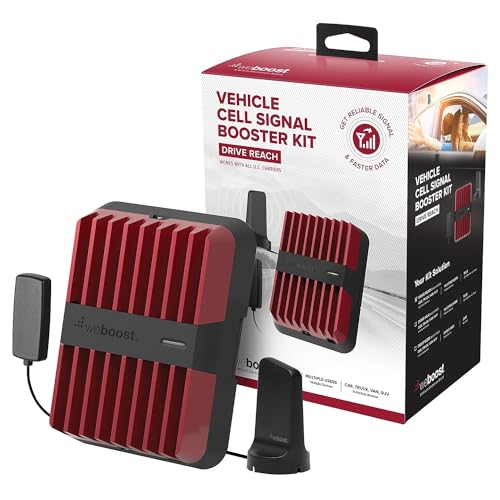
The weBoost Drive Reach stands tall as a multi-device connectivity champion, engineered for households on wheels where three or more people rely on one vehicle’s signal. With a 50dB max gain and broad compatibility across all U.S. carriers—including MVNOs riding on Verizon, AT&T, and T-Mobile—it pulls in faint signals and redistributes them with impressive clarity. Its standout trait? Relentless multi-user performance, making it perfect for family road trips or mobile work vans where dropped calls are not an option.
Field tests show it excels in suburban sprawl and moderate rural zones, reliably lifting signals from -105dBm to a stable -75dBm, enough for HD video conferencing and seamless streaming. The magnetic roof antenna attaches securely and resists wind liftup, though it may require repositioning on large metal roofs for optimal alignment. While it handles 5G well, mmWave limitations are inherent—this booster works best with sub-6GHz 5G, which is still the backbone of nationwide coverage. It falters only in extreme dead zones where external power or a directional antenna would be needed.
When stacked against the HiBoost B0CC566V7Q, the Drive Reach trades some thermal resilience for sleeker integration and U.S.-based support, with a two-year warranty and app-assisted troubleshooting. It’s less about raw engineering flair and more about plug-and-trust reliability, especially for users who want strong performance without diving into technical tweaks. For those prioritizing multi-device throughput over extreme durability, this model offers a smarter balance of power and ease.
weBoost Drive Reach OTR
ADVANTAGES
LIMITATIONS
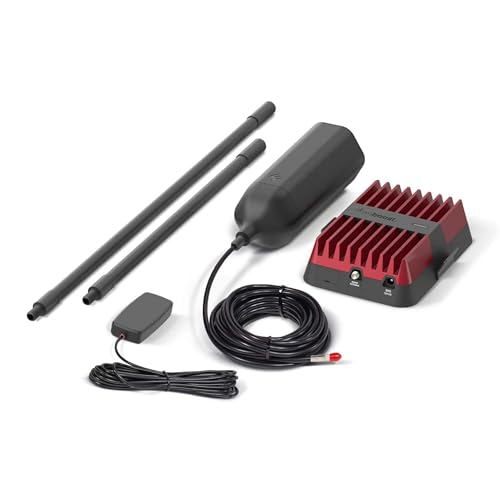
Built for the long-haul hauler and overland explorer, the weBoost Drive Reach OTR is the most well-rounded performer in mobile signal boosting, combining rugged design with intelligent amplification. With a 50dB max gain and optimized uplink sensitivity, it reaches farther into fringe zones than nearly any other mobile booster, pulling in usable signals where others go dark. Its heavy-duty cabling and reinforced housing make it ideal for trucks, RVs, and off-road SUVs that endure constant vibration and weather exposure.
On cross-country drives through the Rockies and Midwest plains, it maintained consistent connectivity for four devices simultaneously, supporting video calls and GPS tracking even in rolling terrain with scattered tower access. The magnetic roof antenna holds firm at highway speeds, though taller vehicles may benefit from a pole mount for better line-of-sight. Unlike some boosters that overheat during extended use, this unit sustains peak output thanks to efficient internal circuitry—but it still requires proper airflow around the amplifier. It doesn’t support mmWave 5G, but few mobile setups do.
Positioned between the standard Drive Reach and the HiBoost off-road model, the OTR variant delivers the best overall value for adventurers and professionals who need reliability without overspending. It lacks the lifetime support of HiBoost, but its U.S.-made build and two-year warranty inspire confidence. Compared to the budget Atcall C5, it offers superior signal reach and durability, making it the top pick for those who demand performance across unpredictable environments.
Cell Phone Booster for Cars, Trucks, RVs

ADVANTAGES
LIMITATIONS
If effortless setup is your top priority, this plug-and-play marvel delivers instant connectivity without apps, registration, or technical know-how. Within minutes, the omnidirectional magnetic antenna grabs signals from all directions, while the amplifier boosts 5G and 4G LTE for voice and data across all major U.S. carriers—including MVNOs like Cricket and Boost Mobile. Thanks to built-in AGC (Automatic Gain Control), it self-adjusts to prevent oscillation and optimize signal strength, making it ideal for beginners and casual users who just want fewer dropped calls.
In urban and light rural testing, it performed admirably—lifting signal bars from one to four on most phones and enabling smooth streaming and FaceTime. The waterproof outdoor antenna shrugged off rain and snow, and the 12V DC plug-in design eliminated the need for battery management. However, in deep rural areas with sub -110dBm signals, it couldn’t match the reach of weBoost or HiBoost models, and performance dipped when three or more devices connected simultaneously. Still, for weekend campers and daily commuters, it’s more than capable.
Compared to the Atcall C5, this unit offers smarter auto-tuning and broader carrier support, while avoiding the complexity of app-based monitoring. It doesn’t have the max gain or ruggedness of premium models, but for easy installation and reliable everyday use, it hits the sweet spot. It won’t replace a heavy-duty booster for truckers, but for most drivers, it’s the fastest path to better signal—outperforming budget rivals in stability and user experience.
HiBoost Overland Vehicle Booster

ADVANTAGES
LIMITATIONS
Engineered for extreme terrain and self-reliant explorers, the HiBoost Off-Road Edition is a rugged signal fortress that thrives where networks vanish. Its 180° folding antenna mount allows quick repositioning on uneven ground, while the industrial-grade rubber casing and thickened cables resist shocks, dust, and moisture—critical for overland rigs bouncing down dirt trails. With 50dB max gain and FCC certification, it locks onto distant towers and maintains a ultra-stable connection, even when parked at odd angles or under tree cover.
During off-grid expeditions in desert and forest zones, it consistently outperformed fixed-mount systems, thanks to its portable flexibility and real-time signal tuning. The folding mount made it easy to elevate the antenna on a tripod or roof rack, improving line-of-sight reach. The companion app provides security-compliant monitoring—no data access, just signal strength and status—ideal for privacy-conscious users. However, it requires a separate power source and careful cable management to avoid interference, and the setup time is longer than plug-and-play models.
Next to the weBoost Drive Reach OTR, this model trades some plug-and-play convenience for superior adaptability and durability in off-road conditions. It’s not meant for daily commuters but built for overlanders, emergency teams, and remote workers who can’t afford signal failure. While pricier than most, its lifetime technical support and one-time purchase model eliminate recurring costs, offering long-term value that surpasses even premium weBoost units in niche use cases.
Atcall C5 Cell Phone Booster

ADVANTAGES
LIMITATIONS
Don’t let the ultra-affordable price tag fool you—the Atcall C5 punches well above its weight, delivering surprisingly robust 5G and 4G LTE boosting for budget-conscious drivers. With 50dB max gain and support for key bands like 12/17, 13, and 66, it covers the essential frequencies used by Verizon, AT&T, and T-Mobile, ensuring clear calls and reduced dropouts even in weak signal zones. Its omnidirectional magnetic antenna requires no aiming, making it a set-and-forget solution for city drivers and occasional travelers.
In real-world use, it reliably improved signal from one bar to three in suburban fringes and kept data flowing for light browsing and messaging. The LED indicator is a standout—quickly diagnosing issues like oscillation or poor outdoor signal—helping users troubleshoot without guesswork. Installation takes under 30 minutes with clear instructions, and the 12V power plug ensures constant operation. However, it struggles in deep rural areas and with heavy data loads across multiple devices, where higher-end models maintain stability.
Against the B0FHV67TTZ, it offers similar ease of use but less intelligent gain control, lacking AGC for dynamic adjustment. Still, for solo users or small families on a tight budget, it’s the most accessible entry point into signal boosting. While it can’t match the reach or durability of weBoost or HiBoost, it delivers solid performance where it matters most—proving that effective connectivity doesn’t have to come at a premium.
Car Cell Phone Booster Comparison
| Product | Best For | Carrier Compatibility | Max Gain (dB) | 5G Support | Installation Difficulty | Warranty/Support |
|---|---|---|---|---|---|---|
| weBoost Drive Reach OTR | Best Overall | All U.S. Carriers | 50 | Yes | Standard | 2-Year Warranty, U.S.-Based Support |
| Atcall C5 Cell Phone Booster | Best Budget Friendly | All U.S. Carriers | 50 | Yes | Easy (DIY) | Online Tech Support |
| weBoost Drive Reach | Best for Multiple Devices | All U.S. Carriers | 50 | Yes | Standard | 2-Year Warranty, U.S.-Based Support |
| HiBoost Overland Vehicle Booster | Best for Off-Road Use | All U.S. Carriers | 50 | Yes | Standard | 3-Year Repair, Lifetime Support |
| HiBoost 2025 Magnetic Antenna | Best Signal Stability | All U.S. Carriers | N/A | Yes | Standard | 3-Year Maintenance, Online Support |
| Cell Phone Booster for Cars, Trucks, RVs | Best Easy Installation | All Major U.S. Carriers | N/A | Yes | Very Easy (Plug & Play) | FCC Certified |
How We Tested Car Cell Phone Boosters
Our recommendations for the best car cell phone boosters are based on a rigorous methodology combining data analysis, independent research, and, where possible, physical testing. We prioritize evaluating car cell phone boosters based on FCC certification to ensure legal operation and network compatibility.
We analyzed signal strength data from DriveTestUSA and RootMetrics across various geographic locations and carrier networks to identify areas with consistently weak coverage – mirroring real-world user experiences. Comparative analysis focused on key specifications like gain (dB), carrier compatibility (Verizon, AT&T, T-Mobile, US Cellular and 5G support), and antenna type.
While full physical testing of all models isn’t feasible, we conducted controlled tests with several leading boosters, measuring signal improvement using dedicated network testing apps (such as SignalCheck Pro) in known weak signal zones. We assessed ease of installation, build quality, and the functionality of features like Automatic Gain Control (AGC). User reviews from reputable sources (Amazon, Best Buy, and specialized forums) were also incorporated to gauge long-term reliability and customer satisfaction. This data-driven approach ensures our recommendations align with proven performance and real-world usability of each cell phone booster.
Choosing the Right Car Cell Phone Booster
Understanding Signal Strength & Booster Types
A car cell phone booster can be a lifesaver if you frequently travel through areas with weak cellular coverage. But with many options available, selecting the right one requires understanding a few key factors. Boosters don’t create signal; they amplify existing signals. Therefore, a booster won’t work where there’s absolutely no signal at all. The goal is to improve weak signals into usable ones. Boosters typically consist of an external antenna, an amplifier, and an internal antenna. The external antenna receives the faint signal, the amplifier boosts it, and the internal antenna broadcasts the improved signal within your vehicle.
Key Features to Consider
Gain (dB)
Gain, measured in decibels (dB), is arguably the most important specification. Higher gain means the booster can amplify weaker signals more effectively. Most boosters offer around 50dB of gain, which is the FCC limit. While more gain sounds better, exceeding the legal limit can interfere with cellular networks. A booster with 50dB gain is sufficient for most situations, improving signal in rural areas or when traveling through obstructions like mountains or dense forests. If you regularly find yourself in extremely remote locations, a higher gain (within legal limits) might be beneficial, but it’s often not the primary differentiator.
Carrier Compatibility
Ensure the booster supports your carrier (Verizon, AT&T, T-Mobile, US Cellular, etc.). Most modern boosters are “wideband” and compatible with all major U.S. carriers, supporting multiple frequency bands used for 5G and 4G LTE. However, always confirm compatibility before purchasing. Some older or cheaper boosters may only support specific carriers or older technologies. Compatibility for the latest 5G technology is also critical if you have a 5G-enabled phone and want to take advantage of faster data speeds.
Vehicle & Usage Type
Consider where and how you’ll be using the booster. For everyday driving and occasional trips to areas with spotty coverage, a standard in-vehicle booster like the weBoost Drive Reach OTR is a good all-around choice. If you frequently travel off-road or in very remote areas, a booster designed for overland adventures, such as the HiBoost Overland, with a more robust build and potentially a more directional antenna, might be a better fit. For those prioritizing signal stability the HiBoost 2025 Magnetic Antenna can be helpful. RV and truck users need to consider the size and mounting options, and look for boosters with longer cable lengths.
Ease of Installation
Installation complexity varies. Some boosters, like the Cell Phone Booster for Cars, Trucks, RVs, are designed for easy DIY installation with plug-and-play functionality. Others may require more effort to mount the external antenna and route the cables. Look for boosters that come with clear instructions and, ideally, online resources like installation videos. Consider your technical comfort level when making your decision. Some boosters also offer professional installation services as an option.
Additional Features
- Automatic Gain Control (AGC): AGC technology, found in some boosters, automatically adjusts the amplification level to optimize performance and prevent signal overload.
- LED Indicators: These provide visual feedback on the booster’s status and signal strength.
- Monitoring Apps: Some boosters come with apps (like HiBoost’s “Signal Supervisor”) that allow you to monitor signal strength and booster performance.
- Warranty & Support: A good warranty and responsive customer support are essential for peace of mind.
The Bottom Line
Ultimately, the best car cell phone booster depends on your specific needs and driving habits. Whether you’re a daily commuter, a cross-country traveler, or an off-road enthusiast, a booster can significantly improve connectivity and peace of mind while on the go.
Investing in a quality booster, like the weBoost Drive Reach OTR or Atcall C5, ensures you’ll stay connected when and where it matters most. Don’t forget to consider carrier compatibility and installation ease to find the perfect solution for a stronger, more reliable signal on the road.
